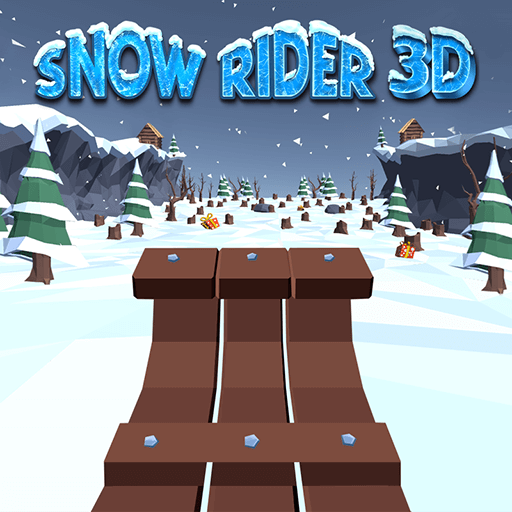
On its face, Snow Rider is the epitome of casual gaming: guide your sled, dodge the trees, and survive as long as you can. It’s a simple loop that anyone can understand in seconds. Yet, watch a recording of an elite player, and you’ll witness something else entirely. Their runs aren’t a series of panicked, last-second swerves. They are a form of high-speed choreography, a smooth, hypnotic ballet where the sled seems to know where the gaps will be long before they appear.
This is no accident. Top riders transform pixelated chaos into clean, controlled lines by internalizing a set of principles that are less about raw reflex and more about disciplined technique. Let’s break down the anatomy of a perfect run and turn your frantic survival attempts into a graceful descent.
The Core Engine: The Three-Beat Loop of See → Plan → Commit
The biggest mistake novices make is fixating on the space directly in front of their sled. This creates a constant state of reaction, where every obstacle is a new surprise. Elite players break this habit by adopting a simple, repeatable three-beat mental loop.
1. See: The first and most critical step is to lift your gaze. Keep your eyes focused two to three “screens” ahead of your character. Think of it like driving a car on the highway; you don’t stare at the hood ornament, you scan the horizon for traffic patterns. Looking ahead buys your brain precious milliseconds to process incoming information, turning a sudden threat into a solvable puzzle. Your immediate surroundings become part of your peripheral vision, which is excellent at detecting motion, while your focus is dedicated to strategy.
2. Plan: With that advanced visual information, you can now plan your route. Crucially, you are not just looking for the next safe gap; you are identifying a safe lane. A gap is a momentary escape, but a lane is a strategic path—a flowing river of safety that threads through multiple obstacle clusters. By pre-selecting a lane, you create a smooth, arcing trajectory that avoids the frantic left-right zig-zagging that destabilizes your sled and kills most runs.
3. Commit: Once you’ve planned your lane, commit to it with small, decisive inputs. Big, panicky swerves are your enemy. They build up erratic momentum, making the next correction even more difficult and often causing you to overshoot your intended path. Instead, think like a surgeon, not a lumberjack. Gentle, confident nudges are all that’s needed to guide your sled along the lane you’ve already planned. This maintains stability and keeps your movement predictable and efficient.
Building Your Library of Obstacle Patterns
As you practice looking ahead, you’ll start to recognize recurring obstacle formations. Identifying them early is the key to effortless navigation. The most common patterns include:
- The Funnel: A sparse field of obstacles that gradually compresses into a tight bottleneck. The key is to choose your exit lane before you enter the squeeze, allowing you to glide through the narrowest point on a straight, stable line.
- The Gate: Two obstacles set close together, creating a clear opening. The goal is to square your sled up to the opening early, so you pass through the center without needing any last-second adjustments.
- Cascades: A rhythmic, left-right-left wave of obstacles. Fighting this pattern leads to overcorrection. The secret is to lean into the rhythm, making smooth, symmetrical arcs that mirror the flow of the cascade.
Pro-Level Drills to Build the Habits
Theory is great, but mastery is forged through practice. Integrate these drills into your sessions to hardwire these skills:
- Lane Lock: Force yourself to stay on either the left or right half of the screen for as long as possible. This builds visual discipline and forces you to solve patterns from non-ideal positions.
- No-Center Challenge: Try to complete an entire run without ever using the middle 20% of the screen. This will make you an expert at reading and navigating the trickier edge patterns.
- Two-Beat Rhythm: As you navigate a Cascade, quietly count “one-two, one-two” as you arc left and right. This helps internalize the timing and promotes smoother, more symmetrical movements.
Ultimately, the most profound secret is also the simplest: your hands follow your eyes. If your gaze drops to your sled in a moment of panic, your inputs will become twitchy and reactive. If you keep your vision locked upfield on the path you intend to take, your hands will subconsciously make the smooth, precise movements needed to get you there. Master your gaze, and you will master the mountain.
source https://regic.net/