For a long time, managing IT in-house felt like the sensible choice. It gave me a sense of control. Costs felt visible. Decisions stayed internal. When something broke, we believed we could fix it ourselves or call someone we trusted. At that stage, I didn’t think much about broader technology trends shaping modern IT operations, such as those often discussed in technology ecosystems.
Outsourcing sounded like something large corporations did, not growing businesses that still wanted to stay close to their operations. Looking back, that assumption shaped a lot of what came next.
When Managing IT In-House Felt Like the Sensible Choice
In the early days, our IT setup was simple enough. A small internal team handled daily issues. A few external vendors supported specific tools. Nothing felt urgent. Systems worked most of the time, and when they didn’t, problems were usually resolved with some extra effort.
There was comfort in that familiarity. I knew who to call. I knew where things were hosted. It felt efficient, even flexible. At that point, IT operations didn’t seem like a risk area. They felt manageable, almost routine—far removed from the automation and intelligence now common in AI-driven IT environments
What I didn’t realize was that this sense of stability depended heavily on things staying exactly the same.
The Cracks I Didn’t Notice Until They Became Problems
The issues didn’t arrive all at once. They crept in quietly.
A system update was delayed because no one owned it clearly. A small outage took longer than expected to resolve because responsibilities overlapped. Vendors blamed each other. Internal teams were stretched thin, juggling tasks outside their core expertise.
These moments introduced a kind of background stress. IT downtime, even when brief, started affecting work rhythms. Security concerns felt harder to assess. I wasn’t always sure whether something was truly under control or just temporarily quiet.
Managing IT in-house began to feel less like oversight and more like constant coordination. The operational risk wasn’t dramatic, but it was persistent.
When “We’ll Fix It Later” Finally Stopped Working
There was a point where postponing decisions stopped being an option. Growth made that clear.
As systems became more interconnected, small issues had wider impact. A delay in one area affected multiple teams. Planning became reactive. Instead of improving systems, we were mostly keeping them running.
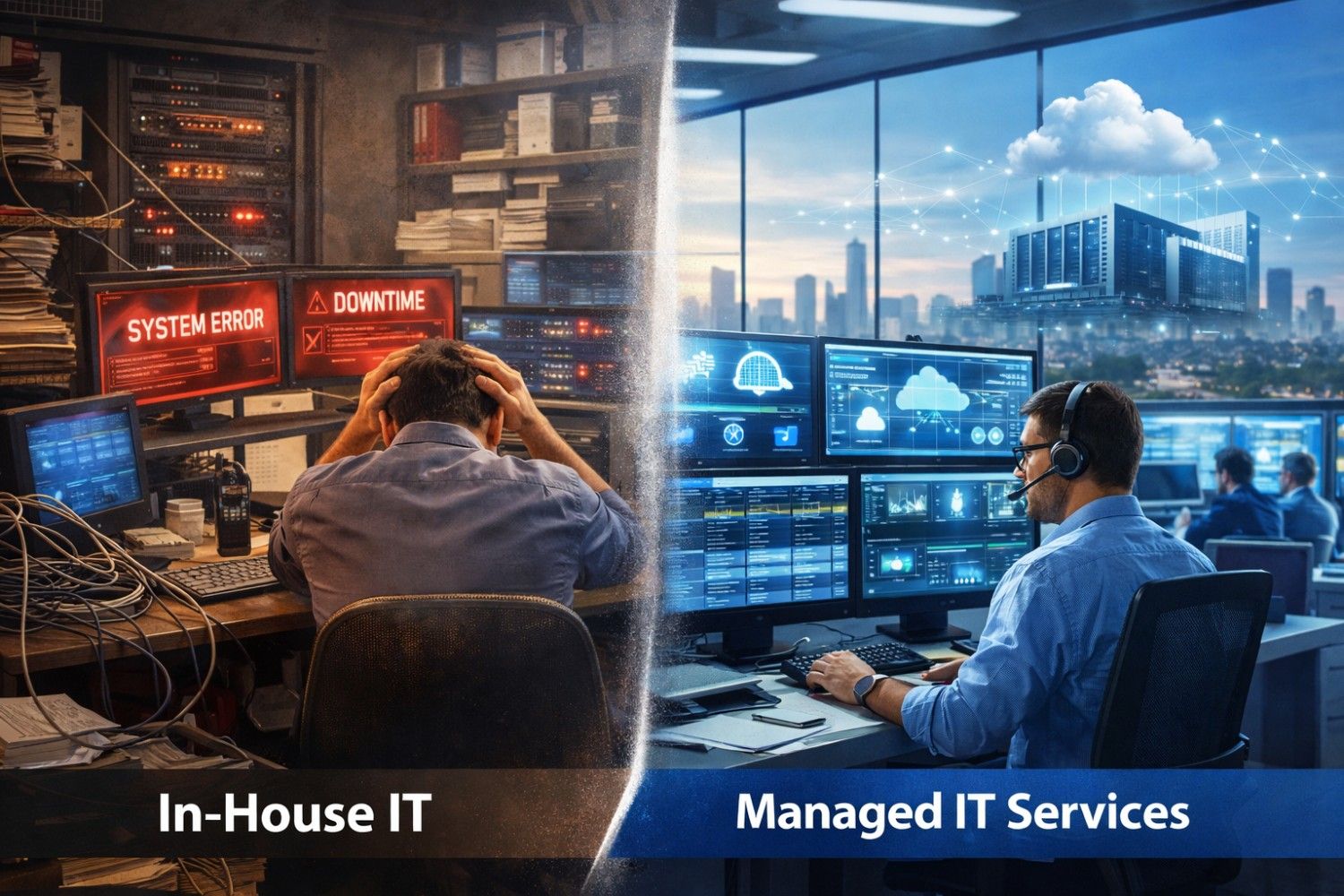
That’s when the comparison between managed IT vs in-house IT became unavoidable. Effort alone wasn’t solving structural problems. Tools weren’t the issue either. The gap was in IT service management, in having a coordinated way to monitor, secure, and scale systems consistently.
It wasn’t a crisis that forced the change. It was the realization that continuing this way would eventually create one.
Discovering Managed & Enterprise IT Services in Pakistan
I didn’t move toward outsourcing with enthusiasm. There was hesitation. Handing over parts of IT felt like giving up control.
What surprised me while exploring Managed & Enterprise IT Services in Pakistan was how different the model actually was from what I imagined. It wasn’t about replacing people or losing visibility. It was about shifting responsibility.
Instead of reacting to problems, there was structured monitoring. Instead of scattered ownership, there was clear accountability. Systems were reviewed regularly, not only when something failed.
The biggest change was predictability. Outsourced IT services in Pakistan weren’t just about support. They introduced a rhythm to operations that had been missing.
Final Reflection
Trying to manage IT alone taught me a lot—mostly where the limits were. Moving beyond that wasn’t about giving something up. It was about making space for the business to grow without IT becoming a constant distraction.
That lesson stayed with me longer than any technical decision ever did.