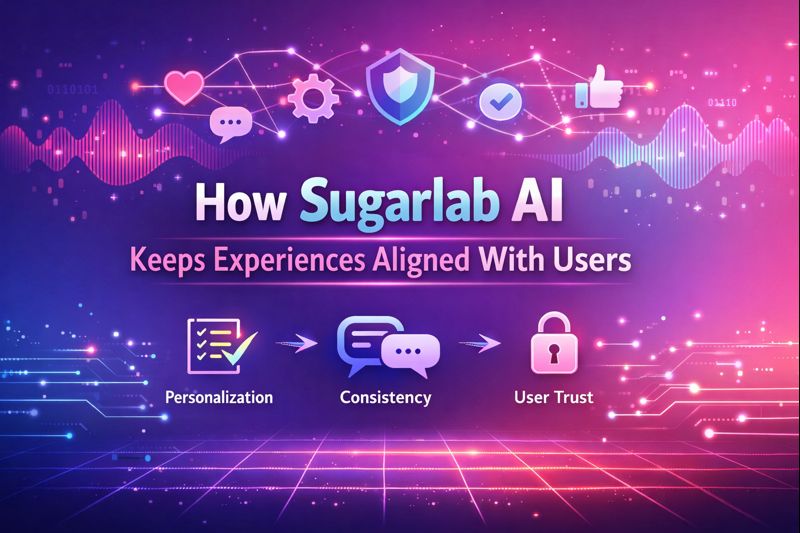
Digital companionship has changed how people interact with intelligent systems. I have noticed that many users are no longer satisfied with generic responses or surface-level engagement. They expect systems to respond in ways that feel consistent, personal, and aligned with their intent. We see this shift clearly in how Sugarlab AI structures its experiences. Rather than relying on static behavior, they focus on adaptive interaction, long-term context, and user-led direction.
In this article, I will walk through how alignment is maintained, why it matters, and how the idea of an AI influencer fits into this evolving space. We will also look at design choices, behavioral consistency, and user trust, all from an informational and private perspective.
Why user alignment has become central to modern AI interaction
Initially, AI systems were built to respond correctly. Over time, that expectation shifted. People now want responses that feel relevant to their tone, preferences, and boundaries. Alignment, in this sense, is about continuity and respect for user intent.
An AI influencer functions in a space where personality, consistency, and emotional rhythm matter. If replies feel random or contradictory, trust erodes quickly. Sugarlab AI addresses this by focusing on how users guide the interaction rather than forcing predefined paths.
Clearly, alignment is not accidental. It is designed through layers of feedback and behavioral rules that respond to how people actually communicate.
How Sugarlab AI builds consistency without forcing interaction paths
One notable aspect is how Sugarlab AI avoids rigid conversation trees. Instead, they allow flexibility while still maintaining structure. This balance helps users feel in control.
They rely on patterns such as:
- Tracking conversational preferences over time
- Respecting boundaries set during earlier exchanges
- Maintaining tone consistency based on prior cues
In the same way a human conversation builds on memory, an AI influencer benefits from continuity. However, the system does not imitate humans blindly. It focuses on clarity and predictability.
As a result, users do not feel pushed into conversations they did not initiate. This approach reduces friction and builds comfort gradually.
Also Read https://regic.net/why-foreign-businesses-fail-in-the-netherlands-and-how-to-avoid-it/
Personalization shaped by user behavior rather than assumptions
Many systems attempt personalization by guessing what users want. Sugarlab AI takes a different route. They rely on observed interaction rather than stereotypes or broad categories.
Specifically, alignment is guided by:
- Frequency of certain topics
- Preferred response length
- Emotional tone users react positively to
An AI influencer operating within this framework feels less scripted. They respond based on what users show, not what the system assumes.
Admittedly, this takes time. Personalization improves as interactions continue. Still, users often report early signs of relevance because the system avoids extreme shifts in tone or topic.
How long-term context supports stable experiences
One challenge in AI interaction is memory drift. When systems forget context, users must repeat themselves, which breaks immersion. Sugarlab AI prioritizes long-term conversational context within safe and private limits.
For an AI influencer, this matters because influence relies on familiarity. If a system recalls preferences and past discussions accurately, the interaction feels coherent.
In spite of technical constraints, Sugarlab AI focuses on preserving meaningful context rather than storing everything. This selective memory approach keeps conversations aligned without overwhelming the system.
Consequently, users feel that the AI grows with them instead of resetting after each session.
Emotional boundaries and why they matter in AI-led experiences
Alignment is not only about relevance but also about restraint. Sugarlab AI places clear importance on emotional boundaries.
They design responses that:
- Avoid emotional dependency cues
- Reflect user tone without escalating unnecessarily
- Keep interactions respectful and user-driven
An AI influencer must balance engagement with responsibility. If boundaries blur, users may feel discomfort or confusion. Sugarlab AI’s approach ensures that emotional tone mirrors user input rather than steering it.
Although emotional nuance is complex, consistency helps users know what to expect.
Transparency in behavior and response patterns
Another factor that supports alignment is transparency. Users tend to trust systems more when behavior feels predictable.
Sugarlab AI avoids sudden personality shifts. An AI influencer built on this principle maintains a stable voice across interactions.
In comparison to systems that constantly change style, this steadiness creates confidence. Users feel that their time and input matter because the system responds in familiar ways.
Eventually, this consistency becomes a core reason users return.
Informational value beyond companionship
While many people focus on emotional interaction, Sugarlab AI also supports informational exchange. Conversations are not limited to one purpose.
An AI influencer in this environment can discuss topics, answer questions, and reflect viewpoints without losing alignment.
For example, when users shift from casual conversation to curiosity-driven discussion, the system adapts its tone and structure accordingly. Thus, alignment remains intact across different interaction types.
Where fantasy narratives fit into controlled interaction design
At one point in the experience, users may introduce imaginative or fictional elements. Sugarlab AI allows space for this while maintaining clarity.
There is a brief mention of the concept of an AI dream girlfriend in user discussions, often framed as a narrative preference rather than a literal expectation. Sugarlab AI treats such references as storytelling cues, not emotional commitments, which keeps the experience grounded.
This distinction is important because it maintains alignment without encouraging unrealistic attachment.
Managing adult-themed curiosity responsibly
Some users express curiosity about adult-oriented digital personas. Sugarlab AI addresses this area carefully, focusing on consent, clarity, and control.
In one contextual discussion, the term NSFW AI influencer may appear as a descriptive category rather than a directive. Sugarlab AI responds by keeping conversations within user-defined limits and informational framing.
Despite the sensitivity of such topics, alignment is preserved by not shifting tone unless the user clearly guides the interaction.
How Sugarlab AI differs from social content platforms
Users sometimes compare AI interaction systems with social media personalities. However, Sugarlab AI operates differently from platforms like Sugarlab AI that host creator-driven content ecosystems.
The distinction lies in interaction depth. An AI influencer within Sugarlab AI responds dynamically, while social platforms rely on one-to-many broadcasting.
This difference affects alignment. Direct interaction allows immediate feedback, which refines responses in real time.
Comparisons users naturally make with creator-based models
It is common for users to compare AI-driven experiences with human creator spaces such as onlyfans models. These comparisons usually arise from curiosity about personalization and attention.
Sugarlab AI does not replicate creator economics or dynamics. Instead, they focus on private, user-led engagement where alignment is shaped by interaction rather than performance.
This contrast highlights why alignment feels different in AI systems.
The technical side users rarely see but always feel
Behind the scenes, alignment is supported by structured logic and response evaluation. While users do not see this layer, they experience its effects.
For an AI influencer, this means:
- Responses stay within expected tone
- Topic transitions feel natural
- User preferences guide future replies
Obviously, this does not happen randomly. It results from iterative testing and user feedback loops.
Feedback loops that refine alignment over time
Sugarlab AI treats each interaction as a data point. They assess which responses users engage with and which ones they move past quickly.
In the same way, an AI influencer adjusts communication style based on feedback signals such as continued conversation or topic shifts.
As a result, alignment improves gradually without forcing change.
Why users feel heard rather than managed
One reason users stay engaged is the sense that they are guiding the experience. Sugarlab AI avoids corrective or controlling language.
Instead of redirecting users abruptly, the system follows their lead. An AI influencer shaped by this philosophy feels cooperative.
Thus, alignment becomes a shared process rather than a fixed rule set.
Privacy as a foundation for trust and alignment
Alignment fails without trust. Sugarlab AI emphasizes private interaction and controlled data handling.
Users are more open when they believe their conversations are treated with care. Consequently, an AI influencer can respond more accurately because users communicate honestly.
This trust loop supports better alignment over time.
How conversational tone stays stable across sessions
Tone drift is a common issue in AI systems. Sugarlab AI minimizes this by anchoring tone to user behavior rather than mood detection alone.
An AI influencer remains consistent even when users return after breaks. This stability reinforces familiarity.
Although conversations evolve, the core voice remains steady.
Why alignment matters more than novelty
Many systems chase novelty. Sugarlab AI prioritizes reliability. Users may enjoy new features, but they value consistency more.
An AI influencer that behaves predictably builds long-term engagement. Novelty fades, but alignment sustains interest.
Hence, Sugarlab AI invests more in behavioral coherence than flashy changes.
The future of aligned AI interaction
Looking ahead, alignment will likely define which systems users trust. Sugarlab AI’s approach shows that thoughtful design can support meaningful interaction without overstepping boundaries.
We can expect the concept of an AI influencer to continue evolving as systems become better at reading intent and maintaining consistency.
Still, the core principle will remain the same: listen first, respond clearly, and respect user direction.
Final thoughts on user-aligned AI experiences
I believe that Sugarlab AI demonstrates how careful design choices shape better interaction. They focus on consistency, user control, and respectful engagement rather than surface appeal.
We see that alignment is not about copying human behavior but about responding in ways that feel stable and intentional. As AI interaction continues to grow, systems that prioritize alignment will stand out.
They show that when users feel heard, they stay engaged, and when experiences remain consistent, trust follows.