
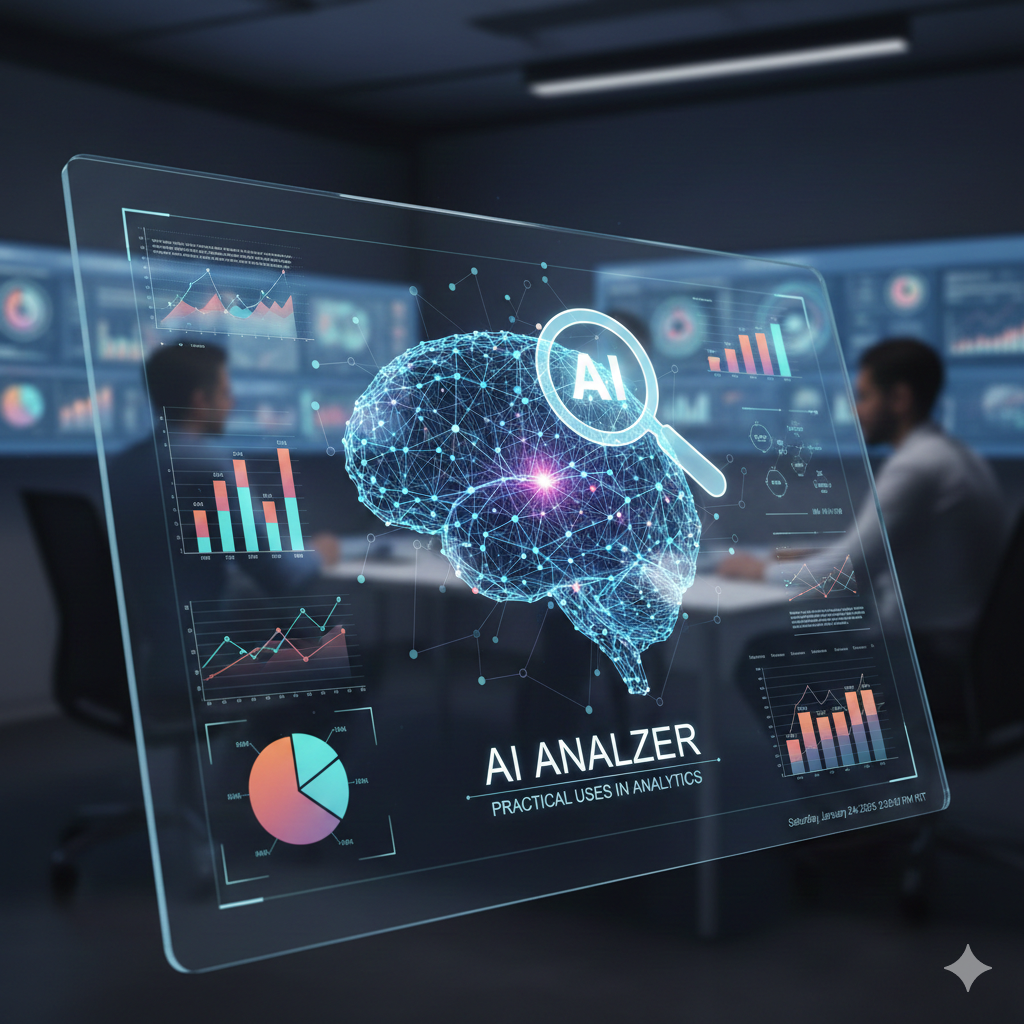
Modern analytics workflows often involve multiple dashboards, diverse data sources, and frequent updates. Teams struggle to extract meaningful insights efficiently while maintaining accuracy across reports. AI Analyzer helps streamline this process by automatically interpreting data, highlighting trends, and offering actionable observations.
By integrating machine learning and natural language processing, it reduces manual work and supports faster decision-making. Many organizations leverage AI Analyzer capabilities to generate reliable summaries, detect anomalies, and enhance reporting accuracy without overwhelming analysts with repetitive tasks.
Streamlining Dashboard Insights
AI Analyzer helps teams interpret dashboards more effectively. Instead of reviewing numerous charts manually, it identifies critical patterns, anomalies, and correlations. This aligns with best practices for navigating conflicting signals across dashboards.
Key benefits include:
- Highlighting unexpected trends across metrics
- Summarizing key insights for stakeholders
- Detecting potential data inconsistencies quickly
This reduces analysis time while improving confidence in the results.
Automating Routine Analysis Tasks
Routine analytics tasks can consume significant time. AI Analyzer automates repetitive tasks that otherwise occupy analyst resources.
Tasks that can be automated:
- Summarizing weekly or monthly performance reports
- Comparing metrics across periods or business units
- Generating commentary for dashboards
Automation allows teams to focus on strategic interpretation rather than repetitive computation. Situations where dashboards show contradictory signals can be clarified faster when routine tasks are handled automatically.
Enhancing Cross-Team Communication
Insights are only useful when understood by all stakeholders. AI Analyzer creates summaries that are accessible to non-technical teams.
Advantages include:
- Translating complex data into plain language
- Supporting marketing, finance, and operations alignment
- Reducing misinterpretation of dashboards
This ensures teams act on accurate insights consistently.
Detecting Hidden Patterns in Data
Large datasets often contain patterns that are not immediately visible. AI Analyzer can scan multiple data sources and uncover trends that might be overlooked.
Use cases include:
- Identifying emerging opportunities
- Detecting early signs of issues or anomalies
- Analyzing historical data trends for strategy
These insights enable proactive decision-making across the organization.
Integrating Analyzer with Workflow Tools
For maximum efficiency, AI Analyzer works best when connected to a central analytics platform. Integration ensures insights are consistently applied across dashboards and reporting tools.
Best practices include:
- Linking Analyzer outputs with centralized datasets
- Setting clear objectives for automated analysis
- Monitoring outputs for consistency and accuracy
Proper integration increases overall workflow reliability and usefulness.
Maintaining Insight Accuracy
The value of AI-generated insights depends on data quality. Teams must maintain validated datasets and ensure proper metrics to avoid misleading conclusions.
Steps to ensure reliability:
- Regularly audit connected datasets
- Review Analyzer outputs for consistency
- Apply human verification for critical decisions
This safeguards the trustworthiness of automated insights.
Scaling Analytics Capabilities
As data volume and complexity grow, manual analysis becomes impractical. AI Analyzer allows teams to scale analytics processes without adding headcount.
Scaling benefits include:
- Faster generation of reports
- Standardized interpretation across departments
- Reduced backlog of routine analysis tasks
This ensures organizations can maintain performance and insight quality even with growing datasets.
Strengthening Analytics Infrastructure
A strong platform amplifies Analyzer capabilities. Many teams adopt Dataslayer analytics hub to centralize data access, integrate AI insights, and ensure consistency across reporting workflows. This combination strengthens organizational decision-making and reduces operational friction.
Conclusion
AI Analyzer enhances analytics by automating repetitive tasks, highlighting patterns, and generating actionable insights. Teams benefit from improved efficiency, clearer communication, and faster decision-making.
Pairing Analyzer with a centralized platform like Dataslayer ensures insights are accessible, reliable, and scalable. By leveraging these tools, organizations can make data-driven decisions confidently while reducing manual workloads and minimizing errors.