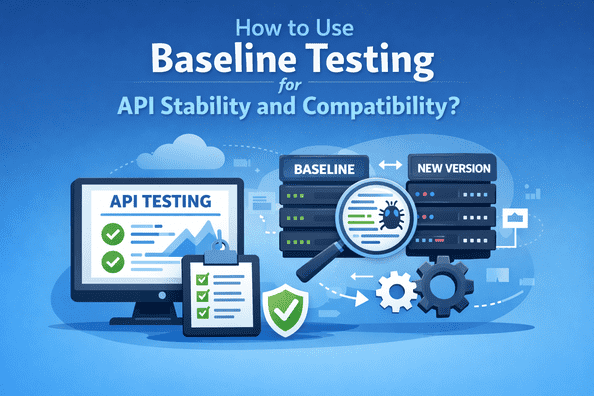
APIs evolve constantly. New fields are added, response formats change, and internal logic is optimized over time. While these changes are often necessary, they also introduce a high risk of breaking existing consumers. Baseline testing helps teams detect unintended changes early by comparing current API behavior against a known, trusted reference.
This article explains how to use baseline testing to maintain API stability and compatibility as systems evolve, without slowing development or blocking intentional improvements.
Why API stability is hard to maintain at scale
APIs sit at the boundary between systems. Even small changes can have wide downstream impact, especially when multiple teams or external consumers rely on them.
Common challenges include:
- Backward-incompatible response changes
- Silent behavior changes that tests do not cover
- Differences between documented and actual API behavior
- Frequent releases with limited manual validation
Baseline testing provides a safety net by validating that APIs continue to behave as expected.
What baseline testing means in the context of APIs
In API-focused systems, baseline testing compares current API responses and behavior against a previously approved baseline.
A baseline may include:
- Response schemas and field presence
- Data types and default values
- Status codes and error responses
- Ordering and structure of payloads
By comparing current results to this baseline, teams can quickly detect compatibility risks.
Establishing reliable API baselines
Effective baseline testing starts with high-quality baselines. Poorly defined baselines lead to noise and false alarms.
To establish reliable baselines:
- Capture responses from stable versions of the API
- Include both success and error scenarios
- Focus on externally visible behavior, not internal implementation
Baselines should reflect what consumers rely on, not how the API is built internally.
Handling intentional API changes
Not all changes are regressions. APIs often evolve to support new use cases.
To avoid blocking valid changes:
- Version baselines alongside API versions
- Explicitly approve baseline updates for intentional changes
- Document why a baseline was updated
This ensures baseline testing highlights unintended changes while allowing controlled evolution.
Detecting backward compatibility issues early
Baseline testing is especially effective at catching subtle compatibility breaks.
Examples include:
- Removing optional fields that clients rely on
- Changing default values
- Modifying error response formats
- Altering pagination or sorting behavior
These issues are often missed by unit tests but are caught quickly through baseline comparisons.
Integrating baseline testing into CI/CD pipelines
To be effective, baseline testing must run automatically as part of CI/CD.
A practical approach includes:
- Running baseline checks on pull requests
- Reporting diffs clearly when mismatches occur
- Failing builds only for high-risk compatibility breaks
This keeps feedback fast and actionable without blocking delivery unnecessarily.
Reducing noise in API baseline comparisons
APIs often include dynamic data such as timestamps or IDs that can cause false positives.
To reduce noise:
- Normalize or ignore dynamic fields
- Compare schemas separately from values
- Focus on structural and semantic differences
Noise reduction keeps baseline testing reliable and trusted by teams.
Using baselines to validate documentation accuracy
Baseline testing can also validate that APIs behave as documented.
Teams can:
- Compare actual responses with documented schemas
- Detect undocumented fields or missing properties
- Ensure error responses match documented contracts
This improves both stability and developer experience.
Maintaining baselines as APIs scale
As APIs grow, baseline management becomes more complex.
Teams should:
- Scope baselines per endpoint or resource
- Assign ownership per API domain
- Periodically review and retire obsolete baselines
This prevents baseline sprawl and keeps tests manageable.
Conclusion
Using baseline testing for API stability and compatibility helps teams detect breaking changes early, protect consumers, and evolve APIs safely. By focusing on externally visible behavior, handling intentional changes explicitly, and integrating baseline testing into CI/CD pipelines, teams can maintain stable APIs even as systems scale.
When treated as a living practice, baseline testing becomes a powerful safeguard against accidental compatibility regressions.