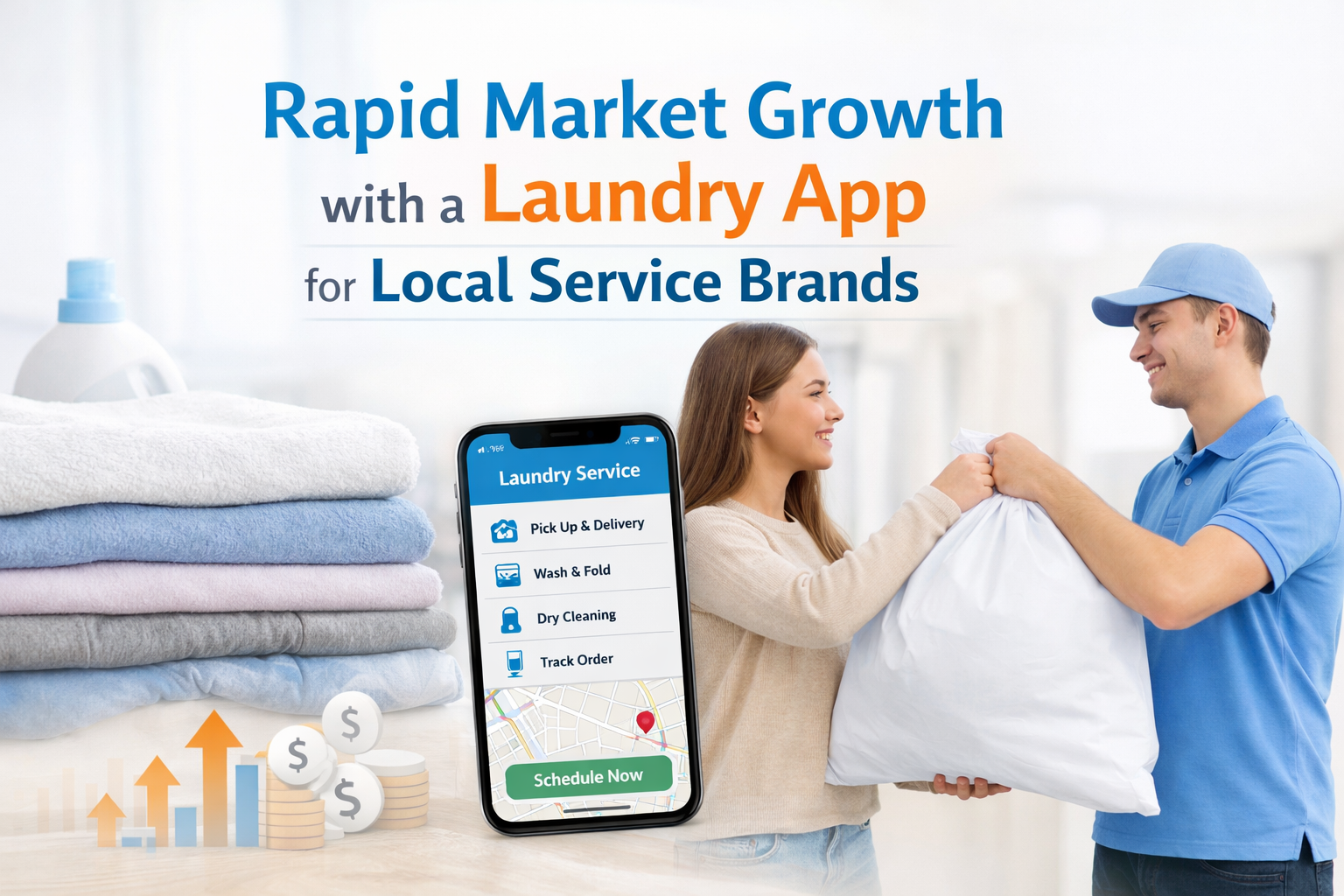
Local laundry businesses are no longer limited to walk-in customers and manual order management. Consumer expectations have shifted toward convenience, speed, and digital interaction. For laundromats, dry cleaners, and home laundry providers, embracing laundry app development has become a strategic move to accelerate market growth and stay competitive.
A well-structured laundry app does more than accept orders. It streamlines operations, automates logistics, improves customer retention, and builds a recognizable digital presence. Local service brands that adapt early are seeing measurable growth in recurring revenue and service expansion.
The Digital Evolution of Local Laundry Services
Urban households, working professionals, and students prefer services that fit into their daily routines. The demand for doorstep laundry, real-time tracking, and digital payments has increased steadily. Manual processes struggle to handle fluctuating demand, delayed pickups, and payment reconciliation.
Through professional laundry app development, service providers can digitize the entire workflow:
- Customer registration and order scheduling
- Real-time pickup and delivery tracking
- Automated billing and digital payments
- Service selection with transparent pricing
- Notifications and loyalty rewards
This digital structure enhances operational accuracy while giving customers a seamless experience. As a result, local brands can compete with larger on-demand service platforms without heavy infrastructure investments.
Revenue Acceleration Through On-Demand Convenience
Customer behavior favors instant solutions. An on-demand laundry platform reduces friction between booking and service fulfillment. When users can schedule a pickup within seconds, repeat usage increases significantly.
A scalable pickup and delivery app allows businesses to manage multiple service zones efficiently. Route optimization, driver allocation, and real-time status updates minimize operational delays. Instead of relying on phone calls or manual logs, every transaction is recorded within the system.
With advanced laundry app development services, brands can integrate:
- Subscription plans for weekly or monthly laundry
- Express service add-ons
- Promotional campaigns and referral programs
- Dynamic pricing for peak hours
These features support recurring income and improve customer lifetime value.
Smart Features That Strengthen Market Position
A high-performing laundry app should include strategic features that contribute to growth rather than just automation.
Real-Time Order Tracking
Customers expect transparency. Live tracking increases trust and reduces service-related queries.
Multi-Payment Integration
Secure gateways, wallet payments, and UPI integration simplify checkout and reduce abandoned bookings.
Admin Dashboard with Analytics
Operational insights help business owners monitor order volume, delivery efficiency, and revenue trends.
Customer Feedback and Ratings
Structured feedback improves service quality and builds brand credibility.
These elements transform a basic mobile tool into a revenue-generating digital platform.
Operational Efficiency and Cost Control
Growth is not only about acquiring customers; it is also about controlling costs. Digitized order allocation and route planning lower fuel expenses and reduce delivery turnaround time. Automated notifications decrease the workload on support staff.
Laundry businesses that opt for structured mobile app development benefit from centralized control. Orders from multiple branches can be managed through one dashboard. Inventory tracking for detergents, packaging materials, and service capacity becomes easier.
A system-driven approach reduces human error in pricing and order handling. This operational clarity allows owners to focus on expansion instead of daily administrative tasks.
Competitive Advantage for Local Service Brands
Large aggregators dominate many service industries, yet local brands hold an advantage in personalization and community trust. A customized app enhances that advantage.
Through customized on-demand app development, businesses can design features tailored to their service model. For instance:
- Specialized garment care categories
- Corporate laundry contracts
- Apartment community tie-ups
- Regional language support
Instead of using generic software, a tailored application aligns directly with brand identity and operational goals.
Scaling Beyond Neighborhood Boundaries
Physical expansion often demands heavy investment in new outlets. A digital-first approach reduces dependency on physical storefronts. With an integrated logistics system and geo-location tracking, services can expand into nearby sectors without opening additional branches immediately.
When supported by scalable laundry app development, the platform can handle increasing order volumes without performance issues. Cloud infrastructure ensures stability, even during peak demand periods.
Entrepreneurs planning to enter new zones may begin with a controlled rollout. Many service providers prefer to develop an MVP app for delivery business operations first. This approach validates demand, refines workflows, and minimizes financial risk before scaling city-wide.
Customer Retention Through Personalization
Acquiring new users costs more than retaining existing ones. A data-driven app can store customer preferences, garment history, and recurring schedules. This information allows businesses to offer targeted discounts and service reminders.
Push notifications about subscription renewals or festive offers encourage repeat engagement. Loyalty programs integrated into the app increase long-term customer relationships.
Structured laundry app development enables brands to build trust through consistent service communication and performance tracking. Reliable digital interaction fosters brand loyalty in competitive markets.
Technology Integration for Future Growth
The next stage of digital transformation involves intelligent automation. Laundry apps can integrate with:
- AI-driven route optimization
- Automated invoice generation
- CRM systems for customer segmentation
- SMS and email marketing platforms
Integration capabilities ensure that the application evolves alongside the business. Instead of replacing systems frequently, a scalable architecture supports long-term growth.
Security also plays a major role. Data encryption, secure authentication, and compliance-ready payment processing protect customer information and maintain brand credibility.
Building a Strong Digital Foundation
Choosing the right technical partner influences the overall success of the project. Experienced teams specializing in laundry app development understand workflow mapping, logistics optimization, and customer engagement strategies.
Key development considerations include:
- Intuitive UI/UX design
- Cross-platform compatibility
- Secure backend architecture
- Performance testing under high traffic
- Post-launch maintenance and upgrades
A structured roadmap prevents unnecessary delays and budget overruns.
Market Expansion with Data-Driven Decisions
Analytics dashboards provide actionable insights. Business owners can analyze:
- Most requested services
- Peak booking hours
- High-demand geographic areas
- Repeat customer frequency
These insights guide pricing strategies, staffing decisions, and promotional campaigns. Instead of relying on assumptions, decisions are supported by real-time data.
As digital ordering becomes the primary channel, laundry businesses gain clarity on growth patterns. This insight-driven expansion reduces risk and increases operational predictability.
Why Timing Matters
The service economy continues to shift toward convenience-based solutions. Consumers rarely prefer manual booking when digital alternatives exist. Local brands that delay digital adoption risk losing customers to tech-enabled competitors.
Strategic laundry app development positions businesses ahead of market demand rather than reacting to it. Early adoption allows a smoother transition, employee training, and gradual customer onboarding.
Final Thoughts
Local laundry service brands are entering a technology-driven era. Digital adoption is no longer optional for businesses aiming for sustainable growth. With strategic laundry app development, service providers can automate operations, improve customer experience, and unlock scalable revenue opportunities.
An intelligently built app strengthens market presence, enhances brand trust, and supports long-term expansion. For local brands seeking structured growth, investing in a scalable laundry platform offers both operational control and competitive advantage.
FAQs
What is laundry app development?
Laundry app development involves designing and building a mobile platform that enables customers to schedule laundry services, manage payments, and track pickups and deliveries digitally.
How does a laundry app increase revenue?
It increases revenue by enabling online bookings, subscription plans, upselling premium services, and improving customer retention through automated engagement.
Can small laundry businesses afford a custom app?
Yes. Many service providers begin with a scalable MVP and gradually expand features as revenue grows, making the investment manageable.
How long does it take to develop a laundry app?
The timeline depends on feature complexity. A basic version may take a few months, while advanced platforms with integrations require additional development and testing time.
Is ongoing maintenance required after launch?
Yes. Regular updates, performance monitoring, and feature enhancements are necessary to maintain security and user satisfaction.