Rock, Paper, Scissors looks like a children’s game. Three hand signs. One quick reveal. Winner decided in seconds. Yet this deceptively simple game has survived for centuries, crossed cultures, entered academic research, and even shaped real-world decision-making.
If simplicity were a sport, Rock, Paper, Scissors would be an Olympic champion.
This article explores the history, rules, psychology, strategy, probability, modern relevance, and digital evolution of Rock, Paper, Scissors—using only verified, credible information. Along the way, you’ll also discover why millions of people still play it online and how it quietly teaches decision science better than many textbooks.
What Is Rock, Paper, Scissors?
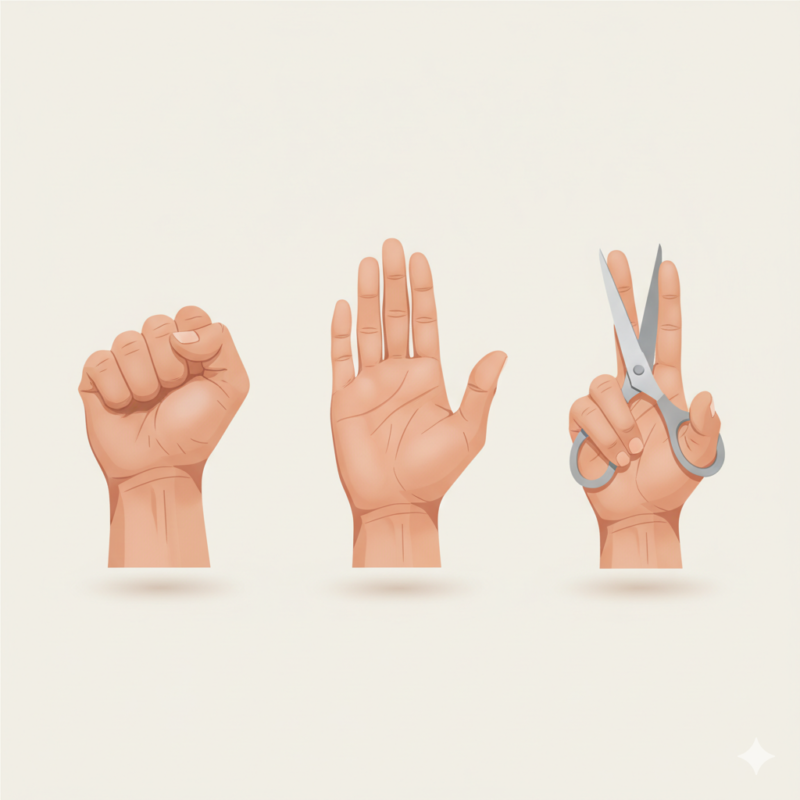
Rock, Paper, Scissors is a zero-sum hand game played by two people. Each player simultaneously forms one of three shapes:
-
Rock (a closed fist)
-
Paper (an open hand)
-
Scissors (a V-shaped hand)
The outcomes follow a simple rule set:
-
Rock crushes Scissors
-
Scissors cuts Paper
-
Paper covers Rock
If both players choose the same symbol, the round ends in a tie.
Despite its simplicity, the game creates a balanced competitive loop, where no option is inherently stronger than another. This balance explains its global longevity.
A Brief History of Rock, Paper, Scissors
Rock, Paper, Scissors did not originate in the modern West. Verified historical records trace its roots to China during the Han Dynasty (206 BCE–220 CE), where it appeared as a hand game called shoushiling.
The game later spread to Japan, where it became known as jan-ken. From Japan, it traveled globally in the late 19th and early 20th centuries through cultural exchange.
By the mid-1900s, Rock, Paper, Scissors had become a universal method for:
-
Settling small disputes
-
Choosing turns fairly
-
Making quick group decisions
Its endurance comes from fairness, speed, and accessibility. You need no tools, language, or preparation—just a hand.
Why Rock, Paper, Scissors Is Perfectly Balanced
Mathematically, Rock, Paper, Scissors is elegant.
Each move has:
-
One winning outcome
-
One losing outcome
-
One neutral outcome
When players choose randomly, each option has an equal 33.33% probability of winning, losing, or tying. No strategy dominates all others, which places the game in a category called non-transitive games.
This structure prevents predictable dominance and forces players to think beyond logic alone.
The Psychology Behind the Game
Here’s where Rock, Paper, Scissors gets interesting.
Humans do not behave randomly even when they try to.
Multiple peer-reviewed studies, including research published in Nature and Cognitive Science, show that players unconsciously follow patterns. Common tendencies include:
-
Starting with Rock more often than Paper or Scissors
-
Repeating a winning move
-
Switching after a loss
These patterns allow observant players to gain a psychological edge.
The game quietly demonstrates how human bias interferes with randomness, making it a useful teaching tool in psychology and behavioral science.
Strategy: Can You Actually Get Better at Rock, Paper, Scissors?
Yes—but not in the way most people expect.
There is no unbeatable move. However, players can improve by:
-
Tracking Opponent Behavior
Humans reveal habits quickly. Many players favor one symbol subconsciously. -
Breaking Your Own Patterns
If you always open with Rock, experienced players will exploit it. -
Using Controlled Randomness
Studies suggest that players who consciously randomize their choices perform better than those who “go with instinct.” -
Adapting, Not Predicting
Successful players react to trends rather than guessing single moves.
In short, Rock, Paper, Scissors rewards adaptive thinking, not luck alone.
Why Rock, Paper, Scissors Is Used in Serious Decisions
Surprisingly, this game appears in serious contexts.
Verified examples include:
-
Professional sports: Teams have used it to decide kickoff choices
-
Legal settlements: Lawyers have agreed to outcomes using the game
-
Business decisions: Executives use it to avoid bias when choices feel equal
Why? Because Rock, Paper, Scissors provides a fair, transparent decision mechanism that all parties accept.
When logic reaches a dead end, randomness restores trust.
Rock, Paper, Scissors and Game Theory
Rock, Paper, Scissors plays a major role in game theory, a branch of mathematics and economics that studies strategic interaction.
Economists use the game to explain:
-
Mixed strategies
-
Nash equilibrium
-
Competitive balance
In a Nash equilibrium, players randomize choices to avoid predictability. Rock, Paper, Scissors demonstrates this concept cleanly, which is why it appears in academic textbooks and university courses worldwide.
Few games teach complex theory with such simplicity.
Digital Evolution: Playing Rock, Paper, Scissors Online
The digital age gave new life to this classic game.
Online versions allow players to:
-
Play instantly without another person nearby
-
Practice strategy against randomized systems
-
Settle friendly debates remotely
If you want a clean, fast, and distraction-free experience, you can play Rock, Paper, Scissors online at
👉 https://rockpaperscissoronline.com/
The platform keeps the game pure—no unnecessary features, no clutter, just instant gameplay. That simplicity mirrors the original spirit of the game itself.
Why Online Versions Are Growing in Popularity
Online Rock, Paper, Scissors platforms succeed because they solve real problems:
-
No setup time
-
No physical presence required
-
Instant results
-
Fair outcomes
They also appeal to users who enjoy quick decision tools without commitment. In a world overloaded with choices, simplicity feels refreshing.
Sometimes, one click beats a long discussion.
Educational Value of Rock, Paper, Scissors
Teachers and trainers use Rock, Paper, Scissors for more than fun.
It helps explain:
-
Probability
-
Decision-making under uncertainty
-
Human bias
-
Competitive behavior
Because the rules are universal, learners focus on concepts rather than mechanics. Few tools teach so much with so little explanation.
Cultural Impact and Global Recognition
Rock, Paper, Scissors appears in:
-
Films and TV shows
-
Advertising campaigns
-
Competitive tournaments
-
Pop culture references
World Rock Paper Scissors championships have been held with formal rules and global participation. The game’s cultural neutrality allows anyone to play, regardless of age, language, or background.
That universality is rare.
Common Myths About Rock, Paper, Scissors
Let’s clear up a few misconceptions.
Myth 1: It’s purely luck
Reality: Behavioral patterns and psychology influence outcomes.
Myth 2: There’s a guaranteed winning strategy
Reality: No dominant strategy exists in a balanced system.
Myth 3: Adults shouldn’t take it seriously
Reality: Professionals and researchers study it extensively.
The game is simple, not shallow.
Why Rock, Paper, Scissors Still Matters Today
In an age of complex algorithms and artificial intelligence, Rock, Paper, Scissors offers a reminder:
-
Fairness matters
-
Simplicity works
-
Human behavior is predictable in unexpected ways
The game teaches humility. No matter how confident you feel, there is always a counter.
That lesson scales far beyond hand gestures.
Conclusion: A Timeless Game With Modern Relevance
Rock, Paper, Scissors survives because it respects balance, fairness, and human psychology. It does not need updates, graphics, or rules revisions. Its design remains nearly perfect.
Whether you play it casually, study it academically, or use it to settle decisions, the game continues to prove its value.
If you want to experience this classic in its cleanest digital form, visit
https://rockpaperscissoronline.com/ and let simplicity do the work.
Sometimes, the smartest choice is the simplest one—revealed in a single throw of the hand.