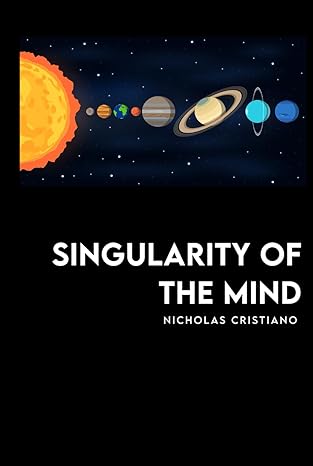
At first glance, Singularity of the Mind reads like a book about numbers, formulas, and unusual patterns. But beneath the surface, it is really a book about meaning. Through personal experience, philosophy, and a self-built system called the Matrix of Life Equation, the author, Nicholas, argues that life is not random. Instead, he suggests that connections exist between identity, time, nature, and consciousness if we are willing to look closely enough.
The search for meaning is deeply human
One of the clearest lessons of the book is that the desire to find meaning is universal. Nicholas traces his journey from childhood experiences to adulthood struggles, including mental health challenges, social isolation, and uncertainty about purpose. He perceives these moments as the foundation of deeper questioning.
He openly discusses psychosis, hospitalization, and therapy, while also describing how his thinking evolved through reflection and research. Which shows us how vulnerability can also become a sign for people to turn towards philosophy, spirituality, or systems of belief when reality feels unstable. The book shows that the human mind constantly seeks patterns to make life feel coherent.
Patterns shape how we understand reality
The Matrix of Life Equation is Nicholas’s attempt to prove that order exists beneath apparent chaos. He links numbers to letters, dates, historical events, and personal milestones using an A to Z equals 1 to 26 system. From this, he constructs numerical relationships that he believes connect his birthdate to broader universal structures.
Whether or not readers accept the system as valid, the larger takeaway is powerful. People do not simply experience the world. They interpret it through symbols. Religion, mathematics, language, and culture all operate on this same principle. The book highlights how meaning is constructed rather than discovered, and how belief systems often say more about human psychology than objective reality.
Knowledge alone is not enough without reflection
Later chapters move away from numerology and toward broader discussions of science, consciousness, and uncertainty. Topics like artificial intelligence, neuroscience, cosmology, and quantum theory are introduced not as technical explanations but as invitations to think more deeply about what it means to be aware. These sections emphasize that modern knowledge expands our understanding, but it does not eliminate life’s biggest questions.
The book repeatedly returns to one idea: understanding requires reflection, not just information. It argues that we must think critically about what we believe, how we interpret experiences, and why we are drawn to certain narratives about reality.
Resilience matters more than certainty
One of the most grounded parts of the book appears in the chapters focused on uncertainty, resilience, and coping. Here, the writing becomes less abstract and more practical. Nicholas stresses the importance of adaptability, emotional awareness, self-compassion, and social support. He suggests that uncertainty is unavoidable, but our response to it defines the quality of our lives.
This may be the most valuable lesson the book offers. Instead of promising answers about the universe, it emphasizes the importance of developing internal stability. In that sense, Singularity of the Mind becomes less about cosmic meaning and more about psychological survival.
Nicholas reveals that meaning is rarely objective. It is built from memory, identity, fear, hope, and experience. This explains how beliefs form, why people cling to them, and how easily interpretation can feel like truth.
Singularity of the Mind does not offer scientific answers about how the universe works. What it offers instead is a window into how the human mind works when it searches for connection. It teaches that people are pattern seekers, meaning makers, and storytellers by nature. It also shows that healing often comes not from having perfect explanations, but from building a narrative that makes life feel worth continuing.
Read it now on Amazon.