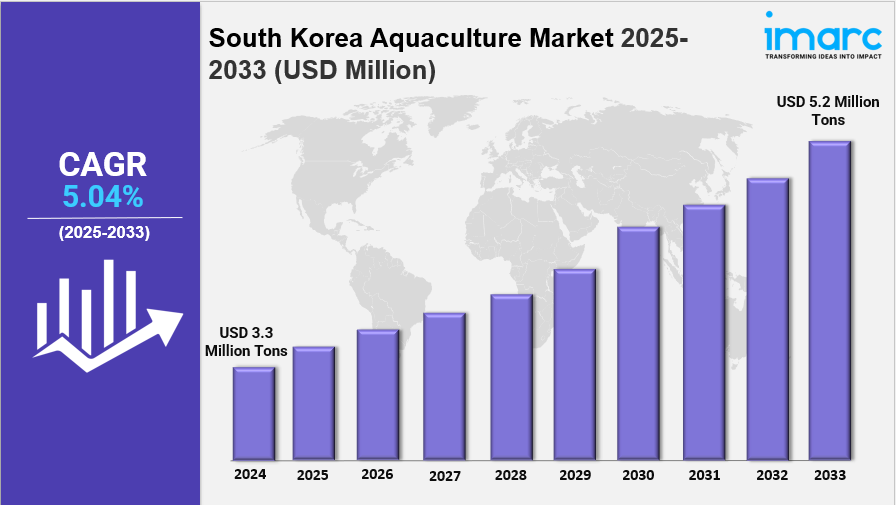
IMARC Group has recently released a new research study titled “South Korea Aquaculture Market Report by Fish Type (Freshwater Fish, Mollusks, Crustaceans, and Others), Environment (Fresh Water, Marine Water, Brackish Water), Distribution Channel (Traditional Retail, Supermarkets and Hypermarkets, Specialized Retailers, Online Stores, and Others), and Region 2025-2033”, offers a detailed analysis of the market drivers, segmentation, growth opportunities, trends and competitive landscape to understand the current and future market scenarios.
South Korea Aquaculture Market Overview
The South Korea aquaculture market size reached a size of 3.3 million Tons in 2024. The market is projected to grow to 5.2 million Tons by 2033, exhibiting a CAGR of 5.04% during the forecast period of 2025-2033. Growth is driven by increasing seafood consumption, government support, and rising health awareness.
STUDY ASSUMPTION YEARS
- Base Year: 2024
- Historical Years: 2019-2024
- Forecast Period: 2025-2033
SOUTH KOREA AQUACULTURE MARKET KEY TAKEAWAYS
- Current Market Size: 3.3 million Tons in 2024
- CAGR: 5.04%
- Forecast Period: 2025-2033
- Increasing seafood consumption due to rising awareness of health benefits.
- Government initiatives promoting sustainable fish farming methods enhance growth.
- Rising demand for organic seafood driven by food safety concerns.
- Advanced technologies and R&D investments are improving aquaculture practices.
- Southwest region dominates the market due to high seafood consumption and government support.
Sample Request Link: [https://www.imarcgroup.com/south-korea-aquaculture-market/requestsample]
MARKET GROWTH FACTORS
The demand for South Korea aquaculture is primarily driven by rising consumer awareness regarding the health benefits of seafood, such as enhanced digestion, improved skin health, and stronger metabolism. This has led to an increased preference for lean and protein-rich foods like squid, mackerels, sailfin sandfish, and salmon. Additionally, the growing farming of aquatic animals supports market expansion.
Governmental policies and initiatives play a critical role in market growth. Several measures are undertaken to promote sustainable fish farming methods and improve seafood productivity, further supported by continuous support from authorities. These efforts help enhance both quality and quantity of aquaculture production in the country.
Food safety concerns owing to the prevalence of foodborne illnesses caused by pathogens in conventionally cultured fish have increased the demand for organic seafood. This trend encourages consumers to opt for organically farmed fish, thereby propelling market growth. Concurrently, industry players invest in advanced equipment for water monitoring, fish behavior analysis, and facility logistics, along with R&D on genetic improvements and disease monitoring.
MARKET SEGMENTATION
- Fish Type
- Freshwater Fish: Includes fish cultivated in freshwater environments, currently representing the largest segment.
- Mollusks: Comprises aquatic mollusks farmed for commercial purposes.
- Crustaceans: Encompasses cultivated crustacean species.
- Others: Covers other types of aquatic organisms not classified above.
- Environment
- Fresh Water: Aquaculture conducted in freshwater environments, holding the largest market share.
- Marine Water: Aquaculture activities in marine water environments.
- Brackish Water: Farming in mixed salt and freshwater environments.
- Distribution Channel
- Traditional Retail: The dominant channel for aquaculture product sales.
- Supermarkets and Hypermarkets: Modern retail outlets selling aquaculture products.
- Specialized Retailers: Retailers focused on specific seafood products.
- Online Stores: E-commerce platforms providing aquaculture products.
- Others: Other available distribution channels.
- Region
- East: One of the key regional markets.
- West: Significant regional segment.
- Southwest: The largest aquaculture market region in South Korea.
- Southeast: Important regional market segment.
REGIONAL INSIGHTS
The Southwest region currently dominates the South Korea aquaculture market. Key growth factors include the region’s increasing seafood consumption, rising health consciousness among consumers, and robust support from government initiatives that promote sustainable aquaculture practices.
ABOUT US
IMARC Group is a global management consulting firm that helps the world’s most ambitious changemakers to create a lasting impact. The company provide a comprehensive suite of market entry and expansion services. IMARC offerings include thorough market assessment, feasibility studies, company incorporation assistance, factory setup support, regulatory approvals and licensing navigation, branding, marketing and sales strategies, competitive landscape and benchmarking analyses, pricing and cost research, and procurement research.
CONTACT US
IMARC Group,
134 N 4th St. Brooklyn, NY 11249, USA,
Email: sales@imarcgroup.com,
Tel No: (D) +91 120 433 0800,
United States: +1-201971-6302