Tire Market Overview:
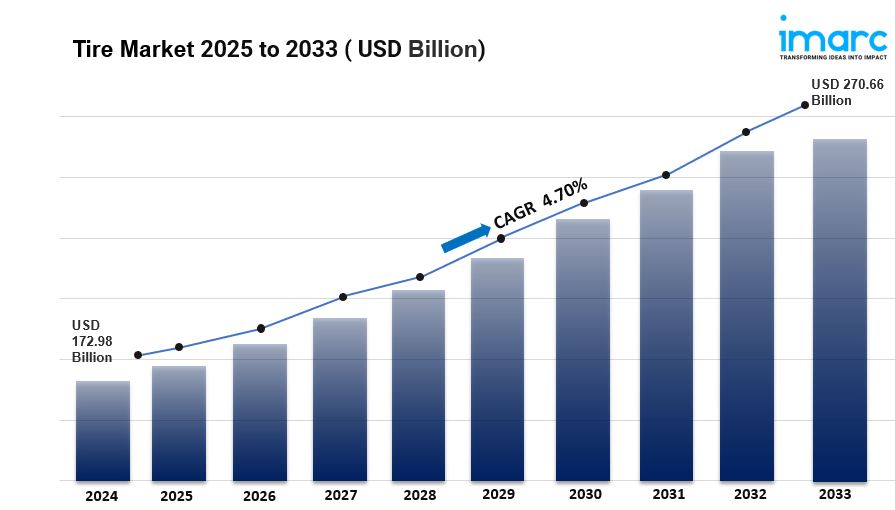
The global Tire Market size was valued at USD 172.98 Billion in 2024 and is forecast to reach USD 270.66 Billion by 2033, growing at a CAGR of 4.70% during 2025-2033. This growth is driven by continuous technological advancements in tire manufacturing, rising demand for eco-friendly and specialized tires, increased vehicle production, and the implementation of stringent safety regulations across the automotive industry.
The tire market is expanding rapidly driven by rising demand for high-performance tires, electric vehicle (EV) adoption, sustainable tire manufacturing, and enhanced durability across passenger cars, commercial vehicles, two-wheelers, and off-the-road applications. Growing adoption in automotive, construction, mining, agriculture, and transportation sectors is accelerating commercial deployment. Advancements in radial tire technology, airless tire development, smart tire systems, fuel-efficient compounds, and integration with tire pressure monitoring systems (TPMS) are driving product innovation. The growth of replacement tire markets, OEM partnerships, green mobility initiatives, and sustainable material adoption including bio-based oils is boosting market expansion. Increasing urbanization, infrastructure development, and rising middle-class demographics further support future global market growth.
Study Assumption Years
- Base Year: 2024
- Historical Years: 2019-2024
- Forecast Years: 2025-2033
Tire Market Key Takeaways
- Current Market Size (2024): USD 172.98 Billion
- CAGR (2025-2033): 4.70%
- Forecast Period: 2025-2033
- The market is propelled by the growing demand for electric vehicle (EV) tires and high-performance variants.
- Increasing focus on sustainable manufacturing and eco-friendly materials is driving innovation.
- Technological advancements such as smart tire systems and airless tire development are enhancing user experience.
- Expansion into emerging markets and infrastructure development is broadening market horizons.
- Raw material price fluctuations and supply chain disruptions present market challenges.
Access Detailed Sample Report:: https://www.imarcgroup.com/tyre-manufacturing-plant/requestsample
Market Growth Factors
The tire market is significantly driven by rapid technological advancements in tire manufacturing. Recent improvements in fuel efficiency, longevity, and performance are enhancing product appeal across all vehicle segments. Companies are investing heavily in research and development to introduce innovative tire variants. For instance, AI-based tire monitoring systems, smart tire technologies, and advanced compounds are emerging trends improving safety and user experience. The development of airless tires (tweels) by manufacturers like Michelin represents breakthrough innovation, eliminating punctures and reducing maintenance needs. Additionally, eco-friendly tire manufacturing using sustainable materials and bio-based oils is gaining momentum as manufacturers aim for carbon neutrality by 2050.
The expansion of the automotive industry is another major growth factor fueling the market. Rising production of passenger and commercial vehicles, driven by increasing consumer expenditure capacity and urbanization, is creating sustained demand for replacement and OEM tires. Vehicle sales in emerging economies like India have shown significant growth, with passenger vehicle sales reaching 310,294 units in October 2020 compared to 271,737 units the previous year. The shift toward electric vehicles (EVs) is creating new opportunities, as EV tires require specialized designs for optimal performance, durability, and efficiency. Major manufacturers are launching EV-specific tire variants to capture this growing segment.
The implementation of regulatory policies and safety standards also drives market expansion. Government bodies worldwide are enforcing stricter regulations to minimize carbon emissions and improve fuel efficiency. In India, the Ministry of Road Transport and Highways (MoRTH) announced regulatory changes covering wet grip, rolling resistance, and rolling sound emissions for passenger vehicles, light commercial vehicles, and trucks. The European Union’s Euro 7 framework sets additional limits for particulate emissions from brakes and tires. Growing emphasis on green mobility and sustainable transportation is accelerating the adoption of eco-friendly tire technologies. Infrastructure development in emerging economies, particularly in Asia Pacific and Latin America, is expanding the commercial vehicle fleet and creating substantial aftermarket opportunities for tire manufacturers.
Market Segmentation
Design:
- Radial: Represents the largest market share due to superior performance characteristics including better fuel efficiency, longer tread life, improved handling, and enhanced safety features. Radial tires are preferred for passenger cars, commercial vehicles, and off-the-road applications. The development of airless radial tire variants (tweels) by manufacturers like Michelin for ATVs, golf carts, light construction vehicles, and military applications is driving innovation in this segment.
- Bias: Traditional tire design with cross-ply construction, still used in specific applications including agricultural vehicles, industrial equipment, and certain two-wheeler segments.
End-Use:
- Replacement Market: Holds the largest market share, driven by emphasis on fuel economy, convenience, and the natural wear-and-tear of tires requiring periodic replacement. Growing inclination toward sustainable practices with manufacturers working to achieve 100% sustainable tires by 2050 through partnerships and zero-carbon technologies is supporting this segment.
- OEM Market: Driven by cutting-edge manufacturing technology adoption and product differentiation through durability, affordability, and sustainability features provided by original equipment manufacturers.
Vehicle Type:
- Passenger Cars: Represents the leading market segment, accounting for the largest share due to the rising number of passenger vehicles on roads globally. Sales growth in key markets like India showed 4.17% growth in November 2020. The segment includes luxury sedans, compact models, sports utility vehicles (SUVs), and crossovers requiring diverse tire specifications.
- Light Commercial Vehicles: Growing segment driven by e-commerce expansion and last-mile delivery services.
- Medium and Heavy Commercial Vehicles: Supported by infrastructure development and logistics sector growth.
- Two Wheelers: Significant segment particularly in Asia Pacific markets.
- Three Wheelers: Important in developing economies for passenger and goods transportation.
- Off-The-Road (OTR): Includes construction, mining, and agricultural equipment applications.
Distribution Channel:
- Offline: Dominates the market, including automotive dealerships, specialty tire shops, big-box retailers, and service centers. Consumers prefer offline channels for professional advice, direct inspection, immediate installation services, and value-added services such as wheel alignment, balancing, and rotation. The hands-on experience before purchase continues to drive preference for established brick-and-mortar stores.
- Online: Growing channel offering convenience, competitive pricing, and home delivery options, though installation still requires physical service centers.
Season:
- Summer Tires: Hold the largest market share, designed for optimal performance in warm, dry, and wet climates. Feature special tread compounds that improve grip and handling, with greater road contact resulting in better stability and traction. Popular in performance vehicles and regions with predominantly warm weather.
- All Season Tires: Versatile option for year-round use in moderate climates.
- Winter Tires: Specialized for cold weather, snow, and ice conditions with enhanced grip and flexibility at low temperatures.
Region:
- North America
- Europe
- Asia Pacific
- Latin America
- Middle East and Africa
Regional Insights
Asia Pacific is the leading regional market for tires, holding the largest market share globally. The region’s dominance is driven by the rapidly increasing number of passenger and commercial vehicles, particularly in China, India, and Southeast Asian countries. Rising economic growth, expanding middle-class demographics, and urbanization are accelerating vehicle ownership. Major tire manufacturers have established significant presence in the region, investing extensively in R&D activities related to advanced tire technologies and TPMS development. For example, AutoChips Inc. in partnership with X-FAB Silicon Foundries announced the production of advanced TPMS chipsets in November 2019. The growing popularity of two-wheeler tires, given the massive motorcycle and scooter markets in India, China, and Indonesia, further strengthens the regional market position. Infrastructure development projects and government initiatives supporting automotive manufacturing continue to propel market growth.
Key Players
- Apollo Tyres Ltd.
- Bridgestone Corporation
- Continental AG
- Hankook Tire & Technology Co., Ltd.
- Kumho Tire Co., Inc.
- Michelin
- MRF Tyres
- Pirelli Tyre C. S.p.A
- Sumitomo Rubber Industries, Ltd.
- The Goodyear Tire & Rubber Company
- The Yokohama Rubber Co., Ltd.
- Toyo Tire Corporation
About Us
IMARC Group is a global management consulting firm that helps the world’s most ambitious changemakers to create a lasting impact. The company provide a comprehensive suite of market entry and expansion services. IMARC offerings include thorough market assessment, feasibility studies, company incorporation assistance, factory setup support, regulatory approvals and licensing navigation, branding, marketing and sales strategies, competitive landscape and benchmarking analyses, pricing and cost research, and procurement research.
Contact Us
IMARC Group,
134 N 4th St. Brooklyn, NY 11249, USA,
Email: sales@imarcgroup.com,
Tel No: (D) +91 120 433 0800,
United States: +1-201-971-6302