
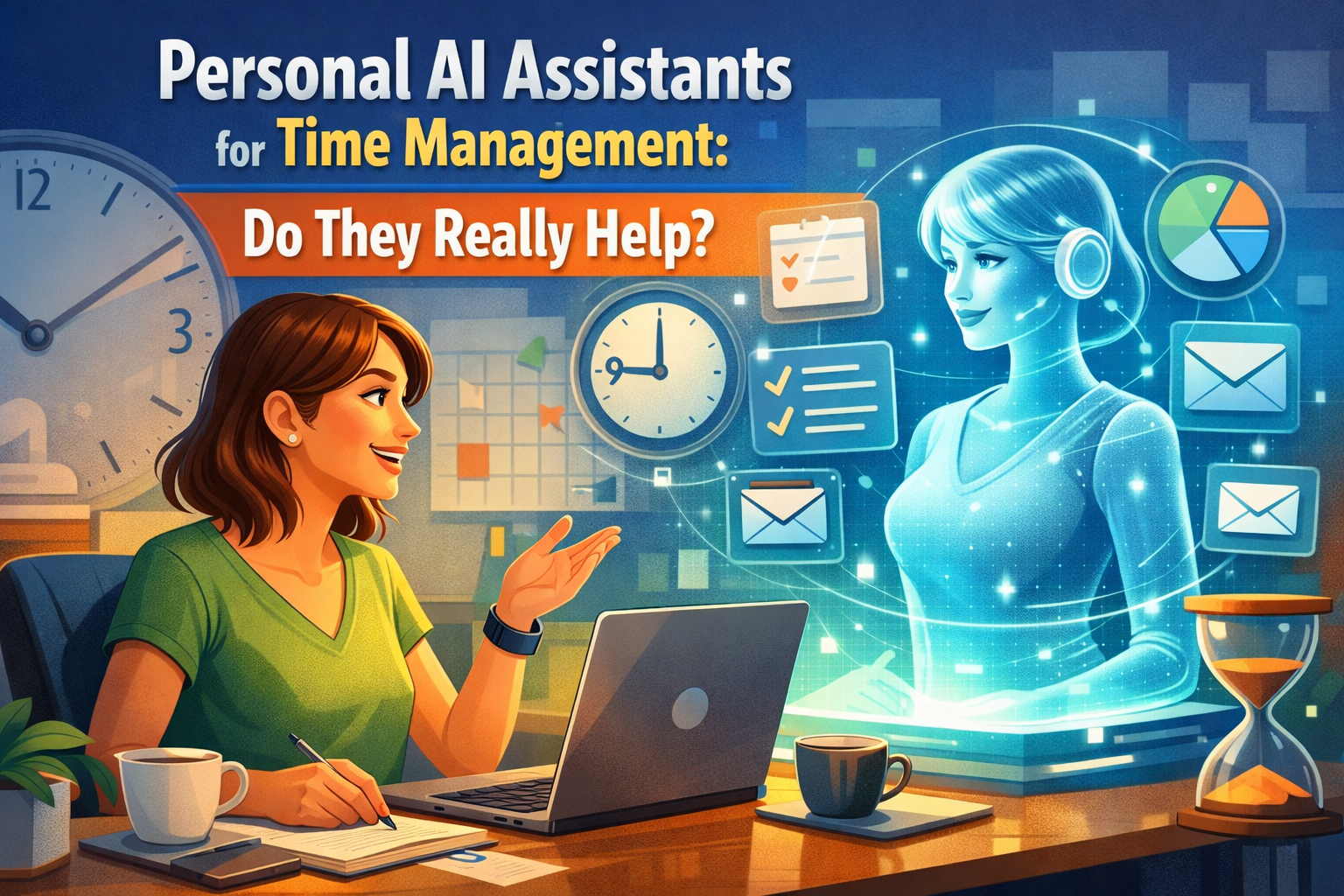
We’ve never had more tools to manage our time yet most professionals feel more overwhelmed than ever. Between constant notifications, overlapping meetings, and endless task lists, “being busy” has become the default state rather than the exception. Ironically, the very digital tools meant to streamline our lives often end up fragmenting our attention.
This is where personal AI assistants enter the conversation, not as another productivity app, but as a fundamentally different approach to managing time. Instead of manually organizing tasks, scheduling meetings, or prioritizing workloads, AI promises to think alongside you, learning your habits and making decisions on your behalf.
But do these assistants actually deliver on that promise? Or are they just another layer of complexity disguised as convenience?
In this article, we’ll go beyond the hype to explore how personal AI assistants truly impact time management. You’ll gain a clear understanding of what they do well, where they fall short, and whether investing in AI personal assistant software development makes strategic sense either as a user or a business.
What Are Personal AI Assistants and How Do They Manage Time?
At their core, personal AI assistants are software systems designed to simulate decision-making and task management behaviors. Unlike traditional productivity tools that rely on manual input, AI assistants leverage machine learning, natural language processing, and behavioral data to automate and optimize daily workflows.
Instead of simply reminding you about a meeting, a well-designed AI assistant can reschedule conflicts, prioritize tasks based on urgency, and even suggest when you should take breaks based on your past activity patterns.
From Reactive Tools to Proactive Systems
Traditional tools are reactive you tell them what to do. AI assistants, on the other hand, aim to be proactive. They analyze your emails, calendar patterns, work habits, and communication styles to anticipate needs before you explicitly state them.
For example, if you consistently decline meetings scheduled after 6 PM, the assistant may begin to automatically block that time. If it detects that you’re overloaded on a particular day, it might suggest rescheduling non-critical tasks or meetings.
This shift from manual control to intelligent delegation is what sets AI apart. It’s not just about saving time it’s about reducing the cognitive load required to manage time.
Key Capabilities That Impact Time Management
While capabilities vary across platforms, most personal AI assistants focus on a few core areas:
- Smart Scheduling: Automatically finding optimal meeting times based on availability and preferences
- Task Prioritization: Reordering tasks dynamically based on deadlines, importance, and workload
- Automated Reminders: Context-aware nudges rather than static alerts
- Email and Communication Management: Drafting responses, flagging important messages, and filtering noise
The real value lies in how these features work together as an integrated system, rather than as isolated functions.
Where AI Assistants Actually Save Time (and Where They Don’t)
The effectiveness of personal AI assistants isn’t uniform it depends heavily on how they’re used and the complexity of your workflows. While some users report significant productivity gains, others find limited value beyond basic automation.
Where They Deliver Real Efficiency
AI assistants excel in environments where tasks are repetitive, structured, and data-driven. For instance, professionals who spend a large portion of their day scheduling meetings or managing emails often see immediate benefits.
In these scenarios, AI reduces time spent on coordination and decision-making. Instead of going back and forth to find a meeting slot, the assistant handles it. Instead of scanning a crowded inbox, it highlights what matters most.
Over time, these small efficiencies compound. Saving 10–15 minutes a day may not seem transformative, but across weeks and months, it adds up to meaningful time reclaimed.
Where They Fall Short
However, AI assistants are not a universal solution. They struggle in situations that require nuanced judgment, emotional intelligence, or highly contextual decision-making.
For example, deciding whether to attend a strategic meeting isn’t just about availability, it involves understanding long-term priorities, relationships, and organizational dynamics. AI can assist, but it can’t fully replace human judgment in these cases.
There’s also the issue of over-automation. When too many decisions are delegated, users may feel a loss of control or become overly reliant on the system. This can lead to friction rather than efficiency, especially if the assistant makes incorrect assumptions.
The Psychology of Time Management: Why AI Feels Helpful
One of the most overlooked aspects of AI assistants is their psychological impact. Even when the time savings are modest, users often feel significantly more in control of their schedules.
Reducing Decision Fatigue
Every day, we make countless micro-decisions: when to respond to emails, which task to tackle next, whether to accept a meeting. These decisions may seem small, but collectively they drain mental energy.
AI assistants help by offloading these decisions. When your assistant automatically prioritizes tasks or suggests the next step, you’re freed from constant deliberation. This reduction in decision fatigue can lead to better focus and improved productivity.
Creating a Sense of Structure
Another key benefit is the sense of structure AI provides. By organizing tasks, setting reminders, and maintaining a dynamic schedule, assistants create a framework that helps users stay on track.
This is particularly valuable in remote or hybrid work environments, where traditional boundaries between work and personal life are blurred. AI can act as a digital “anchor,” reinforcing routines and maintaining consistency.
The Illusion vs. Reality of Productivity
However, it’s important to distinguish between perceived productivity and actual outcomes. Just because your day feels more organized doesn’t necessarily mean you’re achieving more meaningful results.
In some cases, AI assistants can create an illusion of productivity by optimizing low-value tasks while leaving high-impact work untouched. The key is to use AI as a tool for strategic alignment, not just operational efficiency.
Should Businesses Invest in AI Personal Assistant Development?
From a business perspective, personal AI assistants represent both an opportunity and a challenge. While the potential benefits are clear, the decision to invest in AI personal assistant development requires careful consideration.
Strategic Advantages for Organizations
Organizations that successfully implement AI assistants can unlock several advantages:
- Improved Employee Productivity: By automating routine tasks, employees can focus on higher-value work
- Better Time Allocation: AI-driven insights help teams prioritize tasks more effectively
- Enhanced Collaboration: Smart scheduling and communication tools reduce friction across teams
- Data-Driven Decision Making: Insights generated by AI can inform broader operational strategies
These benefits are particularly relevant in industries where time management directly impacts revenue, such as consulting, healthcare, and project-based services.
Understanding the Cost Factor
One of the most common questions businesses ask is about the cost to build AI personal assistant solutions. The answer varies widely depending on complexity, features, and integration requirements.
A basic assistant with limited functionality may require a modest investment, while a fully customized, enterprise-grade solution can be significantly more expensive. Factors influencing cost include:
- Level of AI sophistication (rule-based vs. machine learning-driven)
- Integration with existing systems (CRM, ERP, communication tools)
- Data security and compliance requirements
- Scalability and user personalization capabilities
Rather than viewing cost as a barrier, it’s more useful to consider it in terms of ROI. The real question isn’t how much it costs to build but how much time and efficiency it can save over the long term.
Best Practices for Getting Real Value from AI Assistants
Adopting a personal AI assistant isn’t a plug-and-play solution. To truly benefit, users and organizations need to approach it strategically.
Align AI with Your Workflow
The most effective implementations are those that align closely with existing workflows. Instead of forcing AI into your routine, adapt the assistant to support how you naturally work.
This may involve customizing settings, defining priorities, or integrating the assistant with specific tools you already use.
Maintain Human Oversight
While automation is valuable, complete reliance on AI can be risky. It’s important to maintain oversight, especially for decisions that impact long-term goals or relationships.
Think of AI as a collaborator rather than a replacement. It can handle the heavy lifting, but you remain in control of the final decisions.
Continuously Train and Optimize
AI systems improve over time, but only if they’re properly trained. Regularly reviewing suggestions, correcting errors, and updating preferences helps the assistant become more accurate and effective.
This iterative approach ensures that the system evolves alongside your needs.
The Verdict: Do Personal AI Assistants Really Help?
The short answer is yes but with important caveats.
Personal AI assistants can significantly improve time management, particularly when it comes to automating repetitive tasks and reducing cognitive load. They excel at handling the operational side of productivity, freeing up time and mental energy for more meaningful work.
However, they are not a silver bullet. Their effectiveness depends on how they’re used, the complexity of the tasks involved, and the user’s willingness to engage with the system thoughtfully.
For individuals, the key is to use AI as a support system rather than a crutch. For businesses, the challenge lies in balancing investment with measurable outcomes, ensuring that AI delivers real value rather than just technological novelty.
As AI continues to evolve, its role in time management will likely become even more sophisticated. The future isn’t just about managing time more efficiently it’s about redefining how we think about productivity altogether.
Final Thoughts
We’re entering an era where time management is no longer just a personal skillit’s a collaborative process between humans and intelligent systems. Personal AI assistants represent a significant step in that direction, offering a glimpse into a future where productivity is less about doing more and more about doing what matters.
The real question isn’t whether AI can manage your time. It’s whether you’re ready to rethink how your time should be managed in the first place.