
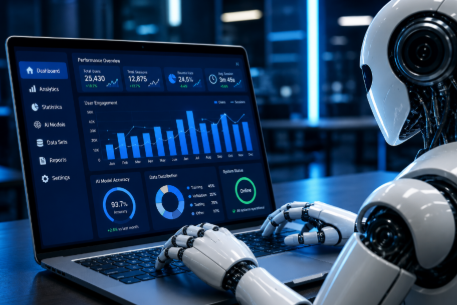
Artificial intelligence is not about software anymore. These days, businesses want intelligence to be built into the machines and devices themselves. From self-driving cars and industrial robots to health devices and smart home products, artificial intelligence is becoming a big part of the physical world.
This change has created a demand for AI hardware integration services. This field combines artificial intelligence, embedded systems, Internet of Things connectivity, and other technologies to create smart systems.
Companies today need to work to cut costs and give customers a better experience. Old systems that rely on people or cloud processing often struggle to do this. AI hardware integration solves these problems by letting machines and devices process information on their own, make decisions quickly, and work independently in the real world.
As industries keep moving towards automation and connected systems, AI-integrated hardware is becoming the backbone of change across healthcare, manufacturing, cars, retail, and other fields.
What Are AI Hardware Integration Services?
AI hardware integration services are about putting intelligence into physical devices and systems. The goal is to create systems that can look at data, automate tasks, respond to their surroundings, and get better over time through machine learning.
Unlike automation systems that follow fixed rules, AI-integrated hardware systems can learn and make smart decisions on their own.
AI hardware integration involves technical parts, including:
- Embedded hardware development
- Artificial intelligence deployment
- Firmware engineering
- Edge computing
- Sensor integration
- PCB design
- IoT communication
- Cloud synchronization
- Data analytics systems
- Real-time processing infrastructure
- Automation frameworks
- Security systems
The result is a system where hardware and software work together seamlessly.
Why AI Hardware Integration Is Becoming
Modern businesses produce a huge amount of data every second. Machines, sensors, cameras, and devices are always sending out information that needs to be processed accurately.
Old systems often send this data to the cloud for analysis. This creates problems like delays, slow response times, and security concerns.
AI hardware integration solves these issues by letting devices process data on their own. Make decisions in real time.
This change gives businesses advantages, including:
- Faster decision-making: AI-powered devices can look at information instantly and make decisions without waiting for the cloud.
- Reduced latency: Local AI processing cuts down on delays caused by network communication.
- Improved automation: integrated devices can automate tasks, optimise workflows, and work independently with minimal human help.
- Better security and privacy: Sensitive data can stay on devices instead of being sent to the cloud.
- Offline functionality: Edge AI systems can keep working without a stable internet connection.
- Operational costs: Local processing cuts down on cloud computing and bandwidth expenses.
Understanding the Core Architecture of AI Hardware Integration
AI hardware integration involves interconnected technology layers working together.
Every smart system has the following parts:
- Data Collection Layer: This layer collects data from the world using sensors and devices.
- Embedded Processing Layer: This layer processes data in time using embedded processors.
- Artificial Intelligence Layer: This layer contains machine learning models and AI algorithms that make decisions.
- Edge AI Processing Layer: This layer processes data on devices instead of sending it to the cloud.
- IoT Connectivity Layer: This layer connects devices and systems to the internet and the cloud.
The Role of Sensors in AI Hardware Integration
Sensors are crucial in AI hardware integration because they provide real-world data.
Different industries use types of sensors, such as:
- Camera systems for facial recognition and industrial inspection
- Motion sensors for security and robotics
- Environmental sensors for temperature and air quality monitoring
- Biometric sensors for healthcare and wearable devices
- Industrial sensors for pressure and machine monitoring
Accurate sensor calibration and synchronisation are essential for reliable AI performance.
AI Hardware Accelerators and High-Performance Computing
Modern AI workloads require hardware that can handle large-scale parallel processing efficiently.
Graphics Processing Units (GPUs), Tensor Processing Units (TPUs), and Neural Processing Units (NPUs) are used to accelerate machine learning computations and computer vision processing.
FPGA-based AI systems provide acceleration for specialised AI applications.
Embedded software engineering firmware acts as the bridge between hardware and AI software layers. Embedded software development includes device drivers, hardware abstraction layers, and real-time operating systems. Reliable firmware is essential for device performance, energy efficiency, security, and real-time responsiveness.
Industries Using AI Hardware Integration Services
AI hardware integration is changing industries, including:
- Healthcare: powered medical devices, smart patient monitoring, and remote healthcare infrastructure
- Manufacturing: maintenance, robotics, automation, and smart quality inspection
- Automotive: driving, driver assistance systems, and smart navigation
- Retail: Automated checkout systems, smart surveillance, and customer behavior analysis
- Smart Homes and Consumer Electronics: Smart speakers, home automation systems, and wearable fitness devices
The Complete AI Hardware Integration Development Process
AI hardware integration is a complex process that involves several stages, from design and development to testing and deployment. It requires an understanding of artificial intelligence, embedded systems, and IoT connectivity, as well as expertise in firmware and embedded software engineering. By following this process, businesses can create systems that are fast, efficient, and secure and that provide a better experience for customers.
AI hardware integration is a process that follows a set of steps.
It begins with understanding what a business wants to achieve and what it needs to accomplish that goal.
Teams look at things like:
- What the device can do
- What kind of intelligence does it need
- How it will be used
- How much power does it need
- How it will connect to things
- How it can be scaled up
Planning helps reduce risks and makes the development process more efficient.
The next step is designing the hardware.
Engineers create a plan for the system based on what it needs to do and how it needs to perform.
This includes things like:
- Choosing the processor
- Designing the circuit board
- Figuring out how to manage power
- Planning for heat
- Integrating sensors
- Setting up communication interfaces
A designed system is more reliable and can be scaled up more easily. Then there is the intelligence model development and optimisation. This is where machine learning models are trained and made to work on the device.
The goal is to make it work fast and use memory. It also needs to be powerful and work with edge artificial intelligence.
Firmware engineers create the software that makes the hardware work.
Their tasks include:
- Creating device drivers
- Integrating real-time operating systems
- Managing sensors
- Setting up communication protocols
- Implementing security measures
All the components are put together to create a system. Testing is done to make sure everything works as it should.
This includes:
- Testing
- Thermal analysis
- Evaluating intelligence accuracy
- Verifying connectivity
- Testing security
- Optimizing performance
After everything is tested and works well, the system is deployed. Maintenance is done to keep it running smoothly.
This includes:
- Updating firmware
- Improving intelligence models
- Applying security patches
- Optimizing performance
- Upgrading scalability
There are challenges in intelligence hardware integration. One of them is power consumption.
Artificial intelligence processing can use a lot of energy. To optimise efficient artificial intelligence models, low-power processors and smart power management systems are used.
Another challenge is management.
High-performance processors generate heat, which can affect stability. Advanced cooling systems are necessary for operation. There is also the risk of cybersecurity. Connected artificial intelligence devices are vulnerable to threats.
Measures like encryption, secure boot systems, authentication protocols, software protection, and access control systems are taken to secure them. Hardware components need to be compatible with each other.
Comprehensive testing is done to ensure this. Artificial intelligence systems need to be scalable. Modular system architecture helps with this. New trends are emerging in intelligence hardware integration. One of them is TinyML, which enables machine learning on low-power microcontrollers. This leads to more energy-efficient smart devices. Another trend is AIoT, which combines intelligence and IoT technologies. Applications include cities, intelligent logistics, connected healthcare, industrial automation, and smart infrastructure. Advanced artificial intelligence robotics rely on integrated intelligence hardware systems for autonomous movement and decision-making. 5G and edge connectivity improve communication speed and responsiveness between devices. Neuromorphic computing mimics brain functionality for more efficient artificial intelligence operations.
The future of intelligence hardware integration is promising.
It will lead to autonomous factories, artificial intelligence-powered transportation systems, smart healthcare ecosystems, intelligent energy infrastructure, and advanced robotics platforms.
Organisations that invest in intelligence hardware integration now will have an advantage in automation, efficiency, innovation, and scalability.
Artificial intelligence hardware integration is changing how businesses create systems and connected products. By combining intelligence with embedded hardware, organisations can create smarter and more efficient solutions. This is driving the generation of digital transformation in industries like healthcare, manufacturing, automotive, and smart consumer electronics. Successful implementation requires expertise in embedded systems, firmware engineering, artificial intelligence deployment, edge computing, IoT connectivity, sensor integration, and infrastructure optimisation.
As industries adopt automation and connected ecosystems, artificial intelligence hardware integration will shape the future of global innovation.
Artificial intelligence hardware integration is very important for creating systems that can make decisions in real-time and work on their own. The future of intelligence hardware integration services looks very promising.
Businesses are moving towards automation and connected infrastructure.
This means artificial intelligence hardware integration will become more important. It will lead to technologies and innovations that will change the world. Artificial intelligence hardware integration is the key to creating a more efficient future. It will help businesses create products that are intelligent, connected, and autonomous. The possibilities are endless. The future is exciting. Artificial intelligence hardware integration is the way.