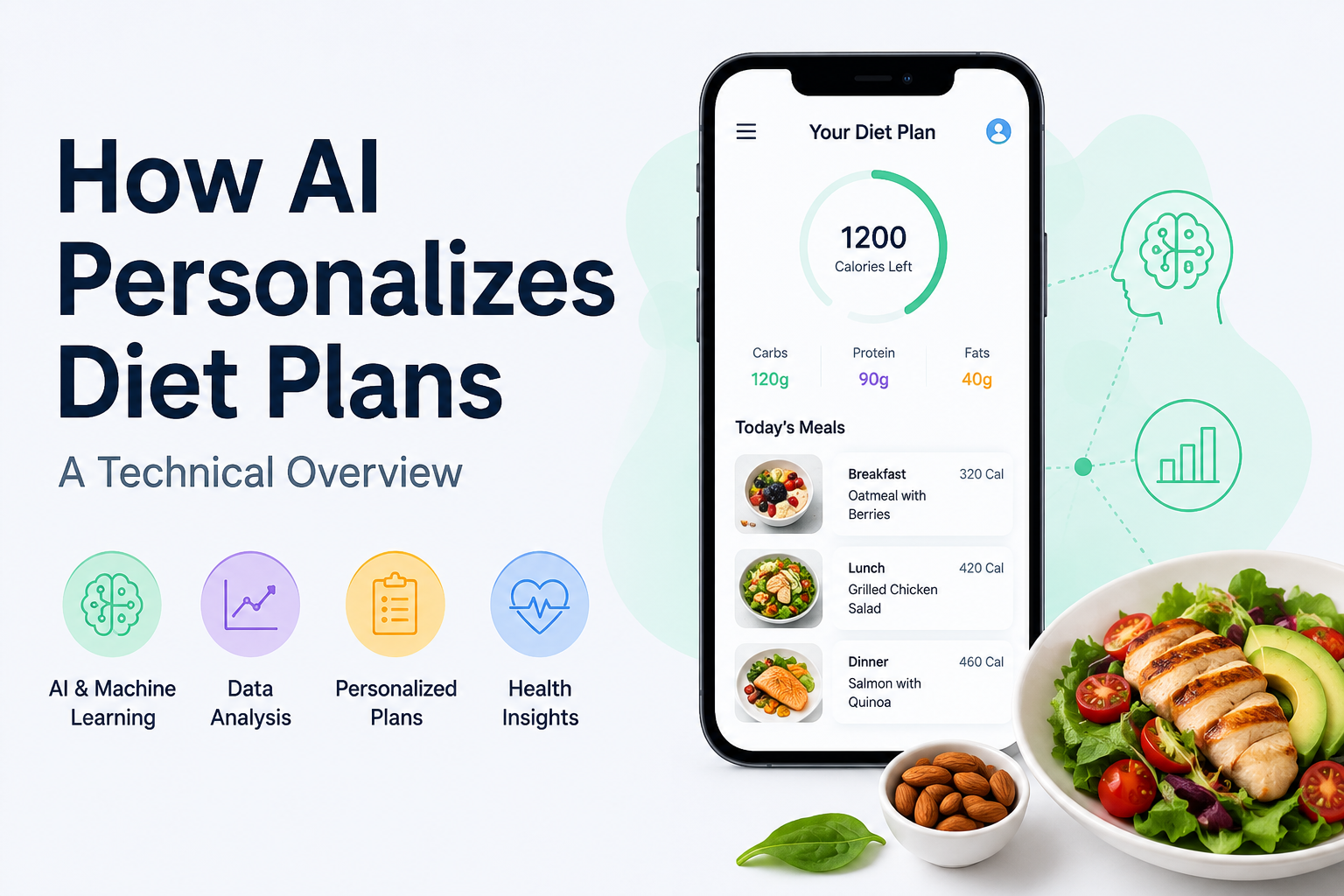
The way people approach nutrition is changing rapidly. Traditional diet plans built around generic calorie charts and one-size-fits-all recommendations are losing relevance in a world where users expect highly personalized digital experiences. Today, consumers want meal suggestions that align with their lifestyle, health goals, allergies, activity levels, cultural preferences, and even real-time biometric data. This shift is exactly why AI-powered nutrition platforms are becoming one of the fastest-growing segments in digital health technology.
At the center of this transformation is artificial intelligence. Modern AI systems can analyze enormous volumes of health and behavioral data, identify patterns humans would miss, and continuously adapt recommendations based on user progress. Instead of static diet charts, users now receive dynamic meal plans that evolve with their habits, metabolism, and goals. From fitness startups to enterprise healthcare platforms, businesses are increasingly investing in AI diet planner app development to meet growing demand for intelligent wellness solutions.
The timing could not be more important. Rising obesity rates, lifestyle diseases, wearable adoption, and consumer interest in preventive healthcare are driving organizations to adopt smarter nutrition technologies. Meanwhile, advances in machine learning, cloud computing, and predictive analytics have made AI personalization more accessible than ever before. Companies exploring AI meal planner app development are no longer just building calorie counters, they are creating intelligent ecosystems capable of delivering personalized health coaching at scale.
In this article, we’ll take a detailed technical look at how AI personalizes diet plans. We’ll explore the technologies powering these systems, the role of data science and machine learning, how recommendation engines work, the infrastructure required for development, and what businesses should understand before investing in AI-driven nutrition platforms.
The Shift From Generic Diet Plans to Intelligent Nutrition Systems
For decades, diet planning relied on generalized assumptions. Nutritionists often created plans based on broad demographic categories such as age, gender, and weight. While these methods worked to some extent, they struggled to account for the complexity of individual biology and behavior. Two people with the same weight and calorie intake can experience completely different outcomes because factors like metabolism, sleep quality, genetics, stress, and physical activity significantly affect nutritional responses.
Artificial intelligence changes this equation by allowing systems to process multidimensional health data in real time. Instead of delivering static recommendations, AI-powered platforms continuously refine meal suggestions based on evolving user behavior. If a user repeatedly skips breakfast, logs low protein intake, or experiences poor glucose responses after specific foods, the system can adjust recommendations automatically.
This personalization is especially valuable because nutrition is deeply behavioral. Sustainable diet planning depends not only on what users should eat, but also on what they are likely to follow consistently. AI systems learn preferences over time, identifying patterns such as favorite cuisines, meal timing habits, shopping behavior, and adherence levels. This enables applications to create realistic, achievable plans rather than idealized diets users abandon after a week.
From a business perspective, this shift creates enormous opportunities. Companies investing in AI diet planner app development can offer more engaging and retention-focused experiences. Personalized recommendations increase user satisfaction, improve health outcomes, and create stronger long-term engagement metrics. This is why many healthcare providers, wellness brands, and fitness startups are partnering with an experienced OpenAI-focused AI development company to build scalable nutrition platforms powered by machine learning.
The Core Technologies Behind AI-Powered Diet Personalization
AI-driven nutrition platforms combine multiple technologies to generate accurate and adaptive meal recommendations. These systems are far more sophisticated than simple calorie calculators. They operate through interconnected layers of data collection, processing, prediction, and recommendation engines.
Machine Learning Models and Predictive Analytics
Machine learning is the foundation of personalized nutrition systems. These models analyze historical user data and identify relationships between dietary behavior and outcomes. For example, if users with similar profiles tend to lose weight faster on high-protein meal plans, the algorithm can recommend similar nutritional structures to new users with matching characteristics.
Supervised learning models are commonly used for predicting:
- Weight loss progression
- Macronutrient optimization
- Calorie expenditure
- User adherence probability
- Blood sugar response patterns
Meanwhile, unsupervised learning helps group users into behavioral clusters. This allows the platform to detect hidden dietary trends and generate more nuanced recommendations. Over time, reinforcement learning techniques can continuously improve recommendations based on feedback loops and user interactions.
The more data the system receives, the smarter it becomes. This is why modern AI meal planner app development often integrates with wearable devices, fitness trackers, and health monitoring systems to gather continuous streams of behavioral data.
Natural Language Processing (NLP)
Natural Language Processing allows users to interact with diet platforms conversationally. Instead of manually navigating complex menus, users can type or speak commands like:
“Suggest a high-protein vegetarian dinner under 500 calories.”
NLP systems interpret user intent, nutritional requirements, and contextual preferences simultaneously. Advanced AI assistants can even analyze food journals, restaurant menus, or grocery receipts to provide personalized recommendations.
This capability significantly improves user engagement because it reduces friction. Conversational interfaces make nutrition guidance feel more natural and less clinical, which is especially important in consumer wellness applications.
Computer Vision and Food Recognition
Many modern nutrition apps now include image recognition features powered by computer vision. Users simply upload a photo of their meal, and the AI estimates:
- Portion size
- Calorie count
- Macronutrient composition
- Ingredient breakdown
This technology relies on convolutional neural networks (CNNs) trained on massive food image datasets. As image recognition accuracy improves, meal logging becomes dramatically faster and more user-friendly.
For businesses entering AI diet planner app development, computer vision represents a major competitive advantage because manual food tracking remains one of the biggest pain points in nutrition apps.
How AI Recommendation Engines Create Personalized Meal Plans
The recommendation engine is the brain of an AI-powered diet platform. It combines user data, nutritional science, behavioral analysis, and predictive modeling to generate individualized meal suggestions.
User Data Collection and Profile Building
Every personalization system starts with data acquisition. AI nutrition platforms typically gather information such as:
- Age and gender
- Weight and BMI
- Medical conditions
- Dietary restrictions
- Activity levels
- Sleep patterns
- Fitness goals
- Food preferences
- Purchase behavior
Some advanced systems also integrate genetic testing and microbiome analysis to provide hyper-personalized recommendations. Although still emerging, these integrations represent the future of precision nutrition.
The platform converts this information into structured user profiles. Machine learning algorithms then analyze these profiles to identify nutritional patterns and generate recommendations tailored to each individual.
Real-Time Adaptation and Behavioral Learning
One of AI’s greatest strengths is continuous adaptation. Traditional diet plans remain fixed for weeks or months, but AI-powered systems evolve dynamically.
For example, if a user consistently ignores recommended meals containing dairy products, the system gradually reduces dairy-based suggestions. Similarly, if a user exercises more frequently than expected, calorie targets and protein recommendations can adjust automatically.
This feedback loop creates a more human-like coaching experience. Over time, the AI becomes increasingly effective at predicting which recommendations users are most likely to follow successfully.
Context-Aware Recommendations
Advanced recommendation engines consider situational context, not just static health data. Factors influencing recommendations may include:
- Time of day
- Local weather
- Work schedules
- Travel patterns
- Restaurant availability
- Grocery delivery options
For instance, an AI platform might recommend lighter meals during hot weather or quick-preparation recipes for users with busy workdays. This contextual intelligence improves practicality and long-term adherence.
Many organizations working with an AI development company are now prioritizing context-aware personalization because user retention depends heavily on convenience and lifestyle compatibility.
Infrastructure and Architecture Required for AI Diet Planner App Development
Building a scalable AI nutrition platform requires far more than an attractive user interface. Behind the scenes, these systems depend on robust cloud infrastructure, data pipelines, APIs, and machine learning deployment environments.
Cloud Computing and Data Pipelines
AI-powered meal planning applications process enormous volumes of data in real time. Cloud platforms such as Amazon Web Services, Google Cloud, and Microsoft Azure are commonly used to support:
- Scalable data storage
- AI model training
- Real-time analytics
- User synchronization
- API integrations
Data pipelines are equally important. These pipelines collect information from wearables, mobile apps, food databases, and health APIs, then transform it into structured datasets suitable for machine learning models.
Without clean, organized, and continuously updated data pipelines, personalization accuracy deteriorates quickly.
API Integrations and Third-Party Ecosystems
Modern AI nutrition platforms rarely operate in isolation. They typically integrate with:
- Fitness trackers
- Smartwatches
- Health monitoring devices
- Grocery delivery platforms
- Telehealth systems
- Electronic health records
These integrations create a richer personalization ecosystem. For example, if a wearable detects poor sleep quality, the app may recommend foods rich in magnesium or suggest reduced caffeine intake.
Strong API architecture is therefore a critical component of AI meal planner app development because interoperability directly affects recommendation quality.
Security, Privacy, and Compliance
Nutrition platforms often process highly sensitive health data, making security and compliance essential. Developers must implement:
- End-to-end encryption
- Secure authentication systems
- HIPAA/GDPR compliance
- Role-based access controls
- Secure cloud storage
Trust is a major factor in health technology adoption. Users are far more likely to engage with AI-driven wellness platforms when they feel confident their personal health information is protected.
Business Considerations and AI App Development Cost Factors
While AI-powered nutrition platforms offer tremendous market potential, development complexity and cost vary significantly depending on functionality, personalization depth, and infrastructure requirements.
What Influences AI App Development Cost?
The overall AI app development cost depends on several factors:
- Complexity of AI models
- Number of integrations
- Real-time analytics capabilities
- NLP functionality
- Computer vision features
- Cloud infrastructure scale
- Compliance requirements
- Cross-platform support
A basic MVP with meal tracking and simple recommendation features may require a relatively moderate investment. However, enterprise-grade systems with predictive analytics, wearable integrations, and advanced personalization engines involve substantially higher development and maintenance costs.
Businesses should also consider ongoing expenses such as:
- AI model retraining
- Cloud hosting
- Data licensing
- Security monitoring
- Continuous feature updates
This is why many startups partner with a specialized AI development company rather than attempting to build internal AI infrastructure from scratch.
The Competitive Advantage of AI Nutrition Platforms
Despite the technical investment required, AI-powered diet systems offer significant competitive advantages. Personalized experiences increase:
- User engagement
- Retention rates
- Subscription conversions
- Health outcome effectiveness
- Customer lifetime value
In an increasingly crowded wellness market, personalization is becoming a key differentiator. Generic calorie-tracking apps are gradually being replaced by intelligent coaching platforms capable of delivering adaptive and context-aware nutrition guidance.
Businesses entering the digital health space are recognizing that AI is no longer a futuristic enhancement, it is becoming the foundation of next-generation wellness experiences.
The Future of AI in Personalized Nutrition
The future of AI-driven diet planning extends far beyond calorie recommendations. Emerging technologies are pushing nutrition toward true precision healthcare.
Soon, AI systems may combine:
- Continuous glucose monitoring
- Genetic analysis
- Hormonal tracking
- Microbiome sequencing
- Emotional health data
- Real-time metabolic responses
This level of personalization could dramatically improve how individuals manage chronic diseases, athletic performance, weight loss, and preventive healthcare.
We are also seeing rapid growth in generative AI applications within nutrition platforms. AI assistants can now create personalized recipes, explain nutritional science conversationally, and provide behavioral coaching in real time. As large language models become more sophisticated, virtual nutrition coaching may become nearly indistinguishable from human interaction.
The companies that succeed in this space will not simply build food-tracking apps. They will create intelligent health ecosystems capable of understanding users at a deeply personal level and continuously adapting to their changing needs.
In many ways, AI-powered nutrition represents the broader future of healthcare itself: proactive, predictive, personalized, and data-driven.