
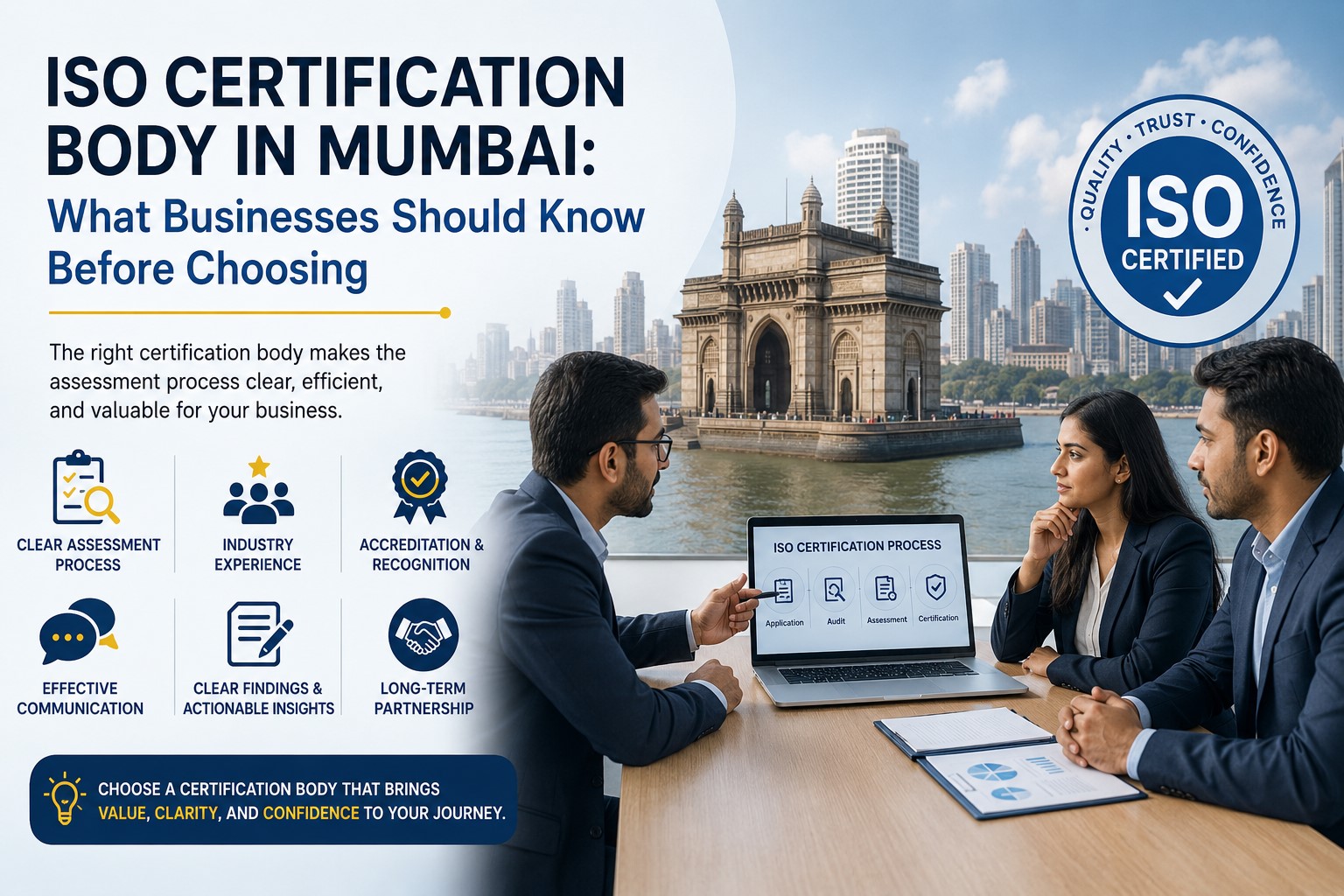
Mumbai is one of India’s largest business centre’s. The city has a diverse mix of financial institutions, manufacturers, technology companies, service providers, and trading businesses. As a result, organizations have different needs when they consider ISO certification.
An ISO certification body plays an important role in this process. It independently assesses whether an organization’s management system meets the requirements of a selected ISO standard.
However, certification bodies are sometimes confused with consultants or training providers. These organizations have different responsibilities. Therefore, understanding their role can help businesses make better decisions.
This guide explains how an ISO certification body in Mumbai supports local businesses. It also covers what organizations should consider before selecting one.
Why Understanding Certification Bodies Matters
Certification Bodies Have an Independent Role
First, businesses should understand what a certification body does. Its main responsibility is to assess a management system against the requirements of an applicable standard.
The assessment should be objective and evidence-based. Therefore, the certification body should not simply confirm that an organization is ready without conducting an appropriate evaluation.
Certification Is More than Receiving a Certificate
ISO certification should not be viewed as a paperwork exercise. Instead, it involves evaluating whether the management system is properly implemented.
For this reason, businesses should focus on actual processes. Documentation is important, but employees must also follow the established procedures.
Understanding Mumbai’s Business Environment
A Strong Financial Services Sector
Mumbai is widely recognized for its financial services sector. Banks, financial companies, insurance organizations, and related businesses operate across the city.
These organizations may have specific requirements around quality, information security, risk management, and business continuity.
Therefore, an ISO certification body in Mumbai should understand the operational environment of the industries it assesses.
Manufacturing and Trading Businesses
Mumbai also has a significant manufacturing and trading ecosystem. Businesses in these sectors may focus on quality, environmental management, occupational health and safety, or supply chain controls.
Consequently, certification bodies need suitable industry knowledge. This helps auditors understand how management systems operate in different business environments.
How an ISO Certification Body in Mumbai Supports Businesses
Conducting Independent Assessments
One of the main responsibilities of a certification body is conducting independent assessments.
Auditors review relevant processes, documents, records, and other evidence. They may also interview employees and observe activities.
As a result, organizations receive an objective assessment of their management system.
Verifying Implementation
A management system should work in practice. Therefore, auditors do more than check whether policies exist.
They examine whether employees understand their responsibilities. They may also check records and operational evidence.
This approach helps determine whether the system has been genuinely implemented.
Supporting Ongoing Certification
Certification does not usually end with the first successful audit. Organizations need to maintain their management systems throughout the certification cycle.
Furthermore, surveillance audits may be conducted at planned intervals. These assessments help confirm continued conformity.
Therefore, businesses should maintain their systems throughout the year.
Why Local Knowledge Can Be Useful
Better Understanding of Business Conditions
A certification body with experience in Mumbai may understand the city’s varied business environment.
This does not mean that a certification body must always have an office in Mumbai. However, relevant regional and industry experience can make communication easier.
Convenient Assessment Planning
Local experience can also help with assessment planning. Businesses may find it easier to coordinate meetings, site visits, and audit schedules.
However, convenience should not replace important factors such as competence and accreditation.
Experience across Multiple Standards
Some businesses may eventually need more than one ISO standard. For example, an organization may begin with quality management and later consider information security or environmental management.
Therefore, experience across multiple standards can be useful when planning future certification activities.
What Businesses Should Expect During the Process
Initial Discussions
The process often begins with discussions about the organization’s activities and certification requirements.
At this stage, businesses should explain their scope clearly. They should also ask questions about audit stages, timelines, costs, and responsibilities.
As a result, both sides can establish realistic expectations.
Reviewing the Management System
The certification process involves reviewing the organization’s management system.
Depending on the applicable standard and audit stage, auditors may review documented information, processes, records, and evidence of implementation.
Therefore, organizations should ensure that their systems are ready before the formal assessment.
Conducting the Certification Audit
The audit provides an opportunity for the certification body to evaluate actual implementation.
Auditors may interview employees and review operational activities. They may also examine evidence related to objectives, risks, controls, and performance.
If issues are identified, the organization may need to take corrective action.
How Certification Bodies Support Different Businesses
Large Organizations
Large companies often have complex structures. They may operate across several departments or locations.
Therefore, assessment planning can require careful coordination. An experienced certification body can help establish a practical audit approach.
Small and Medium Businesses
Small businesses have different needs. Their management systems may be less complex.
However, they still need to demonstrate conformity with the applicable requirements.
A suitable ISO certification body in Mumbai should assess the business according to its actual size and complexity. It should not create unnecessary requirements.
Businesses with Multiple Locations
Some Mumbai organizations operate from multiple sites. Others have offices or facilities in different cities.
In such cases, audit planning becomes more important. The certification body may need to consider the organization’s scope, locations, activities, and applicable requirements.
Therefore, businesses should discuss multi-location arrangements early in the process.
What to Check before Choosing a Certification Body
Verify Accreditation
First, organizations should check the certification body’s credentials.
Accreditation can provide important assurance about the competence and recognition of a certification body. Therefore, businesses should verify relevant accreditation details before making a decision.
Review Industry Experience
Next, consider experience within your industry.
A certification body familiar with your sector may better understand relevant processes and risks. This can help create a more meaningful assessment.
Compare the Certification Scope
Businesses should also review the proposed certification scope.
The scope should accurately describe the activities and locations covered by certification. Therefore, organizations should clarify this before the audit begins.
Understand Costs and Responsibilities
Cost is another important consideration. However, businesses should not select a certification body based only on the lowest price.
Instead, compare the complete service arrangement. Review audit stages, fees, travel expenses, surveillance arrangements, and other relevant terms.
This approach helps prevent unexpected costs later.
Certification Body vs Consultant vs Training Provider
What a Consultant Does
A consultant may help an organization develop or improve its management system.
For example, a consultant may assist with gap analysis, documentation, implementation, or internal audit preparation.
What a Training Provider Does
A training provider focuses on developing employee or professional competence.
Training may cover ISO awareness, internal auditing, lead auditing, or standard requirements.
What a Certification Body Does
A certification body performs the independent conformity assessment.
Therefore, businesses should understand these differences. Keeping these roles separate can help protect the credibility of the certification process.
Common Questions about Certification Bodies in Mumbai
Does a Certification Body Need to Be Located in Mumbai?
Not necessarily. Organizations can consider certification bodies based on competence, accreditation, industry experience, and service capability.
However, local experience may offer practical advantages.
Can a Certification Body Help Us Prepare for the Audit?
A certification body can explain the assessment process and applicable requirements. However, organizations should distinguish this from consultancy support.
The certification body must maintain appropriate independence during certification activities.
What Happens if Auditors Find Nonconformities?
Nonconformities may be identified during an audit. When this happens, the organization generally needs to address the findings through appropriate corrective action.
The relevant evidence is then reviewed according to the certification process.
Is Certification a One-Time Process?
No. Organizations need to maintain their management systems after certification.
Regular surveillance and other certification-cycle activities help confirm continued conformity.
Building a Better Long-Term Relationship
Maintain Open Communication
Good communication can make the certification process easier. Organizations should raise questions early and provide accurate information.
Furthermore, they should communicate significant changes that may affect the certification scope or management system.
Keep the System Active
Businesses should not wait until the next audit to review their management system.
Instead, they should monitor performance throughout the year. Internal audits, management reviews, corrective actions, and improvement activities can help maintain system effectiveness.
Focus on Real Business Value
Finally, organizations should focus on what the management system can achieve.
A well-implemented ISO system can improve consistency, accountability, risk awareness, and process control.
Therefore, certification should support business improvement rather than simply provide a certificate.
Conclusion
Choosing an ISO certification body in Mumbai is an important decision for organizations seeking credible certification. Mumbai’s diverse business environment makes industry knowledge and practical assessment experience particularly valuable.
However, local presence should not be the only selection factor. Businesses should also examine accreditation, competence, industry experience, certification scope, communication, and commercial terms.
Most importantly, organizations should understand the different roles of certification bodies, consultants, and training providers. This knowledge helps businesses make informed decisions and establish realistic expectations.
When certification is approached as an ongoing management commitment, it can provide value beyond the initial audit. It can help organizations strengthen processes, improve consistency, and demonstrate a structured approach to customers and business partners.