
Telehealth Billing 2026 Guide for Rules Codes and Best Practices
Telehealth billing 2026 is no longer a side topic in healthcare. It sits at the center of how many clinics operate. Virtual care is now part of daily patient flow. Billing teams must understand how to submit claims correctly or risk delays and denials.
Many practices still treat telehealth billing as a temporary system that started during the pandemic. That mindset causes mistakes. Telehealth billing 2026 requires structure training and clear processes. The rules continue to evolve and payers expect accuracy.
This guide explains what clinics need to know right now.
Why telehealth billing 2026 matters more than before
Telehealth visits are no longer rare. Insurance plans now expect them. Patients expect them. Regulators monitor them.
When billing teams misunderstand telehealth rules, the clinic absorbs the cost. Denials increase. Payments slow down. Staff spend hours correcting preventable errors.
Telehealth billing 2026 demands attention because payers track virtual services closely. They want proof that each visit meets medical and legal standards. Clean documentation supports clean claims.
Clinics that treat telehealth billing as a serious function protect their revenue and reputation.
Current rules shaping telehealth billing 2026
Telehealth rules differ by payer, but several patterns appear across the industry.
Most payers require clear proof that a service occurred through approved virtual technology. Documentation must show the visit type, provider location, and patient location. Missing details often trigger automatic denials.
Licensing also matters. Providers must meet state rules when delivering virtual care. Billing teams should confirm that credentialing matches service locations. Telehealth billing 2026 depends on compliance, not just coding.
Some payers still maintain temporary flexibilities that started during emergency periods. Clinics should never assume these policies will last. Teams must review updates regularly and adjust workflows.
Telehealth billing 2026 and coding accuracy
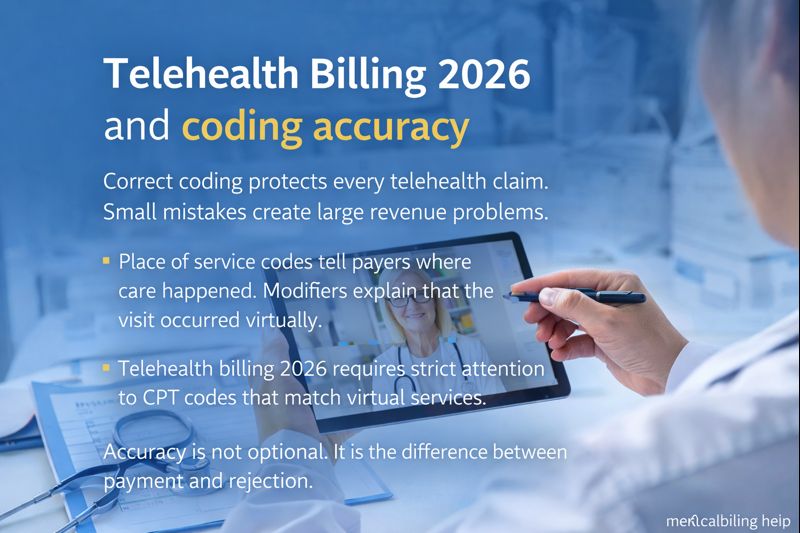
Correct coding protects every telehealth claim. Small mistakes create large revenue problems.
Place of service codes tell payers where care happened. Modifiers explain that the visit occurred virtually. When staff skip or misuse these indicators, the claim looks incorrect even if the care was valid.
Telehealth billing 2026 requires strict attention to CPT codes that match virtual services. Not every in person service translates to telehealth. Billing teams should maintain updated reference lists and train staff consistently.
Accuracy is not optional. It is the difference between payment and rejection.
Learn how denial management services protects telehealth revenue
Documentation standards in telehealth billing 2026
Documentation supports every claim. Without it, billing becomes guesswork.
Providers must record the method of communication, patient consent, visit length when required, and clinical reasoning. Notes should read as clearly as in person visits.
Auditors often review telehealth services more carefully because virtual care still carries higher scrutiny. Strong documentation protects the clinic during reviews.
Tele health billing 2026 rewards clinics that treat virtual records with the same seriousness as physical encounters.
Best practices for stable telehealth billing 2026
Successful clinics follow repeatable systems.
First, they standardize telehealth workflows. Every visit follows the same intake, documentation, and coding structure. Consistency reduces errors.
Second, they train billing staff continuously. Rules change often. Teams need refreshers, not one time instruction.
Third, they audit claims internally. Regular reviews catch patterns before payers do. Prevention saves more money than correction.
Fourth, they communicate across departments. Providers, schedulers, and billers must understand shared responsibilities. Telehealth billing 2026 succeeds when teams act as one system.
Technology and telehealth billing 2026
Software helps but does not replace human judgment.
Automation speeds eligibility checks and claim submission. It flags missing fields and outdated codes. These tools reduce manual workload.
However, billing teams must still understand the logic behind each claim. Technology supports decisions. It does not make them.
Clinics that rely only on software often miss payer nuance. Human review ensures accuracy and compliance.
Telehealth billing 2026 works best when technology and training grow together.
Common mistakes in telehealth billing 2026
Many denials come from predictable habits.
Some clinics assume all telehealth visits qualify for payment. They do not verify payer coverage first.
Others forget modifiers or apply the wrong place of service codes.
Some providers write brief notes that fail to justify medical necessity.
These mistakes look small but create major revenue leaks. Awareness alone reduces risk. Structured review prevents repetition.
Preparing for the future of telehealth billing 2026
Telehealth will not disappear. It will expand.
Regulators continue refining rules. Payers continue tightening audits. Clinics must prepare for more complexity, not less.
Strong billing foundations today protect growth tomorrow. Teams that invest in education, documentation, and review systems adapt faster to change.
Telehealth billing 2026 is not about chasing rules. It is about building resilience inside the revenue cycle.
Practices that respect the process create stability for providers, staff, and patients.
Final thoughts
Telehealth billing 2026 demands clarity, discipline, and teamwork.
Virtual care increases access, but it also increases responsibility. Claims must stand up to scrutiny. Documentation must support every service. Coding must stay precise.
Clinics that treat telehealth billing as a strategic function thrive. Those that ignore it struggle with denials and delays.
Billing protects more than payment. It protects the future of the practice.
FAQ Telehealth Billing 2026
What is telehealth billing 2026
Telehealth billing 2026 refers to the current rules and claim process for virtual healthcare visits. Clinics must follow payer guidelines, correct coding, and full documentation to receive payment.
What codes are used in telehealth billing 2026
Telehealth billing 2026 uses CPT codes that match virtual services, along with correct place of service codes and modifiers. These tell payers that care happened through telehealth and not in person.
Why is coding accuracy important in telehealth billing 2026
Coding accuracy protects every telehealth claim. Small mistakes can trigger denials, audits, and delayed payment. Correct coding proves that the service meets payer rules.
Can telehealth claims be audited
Yes. Payers review telehealth claims closely. They expect clear documentation, proof of virtual care, and proper coding. Strong records protect the clinic during audits.
How can clinics improve telehealth billing 2026
Clinics improve telehealth billing 2026 by training staff, reviewing claims before submission, and following standard workflows. Many practices also use outside billing support to reduce risk. Resources and billing guidance are available at medicalbilling.help