
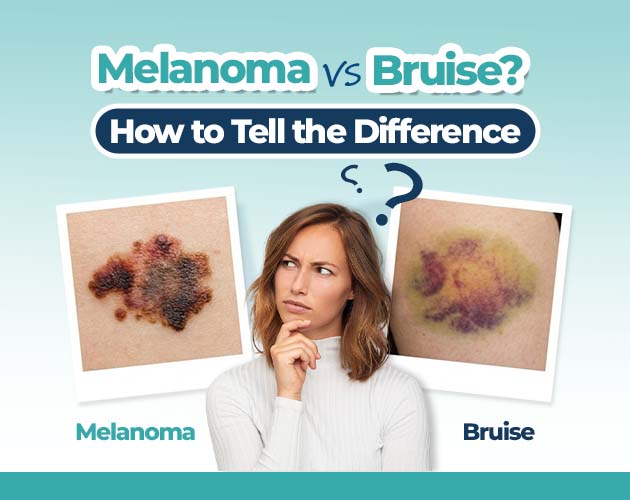
Yes, some skin cancers can look like a bruise. A dark, purple or bluish mark that appears without an injury, or one that doesn’t fade the way a bruise should, is worth having checked. Most bruise-like marks are harmless, but the few that aren’t are easy to dismiss precisely because they look familiar.
How a Normal Bruise Behaves?
A bruise (ecchymosis) forms when small blood vessels under the skin leak after a knock or pressure. Its behavior is predictable:
- It has a cause. You can usually link it to a bump, even a minor one. Older adults and people taking blood thinners may bruise from trivial contact.
- It changes colour. It typically moves from red or purple to blue-green and then yellow-brown as the body reabsorbs the blood.
- It is often tender when pressed.
- It fades. Most bruises clear within two to four weeks.
A mark that skips these steps, especially one that stays the same or grows, is behaving differently from a bruise.
Which Skin Cancers Can Resemble a Bruise?
Melanoma
Melanoma starts in melanocytes, the pigment-producing cells of the skin. It is usually brown or black and is often described using the ABCDE rule: Asymmetry, irregular Border, uneven Colour, Diameter larger than about 6 mm, and Evolving (any change in size, shape or colour). Some melanomas are dark, flat patches that people describe as a bruise that never went away.
Two forms are especially easy to misread:
- Acral lentiginous melanoma appears on the palms, soles or under the nails. It tends to be discovered late because people assume the dark area is an old injury, and it makes up a larger share of melanomas in people with darker skin tones.
- Nodular melanoma grows as a raised, firm lump that may be dark, red or even skin-coloured. It can grow over weeks and often doesn’t fit the ABCDE pattern. Many Australian clinicians teach the “EFG” cues instead: Elevated, Firm, and Growing.
Merkel Cell Carcinoma
This rare, fast-growing cancer typically shows up as a painless, firm, dome-shaped bump that is red, purplish or flesh-coloured. It is often found on sun-exposed skin such as the face, neck and scalp, and it can be mistaken for a cyst, an insect bite or a bruise. Because it can spread early, any quickly growing, painless lump deserves prompt assessment, and the ABCDE rule does not apply to it.
Other Possibilities
- Pigmented basal cell carcinoma, the most common skin cancer, can look blue-black or brown, though it more often appears as a pearly or shiny bump.
- Kaposi sarcoma causes red or purple patches or nodules and is more common in people with weakened immune systems.
A Dark Streak Under a Nail: Bruise or Melanoma?
The nail is where this confusion is most common. A subungual hematoma (blood trapped under the nail) usually follows a knock or tight footwear. It starts as a blotch, may hurt at first, and slowly grows out toward the tip as the nail grows. Fingernails grow roughly 3 mm a month and toenails more slowly, so a big toenail bruise can take many months to clear.
Subungual melanoma looks different. It often appears as a brown or black band running lengthwise from the cuticle, may widen over time, and does not move with nail growth. A key warning sign is Hutchinson’s sign, where pigment spreads from the nail onto the surrounding skin. The nail may also split, crumble or lift.
For a closer comparison of the features that separate the two, this guide to melanoma versus a bruise walks through nail and skin examples in detail.
Warning Signs a “Bruise” May Not Be a Bruise
Get a mark assessed if you notice any of the following:
- No known injury to explain it.
- No fading after about four weeks, or a nail mark that doesn’t move outward after three to four months.
- Growth or change in size, shape or colour.
- A raised, firm or rapidly growing lump, even if it doesn’t hurt.
- Bleeding, crusting or a sore that won’t heal.
- Pigment spreads beyond the original edge, or onto the skin around a nail.
- A location that is easy to overlook: soles, palms, under nails, between toes, scalp.
Pain is not a reliable guide. Early skin cancers are often painless, and tenderness doesn’t rule cancer out.
When Bruising Points to Something Else
Not every unexplained bruise is a skin cancer concern. Frequent or easy bruising can also be linked to medications such as anticoagulants or aspirin, low platelet counts, clotting disorders, vitamin deficiencies or age-related thinning of the skin. A doctor can sort out which explanation fits. Either way, unexplained or persistent marks are worth a conversation.
What Happens at an Appointment?
A doctor will usually ask about injuries, how long the mark has been there and whether it has changed. Then:
- Skin or nail examination and review of your personal and family history of skin cancer.
- Dermoscopy, in which a lit, magnifying handheld device reveals pigment patterns invisible to the naked eye.
- Biopsy if anything looks suspicious. Examining a tissue sample under a microscope is the only way to confirm a diagnosis.
If melanoma is confirmed, treatment depends on depth and stage but commonly starts with surgical removal. In Australia, national guidance from Cancer Council Australia and patient resources from Melanoma Institute Australia are reliable places to read further.
Practical Habits That Help
- Photograph suspicious marks with a ruler or coin beside them so you can compare over time.
- Check your whole body, including soles, nails, scalp and the areas you can’t easily see, or ask a partner to help.
- Book regular professional skin checks if you have fair skin, many moles, a family history of melanoma, or a history of heavy sun exposure.
- Don’t cover or ignore a changing nail or mark with polish, plasters or clothing.
Frequently Asked Questions
Can a bruise be cancer?
A true bruise is not cancer. However, cancer can mimic one. If a “bruise” appears without injury, doesn’t fade, or keeps changing, it needs assessment.
How long should a bruise last before I worry?
Most clear within two to four weeks. A mark that persists beyond that, or one that is growing, is worth checking.
Does skin cancer hurt?
Often it doesn’t, especially in early stages. Painless doesn’t mean harmless.
Who is most at risk of bruise-like skin cancers?
Risk factors include a personal or family history of melanoma, many moles, heavy sun exposure, fair skin, older age and a weakened immune system. Acral and nail melanomas occur across all skin tones and make up a higher share of melanoma diagnoses in people with darker skin.
Summary
Bruises have a cause, change colour and fade. Skin cancers that resemble them tend to appear without injury, persist or grow. Knowing the difference, and acting on a mark that doesn’t add up, gives you the best chance of catching a problem early, when treatment is most effective.