
Prescribing medications safely requires a thorough understanding of how the human body processes and eliminates drugs. For medications that undergo extensive hepatic metabolism, liver function dictates clearance rates. However, when a drug depends almost entirely on the kidneys for elimination, compromised renal function radically alters its pharmacokinetics.
Gabapentin, a structural analog of gamma-aminobutyric acid (GABA) widely prescribed for neuropathic pain, postherpetic neuralgia, and focal seizures is a prime example of a renal-dependent medication. Because the drug is excreted unchanged in the urine, declining kidney function directly slows clearance. Without timely protocol adjustments, standard dosing can rapidly lead to accumulation, severe sedation, neurotoxicity, and hospital admissions.
The Pharmacokinetics of Gabapentin: Why Kidney Function Matters?
Unlike many central nervous system active medications, gabapentin does not bind to plasma proteins and does not undergo hepatic metabolism. Instead, its absorption relies on a saturable L-amino acid transport system in the small intestine, and its elimination occurs exclusively through renal excretion.
Elimination Half-Life Dynamics
In individuals with healthy kidney function (estimated glomerular filtration rate or eGFR > 80 mL/min), the elimination half-life of gabapentin ranges from 5 to 7 hours. However, as renal filtration capacity drops, the clearance rate decreases proportionally.
- Normal Renal Function (CrCl > 60 mL/min): Half-life is 5 to 7 hours; standard dosing schedules apply.
- Moderate Impairment (CrCl 30–50 mL/min): Half-life extends to 15–20 hours.
- Severe Impairment (CrCl 15–29 mL/min): Half-life stretches up to 30–40 hours.
- End-Stage Renal Disease (ESRD / Hemodialysis): Half-life can exceed 130 hours without dialysis intervention.
Because clearance drops in direct linear proportion to creatinine clearance (CrCl), maintaining a standard 300 mg three-times-daily regimen in a patient with an eGFR of 20 mL/min quickly elevates plasma drug concentrations to toxic levels.
Recognizing Signs of Gabapentin Toxicity in Renal Patients
Because early symptoms of accumulation mirror common medical comorbidities, gabapentin toxicity in patients with chronic kidney disease (CKD) is frequently misdiagnosed as metabolic encephalopathy, stroke, or disease progression.
Primary Signs of Accumulation:
- Central Nervous System Depression: Extreme somnolence, profound lethargy, and blunted cognitive processing.
- Neuromuscular Symptoms: Myoclonus (sudden involuntary muscle jerks), severe tremors, ataxia (unsteady gait), and dysarthria (slurred speech).
- Respiratory & Hemodynamic Risk: In elderly patients or those taking concurrent opioids, elevated drug concentrations can cause dangerous respiratory depression and severe hypotension.
When toxic symptoms manifest in patients with impaired clearance, immediate discontinuation or reduction of the drug alongside supportive care is required. In severe toxicity cases, emergency hemodialysis efficiently removes the molecule from circulation due to its low molecular weight and lack of protein binding.
Dosing Adjustments Based on Creatinine Clearance (CrCl)
To prevent adverse drug events while maintaining pain relief or seizure control, clinicians adjust both the total daily dose and the dosing interval based on calculated creatinine clearance using the Cockcroft-Gault equation.
| Creatinine Clearance (CrCl) | Recommended Total Daily Dose Range | Typical Dosing Regimen / Schedule |
| ≥ 60 mL/min | 900 mg – 3,600 mg / day | 300 mg to 1,200 mg three times daily (TID) |
| 30 – 59 mL/min | 400 mg – 1,400 mg / day | 200 mg to 700 mg twice daily (BID) |
| 15 – 29 mL/min | 200 mg – 700 mg / day | 200 mg to 700 mg once daily (QD) |
| < 15 mL/min | 100 mg – 300 mg / day | 100 mg to 300 mg once daily (QD) |
| Hemodialysis (ESRD) | Post-HD supplemental dose | 125 mg to 350 mg after each 4-hour dialysis session |
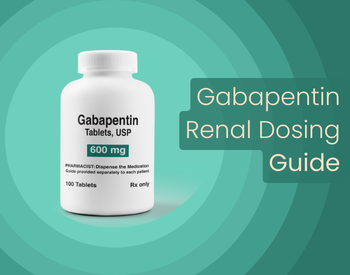
For precise, step-by-step clinical titration algorithms and renal dose adjustments across various stages of kidney disease, healthcare providers can reference the detailed gabapentin renal dosing guide for comprehensive patient care considerations.
Key Clinical Considerations and Pitfalls
Successfully managing patients on gabapentinoids requires avoiding several common prescribing mistakes.
1. Do Not Rely Solely on Serum Creatinine
Serum creatinine alone can be misleading, particularly in elderly or malnourished patients with low muscle mass. A patient may present with a seemingly normal serum creatinine of 0.9 mg/dL, yet their actual creatinine clearance may be well below 30 mL/min due to advanced age and low body weight. Always calculate estimated CrCl or eGFR before initiating therapy.
2. Manage the Abrupt Withdrawal Risk
While lowering doses is critical to prevent toxicity, suddenly stopping gabapentin should be avoided whenever possible. Abrupt cessation can trigger withdrawal symptoms including anxiety, insomnia, nausea, diaphoresis, and rebound pain or precipitate status epilepticus in patients with seizure disorders. When reducing doses, taper the medication systematically over 1 to 2 weeks.
3. Account for Concurrent Opioid Use
Combining gabapentinoids with prescription opioids exponentially increases the risk of fatal central nervous system and respiratory depression, even at moderate doses. The U.S. Food and Drug Administration (FDA) issued explicit safety warnings highlighting that patients with existing renal impairment face heightened vulnerability when these drug classes are co-prescribed.
Frequently Asked Questions
Why does gabapentin require dosing adjustments while pregabalin also does?
Both gabapentin and pregabalin are gabapentinoids eliminated almost entirely by renal excretion without liver metabolism. Consequently, both medications require proportional dose reductions as kidney function declines to avoid severe drug accumulation.
Can gabapentin cause direct acute kidney injury (AKI)?
Gabapentin is not classified as a nephrotoxic drug; it does not directly damage renal tubular cells or reduce renal blood flow. The primary concern is not that the drug damages the kidneys, but rather that pre-existing kidney dysfunction prevents the body from clearing the medication.
How is gabapentin managed for patients undergoing continuous renal replacement therapy (CRRT)?
Patients receiving continuous venovenous hemofiltration (CVVH) or hemodiafiltration (CVVHDF) clear gabapentin more efficiently than those on intermittent hemodialysis. Prescribers typically utilize dosing schedules aligned with a CrCl of 15 to 30 mL/min, monitoring closely for sedation.
How soon after starting a reduced renal dose should a patient be re-evaluated?
Patients with stage 3b to 5 CKD initiating therapy should be evaluated within 3 to 7 days for early signs of somnolence, dizziness, or unsteadiness. Dose titrations should occur slowly, allowing at least several days between increases to assess steady-state accumulation.
Summary
Dosing gabapentin safely in patients with renal impairment hinges on understanding its urinary elimination pathway. Because clearance declines alongside kidney function, failing to adjust doses risks severe central nervous system depression, ataxia, and neurotoxicity. By calculating creatinine clearance prior to initiation, starting at low baseline doses, titrating cautiously, and recognizing early signs of toxicity, clinicians can deliver effective relief while safeguarding vulnerable patients.