
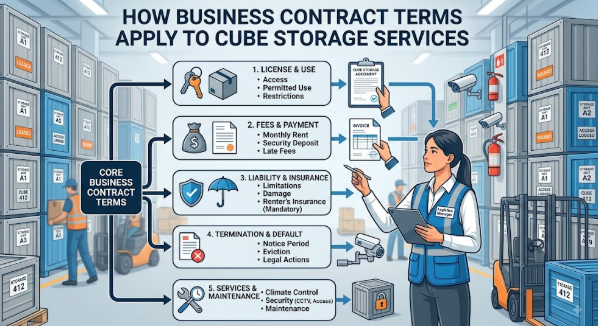
As enterprises scale, managing physical inventory, archival documents, and operational equipment requires flexible, secure, and cost-effective commercial warehousing. Modular commercial storage, flexible warehouse spaces, and dedicated “cube” storage solutions have become standard operational infrastructure for businesses ranging from e-commerce startups to multi-national logistics operations.
However, entering into a service agreement with a storage provider involves complex commercial legalities. Unlike standard residential self-storage rentals, commercial cube storage contracts create a legal relationship called a bailment—where physical custody of commercial assets is transferred to a third party while ownership remains with the client. Understanding how core business contract terms apply to cube storage services is critical to mitigating operational risk, controlling costs, and protecting corporate assets.
Defining the Core Legal Relationship: Landlord vs. Bailee
The fundamental structure of a commercial cube storage agreement hinges on whether the provider acts as a commercial landlord leasing real estate or as a bailee accepting custody of goods.
- Lease Agreements (Landlord Model): The tenant rents a specific, designated square footage or physical cube unit. The client maintains sole physical control and possession of the items inside.
- Bailment Agreements (Warehouse Operator Model): The operator accepts responsibility for receiving, storing, and releasing specified goods. The operator assumes a legal standard of care over the items.
Understanding this distinction determines which legal frameworks apply when items are damaged, lost, or subjected to regulatory inspection.
Key Contractual Clauses in Cube Storage Services
A commercial storage agreement must balance accessibility with risk allocation. Below is a detailed breakdown of how standard business contract clauses apply directly to cube storage operations.
Overview of Critical Cube Storage Contract Clauses
| Contract Clause | Primary Function in Cube Storage | Common Risk / Pitfall |
| Goods Description & Identification | Defines exact inventory, pallet count, condition, and value upon delivery. | Vague descriptions (“miscellaneous inventory”) prevent recovery for lost or damaged items. |
| Standard of Care | Establishes the provider’s duty to protect goods from theft, pests, and climate damage. | Relying on common law without explicit contractual standards. |
| Limitation of Liability | Caps maximum financial payout by the provider in case of loss or destruction. | Assuming the facility’s policy covers full replacement value of high-value goods. |
| Insurance Obligations | Mandates property, casualty, and bailee liability coverage. | Operating without a mutual waiver of subrogation. |
| Warehouseman’s Lien Rights | Grants provider rights to withhold or auction goods for non-payment. | Unexpected liquidation of high-value equipment due to disputed invoices. |
Deep Dive into Critical Contractual Provisions
Description of Goods and Verification Terms
To establish an enforceable contract, the scope of property stored within the cube environment must be clearly defined. Providers typically require a detailed bill of lading or inventory schedule prior to accepting delivery.
- Serial Numbering & Tracking: High-value hardware, electronic components, or medical equipment require itemized serial logging upon entry.
- Condition on Arrival: Terms should explicitly state who inspects items for pre-existing damage upon receipt.
- Hazardous & Restricted Materials: Contracts universally prohibit hazardous, explosive, or illegal items. Tendering unauthorized goods can result in immediate contract termination, fines, and broad indemnification liabilities.
Standard of Care and Facility Specifications
The standard of care dictates how well the provider must maintain the storage climate and security system.
- Reasonably Prudent Person Standard: Most warehouse contracts bind the operator to the care a reasonably prudent person would exercise under similar circumstances.
- Climate Control Guarantees: For temperature-sensitive inventory, the agreement must explicitly define microclimate thresholds rather than vague terms like “climate-controlled.”
- Security Specifications: Specific clauses should stipulate round-the-clock CCTV monitoring, perimeter access logging, individual unit alarm systems, and fire suppression compliance.
Financial Structure and Payment Terms
Commercial cube storage contracts utilize several pricing mechanisms based on space utilization, handling frequency, and duration.
Common Billing Structures
- Flat Monthly Lease Rate: Fixed fee per cubic container, module, or square foot regardless of density.
- Volumetric / Per-Pallet Billing: Scalable fee structure calculated monthly based on actual occupied cubic volume or total pallet count.
- Handling and Access Fees (In/Out Charges): Service charges assessed whenever goods are moved, picked, loaded, or inspected.
Escalation Clauses and Additional Surcharges
Contracts must be carefully reviewed for unexpected price adjustments:
- Annual Escalation Caps: Limit automatic yearly price adjustments to a fixed percentage or tie them to the Consumer Price Index.
- Utility & Energy Surcharges: Specify how fluctuating energy costs impact climate-controlled cube storage pricing.
- Demurrage and Detention Fees: Charges applied when delivery vehicles exceed allotted loading or unloading timeframes.
Liability Caps, Insurance, and Risk Allocation
The liability section is often the most heavily negotiated part of a commercial cube storage agreement. Providers standardly limit their exposure to a fraction of the actual value of stored goods.
Typical Liability Cap Structures
- Per Weight / Per Package Caps: Standard warehouse receipts often limit provider liability to set dollar amounts per pound or per package unless a higher value is declared in advance.
- Declared Value Options: Clients can increase provider liability caps by declaring a higher inventory value and paying an adjusted monthly premium.
- Consequential Damage Exclusions: Nearly all commercial storage agreements contain strict waivers excluding liability for indirect damages, such as lost business profits, supply chain downtime, or reputational harm.
Insurance Alignment Matrix
| Coverage Type | Responsible Party | Key Function |
| All-Risk Commercial Property | Client (Depositor) | Covers full replacement value of goods against fire, natural disasters, theft, and water damage. |
| Bailee’s Customer Liability | Storage Provider | Covers operator’s legal liability for damage caused by provider negligence. |
| General Commercial Liability | Both Parties | Covers third-party bodily injury and property damage occurring within the facility. |
| Waiver of Subrogation | Both Parties | Prevents insurers from suing either party after a claim is settled. |
Access Rights, Security Protocols, and Default Provisions
Access and Facility Regulations
Business contracts must establish precise terms regarding physical access to cube storage units:
- Authorized Personnel Lists: Requiring designated, verified corporate representatives for security access.
- Notice Requirements: Mandatory advance notice before accessing specialized or high-security modular cubes.
- Audit Rights: Terms enabling clients to perform scheduled physical inventory counts and security compliance audits.
Default, Non-Payment, and Warehouseman’s Lien
If a business defaults on payment, commercial storage contracts invoke statutory and contractual enforcement mechanisms:
- Cure Periods: The standard timeframe granted to remedy delinquent payments before access is suspended.
- Enforcement of Lien: Provider’s right under commercial law to seize and publicly auction stored goods to recover unpaid balances.
- Property Disposition Clauses: Terms defining how abandoned property or unsellable inventory is disposed of following contract termination.
Best Practices for Contracting Cube Storage Services
- Conduct Physical and Legal Audits: Inspect the physical facility’s fire systems, security measures, and climate controls prior to signing.
- Align Contract Values with Real Replacement Costs: Avoid relying on default liability limits; ensure property policies cover full asset value.
- Clarify Term & Termination Terms: Build clear non-renewal timelines to avoid automatic long-term renewals.
- Detail Operational SLAs: Explicitly outline retrieval turnarounds, loading dock scheduling, and climate stability metrics.
By systematically evaluating and negotiating these core contract terms, businesses can securely utilize cube storage services as a flexible extension of their supply chain while protecting operational interests and mitigating liability