
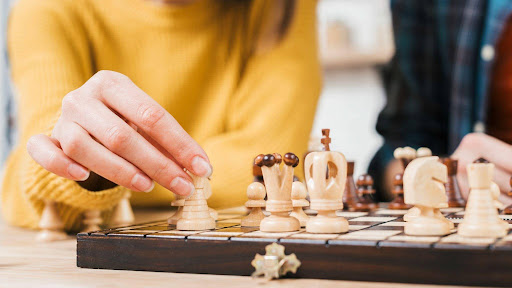
At some point, every chess player reaches a stage where knowing the rules and basic tactics no longer guarantees better results. You may understand openings, spot simple combinations, and know common checkmate patterns, yet still struggle to decide what the position actually demands. This is where chess becomes more thoughtful. For players exploring top chess online intermediate training, the next step is not simply learning more moves. It is learning how to evaluate positions, build plans, calculate accurately, and make decisions with purpose.
Tactics Are About More Than Spotting Combinations
Tactical training remains an important part of intermediate chess. Forks, pins, skewers, discovered attacks, sacrifices, and double attacks continue to appear in practical games. However, stronger players begin to recognize why tactical opportunities arise. A tactical combination often develops because a piece has been left undefended, a king has become exposed, a defender is overloaded, or a particular square has become vulnerable.
Recognizing these conditions allows players to prepare for combinations rather than waiting for them to appear by chance. This is where tactical knowledge starts connecting with strategic understanding. A player who understands the position can often identify the areas where tactical possibilities are most likely to develop.
Develop the Habit of Evaluating the Position
Calculation is essential, but calculation without evaluation can send a player down unnecessary variations. Before spending significant time calculating, take a moment to understand the position.
A practical evaluation can include:
- Material: Is either side ahead or behind?
- King safety: Which king has fewer defensive resources?
- Piece activity: Whose pieces have better squares?
- Pawn structure: Are there weaknesses that can be attacked?
- Space: Which side controls more useful areas of the board?
- Position-specific advantages: Are there open files, strong outposts, weak squares, or passed pawns?
This does not mean trying to calculate the entire game in advance. It simply gives your calculation direction.
Understanding What to Do After the Opening
One common challenge for intermediate players appears immediately after the opening phase. The pieces have been developed. The king is relatively safe. The centre has been addressed. Then the player suddenly runs out of ideas. This is where middlegame planning becomes important.
A good plan may involve improving a badly placed piece, attacking a pawn weakness, taking control of an open file, creating a pawn break, occupying an important square, or limiting the opponent’s most active piece. A plan does not necessarily need to produce an immediate attack. Sometimes the best decision is simply to improve your position while making the opponent’s position less comfortable.
Studying complete master games can be particularly useful here. Rather than memorizing opening sequences, players can observe how strong competitors identify weaknesses and gradually turn small positional advantages into practical opportunities.
Strategy and Tactics Work Together
It is easy to think of tactics and strategy as two separate areas of chess. Strong practical play shows that they are closely connected. Suppose a player establishes a strong knight on an outpost. That knight may restrict several enemy pieces. As the opponent becomes increasingly constrained, tactical possibilities may eventually appear. The reverse can happen too. A tactical weakness may expose a deeper positional problem.
For this reason, choosing the best chess online intermediate training should involve more than counting the number of tactical puzzles offered. Good training should explain the connection between positional decisions and tactical consequences. The objective is not simply to solve a combination correctly. It is to understand what made that combination possible.
Do Not Ignore the Endgame
Many players focus on openings and tactics while overlooking endgames. Yet, endgame study sharpens practical decision-making by teaching king activity, pawn structure, calculation, and the importance of every tempo. Intermediate players should become familiar with concepts such as:
- King activity.
- Opposition.
- Key squares.
- Passed pawns.
- Pawn promotion.
- Basic rook endings.
- Queen-versus-pawn situations.
- Converting material advantages.
Endgame knowledge also influences earlier decisions. If you know that a particular exchange leads to a favourable ending, you can make that trade confidently during the middlegame.
Your Own Games Are a Powerful Classroom
Playing more games is useful, but simply moving from one game to another does not guarantee improvement. Analysis is what turns playing experience into learning. After a game, look for recurring mistakes. You might discover that you:
- Calculate only your own ideas.
- Move too quickly in complicated positions.
- Miss defensive resources.
- Exchange pieces without a clear reason.
- Create unnecessary pawn weaknesses.
- Struggle to formulate middlegame plans.
- Enter endgames without understanding their requirements.
Try analysing your game yourself before consulting an engine. This forces you to think about the position and identify where your decision-making went wrong.
What Makes Intermediate Online Chess Training Worthwhile?
Not every course designed for intermediate players offers the same learning experience. A strong program should help students progress from understanding concepts to applying them independently.
Look for a curriculum that combines:
- Advanced tactical training.
- Calculation exercises.
- Positional concepts.
- Strategic planning.
- Middlegame preparation.
- Opening understanding.
- Endgame fundamentals.
- Game analysis.
- Practical playing opportunities.
- Tournament preparation.
- Instructor feedback.
For families exploring online chess intermediate classes in the USA, strong instruction and a well-planned curriculum matter. Look for interactive lessons, guided practice, personalized feedback, and opportunities that help students apply their skills in real games
The Real Meaning of Progress
Intermediate improvement does not always look dramatic. Sometimes progress means recognizing an opponent’s threat before it becomes dangerous. Sometimes it means refusing to launch an attack when the position does not support one.
It may mean improving your worst-placed piece instead of searching for an immediate combination. These small decisions reveal something important: the player is beginning to understand the position rather than simply respond to it.
Conclusion
The intermediate stage marks an important transition in a player’s chess journey. Knowing tactical patterns and opening principles provides the foundation, but genuine improvement comes from understanding why particular decisions work. Better evaluation, calculation, strategic planning, positional awareness, endgame knowledge, and game analysis help players make that transition. For students exploring the best chess online intermediate training, structured learning can provide the guidance needed to turn knowledge into confident, practical play.
For students ready to strengthen their tactical and positional abilities, Chessbrainz offers structured learning designed to develop advanced patterns and support the beginning of a competitive chess journey. Their experienced instructors and progressive curriculum give young players opportunities to develop stronger chess habits while building a deeper and lasting appreciation for the game.