
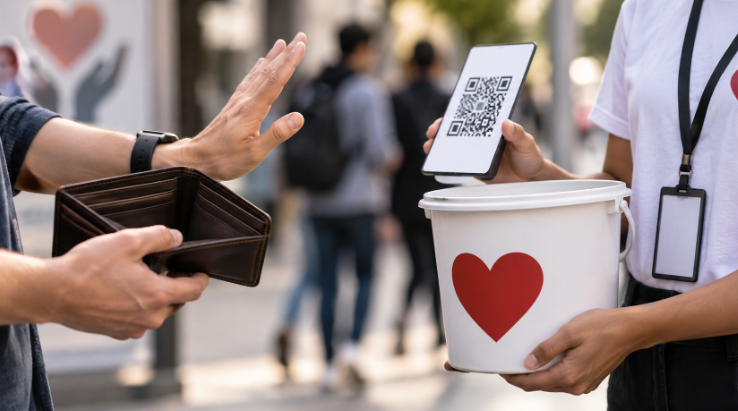
A volunteer stood outside a supermarket for six hours with a bucket and collected eleven pounds forty.
Not because people were unwilling. Roughly a hundred people apologised on their way past, and most of them meant it. They simply did not have any coins, because almost nobody carries coins anymore, and the gap between wanting to give and being able to give had become a physical one.
That is a solved problem now, and a lot of small charities have not yet solved it.
The bucket, upgraded
Print a code on a weatherproof card, cable-tie it to the bucket, add one line saying “or give by phone”.
That is the entire intervention. The same volunteer, the same six hours, the same conversations, except now the hundred people who apologised have a path to actually giving. Small charities that have done this report multiples of their previous cash take, not percentages.
The code needs to point at a donation page that works properly on a phone. This is where it goes wrong more often than the code itself. A donation form asking for a title, full postal address, and gift aid declaration before it will accept two pounds is a form that most people abandon on a pavement in the cold.
Amount, card, done. Ask for the rest afterwards, on the thank-you page, where the person has already given and is feeling good about it.
Where else to put them
Posters and window displays. Community boards, shop windows, church noticeboards. A poster that asks for support and provides no way to act on it is doing half a job, and adding a code costs nothing at print time.
Event signage. At a fundraiser, put codes on table cards, on the bar, and on the way out. The moment after somebody has enjoyed themselves is the highest-conversion moment you will get all year, and it is usually wasted because the only donation route is a bucket by a door.
Collection tins in shops. The tin sits there for months collecting almost nothing. A code on the tin extends it to everyone who does not carry change, which is now nearly everyone.
Newsletters and annual reports. Printed reports go out to your most engaged supporters and typically end with a paragraph about how to give. Put a code beside it.
Volunteer sign-up. Not everything is money. A code linking to a volunteer form on a poster or a stall converts far better than an email address people have to memorise and act on later.
Sponsored events. Runners with a code pinned to their shirt collect from spectators who have no other way to sponsor them mid-race.
Charity shop counters. Round-up donations at the till, or a code by the door for people who browsed and did not buy.
Setting it up without a budget
Almost all payment providers and donation platforms give you a hosted page with its own web address. Whichever you already use, find that address.
Then QR code generator for business tools will turn it into a printable image in about a minute, free, with no account. Download at the highest resolution offered, and keep the original file somewhere the whole team can reach it, because you will need it again for the next poster and somebody will otherwise regenerate it slightly differently.
One code, used consistently, everywhere. Do not let three different volunteers make three different codes pointing at three different pages, because you then cannot tell what worked.
If you want to know which placements perform, add a simple source tag to the donation page address before generating each code. One for buckets, one for posters, one for events. Your platform’s reporting will then tell you where the money actually came from, and you can stop doing the thing that does not work.
Practical details that matter outdoors
Weatherproof it. A printed code on ordinary paper cable-tied to a bucket in November lasts about two hours. Laminate, or print on synthetic stock.
Make it big. Collection points are approached from a distance and scanned quickly, often by someone holding shopping. Ten centimetres square on a bucket card is not excessive.
Suggest amounts on the page. “£3, £5, £10” converts better than an empty box, because an empty box forces a decision and decisions cause hesitation.
Tell people what the money does, in one line, next to the code. “£5 feeds a family for a day” outperforms “please donate” by a wide margin, and it fits on the same card.
Test the whole flow yourself, with a real card, giving a real pound. Volunteers should not discover a broken payment page while standing in a car park.
The trust question
Worth addressing directly, because it is a real barrier now.
People have learned to be wary of codes in public places, and fake charity collections have existed for as long as charity has. Somebody scanning your bucket has a legitimate reason to hesitate.
So make verification easy. Point the code at your own domain rather than an anonymous shortener, so the preview shows your organisation’s name. Put your registered charity number on the card beside the code. Have the volunteer wearing branded clothing. These three together resolve almost all hesitation.
And accept that a small number of people will prefer to give another way. That is fine. You are adding a channel, not replacing one.
Keep the bucket. Add the code.
If you have a fundraising event in the next month, that is the place to start. Generate a code for your donation page, print it on twenty table cards and one large sign by the exit, and compare the evening’s total against last year’s.
The comparison usually settles the argument quickly.
FAQ
Do donors need an app to give through a QR code? No. The code opens your donation page in the phone’s browser, and payment happens there using a card or a digital wallet already on the device.
What should a donation QR code link to? A mobile-friendly page asking only for the amount and payment details. Collect address and gift aid information afterwards, on the confirmation page.
How can donors tell a charity code is genuine? Point the code at your own domain so the preview shows your name, print your registered charity number beside it, and have volunteers in identifiable clothing.
Can we tell which posters or events raised the most? Yes. Add a distinct source tag to the donation page address for each placement before generating each code, then read the breakdown in your platform’s reporting.
How big should a code on a collection bucket be? Around ten centimetres square, laminated or printed on weatherproof stock, so it survives outdoor use and scans quickly from a short distance.