
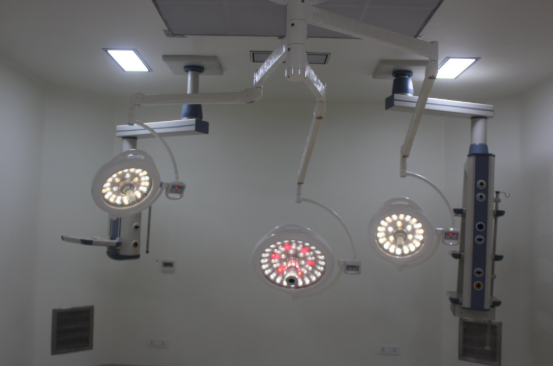
A decade ago, buying an operation theatre light meant choosing between halogen models that heated the surgical field and burned through bulbs every few months. Today the question has changed entirely: not “halogen or LED” but “which LED, at what price, and which specs am I actually paying for?” The LED operation theatre lights price in India runs from under a lakh to well past ten — and unless you know what sits behind that spread, you’re negotiating blind.
Why LED Took Over (and What It Did to Prices)
LED won the operating room for practical reasons: 50–70% lower power draw, almost no radiant heat on the incision site, a source life of 40,000–60,000 hours versus roughly 1,000 for halogen, and stable colour output through a long surgery. The interesting part is what happened to pricing — as Indian manufacturers scaled up, a good domestic OT LED light price dropped to a fraction of imported equivalents, without the specification gap that existed ten years ago.
The 7 Factors Behind Every Quote
1. Lux intensity
The single biggest cost driver. Entry units deliver 60,000–80,000 lux — adequate for general procedures. Cardiac, neuro and deep-cavity work needs 130,000–160,000 lux, and that jump can double the price.
2. Dome configuration
A single dome suits smaller OTs; a double dome (one main, one satellite) eliminates the shadows a single source can’t, and typically costs 60–100% more than the equivalent single unit.
3. Shadowless design quality
All modern OT lights claim to be shadowless; the engineering varies enormously. Multi-LED arrays with precision reflectors and adjustable focus genuinely dilute shadows cast by the surgical team — and that optical engineering is a real cost, not a marketing line.
4. LED chip source
Units built on premium imported chips — CREE (USA) being the benchmark — cost more than generic-LED equivalents but degrade far slower. On a light you’ll run daily for ten years, the chip decides whether year seven looks like year one.
5. Colour performance (CRI and CCT)
A CRI of 95+ renders tissue colour faithfully; adjustable colour temperature lets surgeons tune the field for different procedures and reduce eye fatigue. Both features sit in the mid-to-premium price band.
6. Battery backup
In much of India this isn’t optional — a power cut mid-surgery is a genuine risk. Integrated backup adds roughly ₹30,000–₹80,000 depending on capacity.
7. Camera and smart controls
An in-dome HD camera for teaching or recording, plus wireless remote control, pushes a system into the premium tier — typically ₹4 lakh upward.
OT LED Light Price: Quick Reference
| Configuration | Indicative Price (Indian brands, 2026) |
| Mobile LED OT light | ₹40,000 – ₹1.5 lakh |
| Single dome ceiling LED | ₹70,000 – ₹2.5 lakh |
| Double dome ceiling LED | ₹1.5 lakh – ₹5 lakh |
| Double dome with camera & battery backup | ₹4 lakh – ₹12 lakh+ |
Indicative installed prices; final quotes depend on lux, features and site conditions.
The Cost Nobody Quotes: Running Expenses
Two lights with the same sticker price can differ by lakhs over their life. A quality LED system draws a fraction of the power of older halogen setups, needs no bulb changes, and keeps the OT’s air-conditioning load lower because it throws almost no heat into the room. Factor a decade of electricity, consumables and downtime into your comparison and the mid-priced unit from a manufacturer with a real service network almost always beats the cheapest quote on the table. Ask every vendor for the light’s rated LED life in hours and the cost of a replacement dome — the answers reveal more than the brochure does.
Getting Value, Not Just a Low Price
Two questions filter out 90% of bad purchases. First: is the light CDSCO-registered, and will the manufacturer service it in your city for the next decade? Second: can you see the exact model running in a hospital near you before you pay? Established Indian manufacturers say yes to both. Ventek, for instance, has put over 30,000 installations into hospitals through 1,150+ distributors, and its shadowless LED OT light range — from compact mobile units to camera-equipped Solitaire double domes — covers every price band in the table above with CREE-based optics and battery backup options.
The honest summary: a dependable LED OT light for routine surgery costs ₹1–2.5 lakh installed; serious multi-speciality work justifies ₹3–5 lakh; and everything above that buys imaging, redundancy and comfort rather than raw brightness. Fix your surgical requirement first, and the right price finds itself.