
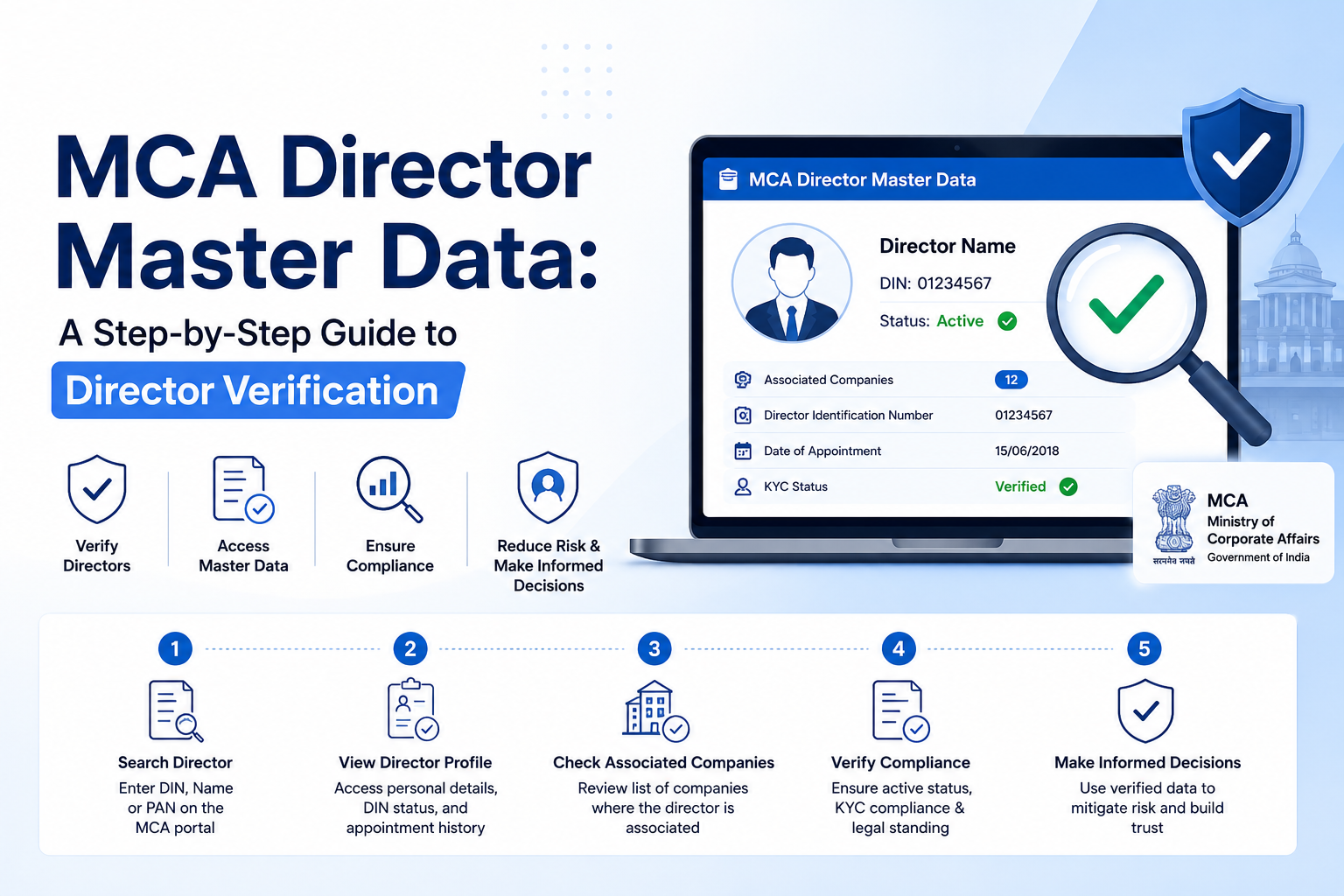
In today’s competitive business world, timely access to accurate company information is crucial to making informed financial and commercial decisions. Whether a business is evaluating a new customer, verifying a supplier, conducting due diligence for a new client/customer, assessing a borrower, or monitoring an existing business relationship, having reliable company data can reduce the risk associated with the business transaction.
The MCA Master Data & Company Search Portaal is a simple way to access Public Corporate Data registered with the Ministry of Corporate Affairs (MCA) in India. To obtain company information, a business only needs to do a company search using either the company name or Corporate Identification Number (CIN). From that search, a business will be able to retrieve information on the company’s legal identity, the status registration of the company, the company directors, the company’s capital structure, and other various corporate records.
What Is MCA Master Data?
MCA Master Data refers to key corporate information maintained in the Ministry of Corporate Affairs database. The MCA maintains records of companies and limited liability partnerships (LLPs) registered under the applicable Indian corporate laws.
The information available through company master data can help users establish the identity and basic status of a registered business.
Depending on the entity and information available in the MCA database, company records may include:
- Company name
- CIN
- Company registration number
- Date of incorporation
- Company status
- Registered office information
- Company category and class
- Authorised and paid-up capital
- Number and details of directors
- Registrar of Companies (ROC)
- Company type
- Previous company names, where applicable
This information can serve as an important starting point for corporate verification and business research.
What Is an MCA Company Search Portal?
An MCA Company Search Portal enables users to locate and review company information without manually navigating through multiple corporate records.
A typical company search may be conducted using:
- Company name
- CIN
- Registration number
- LLP name or LLPIN, where applicable
Once the relevant entity is identified, users can review available company information and use it as part of their broader business verification process.
For businesses dealing with multiple customers, suppliers, vendors, borrowers, distributors, or corporate partners, a structured company search process can make information gathering faster and more consistent.
Why MCA Master Data Matters for Businesses
Corporate information is significant in financial and commercial decision-making. When a potential client wishes to form a significant business relationship, a company needs to conduct due diligence to understand the client, determine the client’s identity, and assess whether the client’s legal business entity exists and is validly formed.
1. Verify Corporate Identity
MCA data can help businesses verify whether a company exists as a registered corporate entity and confirm important identifiers such as its legal name and CIN.
This can reduce the risk of relying solely on information provided by a prospective customer, vendor, or business partner.
2. Support Vendor Due Diligence
Businesses frequently work with numerous suppliers and service providers. Before onboarding a vendor, companies can use MCA information as one component of their due diligence process.
Corporate records can help validate the vendor’s registered identity and basic corporate details before further commercial evaluation.
3. Improve Credit Assessment
Banks, NBFCs, fintech companies, lenders, and other financial institutions may need reliable company information when assessing business borrowers or counterparties.
MCA data can complement financial statements, credit reports, banking information, GST records, and other sources used during credit assessment.
4. Identify Directors and Management
Director information can provide useful context when researching a company. Reviewing the individuals associated with a business can support broader management due diligence and corporate relationship analysis.
However, director information should be considered alongside other reliable sources rather than treated as the sole basis for a business decision.
5. Monitor Existing Business Relationships
Company information is not only useful during onboarding. Businesses can also periodically review corporate records to identify changes in company status, directors, registered office information, or other relevant details.
This can support ongoing counterparty and portfolio monitoring.
MCA Master Data for Due Diligence
Due diligence is particularly important when the financial or operational exposure to a business is significant.
For example, before extending credit to a new corporate customer, a company may review:
- Legal entity details
- Incorporation information
- Company status
- Directors and management
- Registered office
- Capital structure
- Charges and secured lending information, where available
- Filing and compliance-related information
- Financial and credit information from other sources
- Litigation, regulatory, and adverse information, where relevant
MCA Master Data can therefore function as an important first layer of corporate verification.
It should not, however, be treated as a complete due diligence report. A comprehensive assessment generally requires information from multiple sources.
MCA Company Search for Credit and Risk Teams
For credit teams, risk managers, procurement departments, and financial professionals, company research can become a repetitive operational activity.
A structured MCA company search process can help teams establish a consistent workflow:
Search → Identify → Verify → Assess → Monitor
For example, a lender evaluating a business borrower can first verify the entity through MCA records. The lender can then combine corporate information with financial performance, repayment history, credit bureau information, banking data, ownership information, and other risk indicators.
This multi-source approach provides a more comprehensive view of counterparty risk.
MCA Master Data vs. Comprehensive Business Intelligence
MCA Master Data is valuable, but it represents only one part of the overall corporate intelligence process.
| MCA Master Data | Comprehensive Business Intelligence |
|---|---|
| Corporate registration information | Corporate + financial + risk information |
| Company identity | Company identity and business profile |
| Director information | Management and ownership analysis |
| Capital information | Financial performance analysis |
| Company status | Credit and risk assessment |
| Corporate records | Multi-source due diligence |
| Registration verification | Ongoing monitoring |
For basic company verification, MCA data may be sufficient. For lending, investment, supplier onboarding, high-value transactions, or risk management, organizations may require a broader Business Information Report (BIR) or Due Diligence Report.
How to Use an MCA Company Search Effectively
Businesses can make their company research more effective by following a structured approach.
Step 1: Identify the Company
Search using the legal company name or CIN. Avoid relying only on a brand name because the operating brand may differ from the registered legal entity.
Step 2: Verify the CIN
The CIN is an important corporate identifier. Confirm that the company details correspond to the entity being evaluated.
Step 3: Review Company Status
Check whether the company is active or whether its status indicates another condition requiring further investigation.
Step 4: Review Directors
Compare available director information with the information provided by the business during onboarding or due diligence.
Step 5: Review Capital and Corporate Information
Consider authorised and paid-up capital and other available corporate information as part of the overall assessment.
Step 6: Conduct Additional Due Diligence
For high-risk or high-value relationships, supplement MCA information with financial, credit, legal, ownership, GST, banking, and other relevant information.
Who Can Benefit from MCA Company Search?
MCA company search can be useful for a wide range of professionals and organizations, including:
- Banks
- NBFCs
- Fintech companies
- Credit and risk teams
- Procurement departments
- Enterprises
- Investors
- Exporters and importers
- Suppliers and manufacturers
- Insurance companies
- Legal and compliance professionals
- Business consultants
- Debt collection and recovery agencies
For these users, reliable corporate information can support better decision-making and reduce avoidable business risks.
MCA Master Data and Business Risk Management
Reliable info is your best friend when it comes to risk management. Limited data can sometimes make a company seem financially appealing. However, information can sometimes be misleading. Restructuring can lead to changes in management, registered details, etc., which can pose risks to a potential investor. Companies should implement MCA Company Search and avoid one-time corporate verifications.
For companies managing large customer or vendor bases, regularly monitoring can help identify changes that might need more consideration.
Final Thoughts
The MCA Master Data & Company Search Portal helps analyze제공offered by the registerede Indian companies. It aids in corporate identity verification, preliminary due diligence, and credit assessment as well as researching directors and tracking commercial relationships.
The information provided by MCA should not be considered an exhaustive report in confirming business verification or substituting for extensive due diligence.
It is better to analyze and verify MCA Master Data in the context of financial, credit, legal, ownership, GST and other business-related information. It can enhance the organization’s framework in managing credit risk, vendor analysis, and third-party assessment in a more informed manner.
An MCA company search is essential for making informed and strategic business decisions in circumstances such as risk assessment in loans, purchases, and new partnerships.