
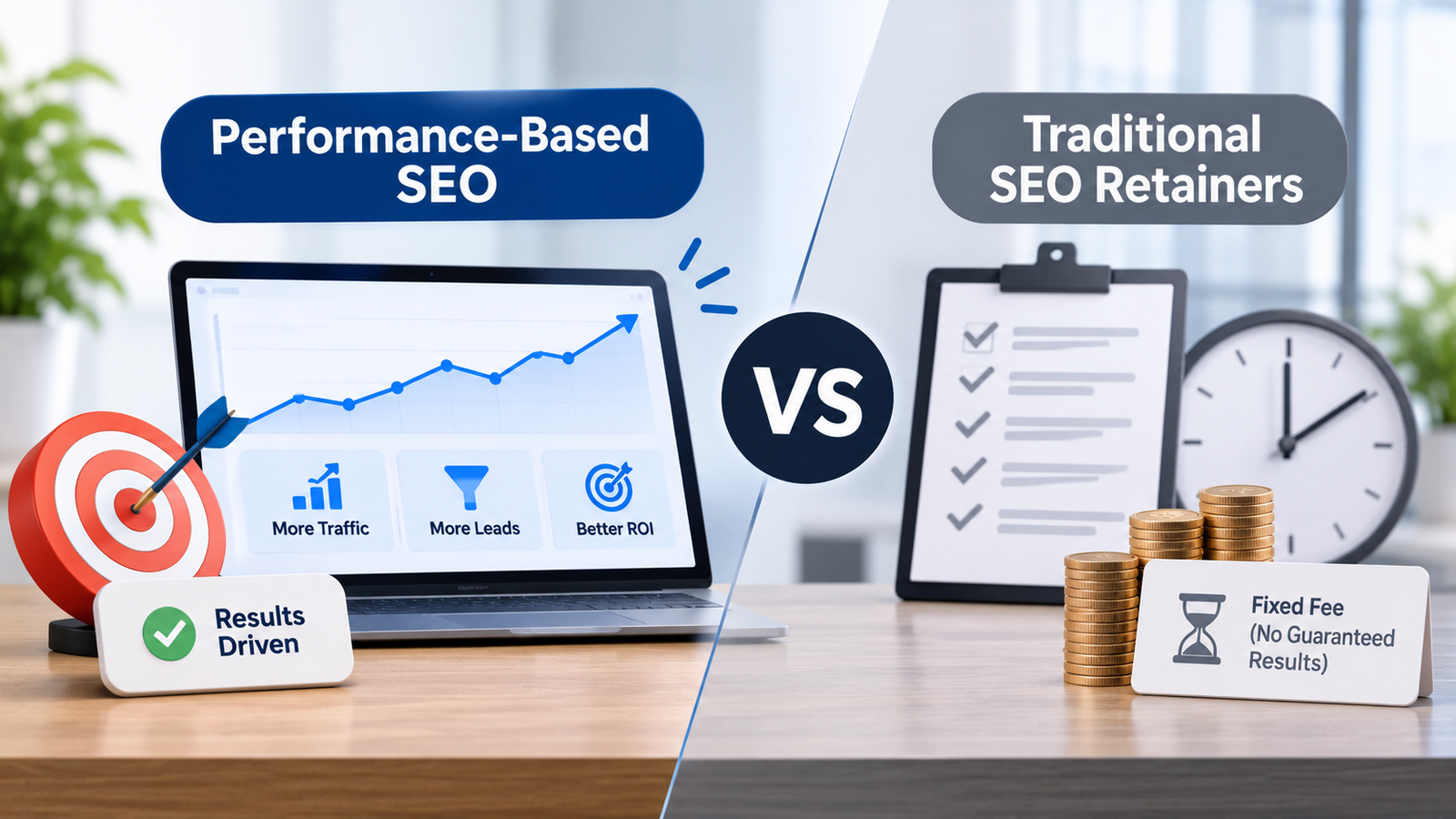
When hiring an SEO agency, businesses usually face two pricing options: pay a fixed monthly retainer for ongoing SEO work or choose a performance-based arrangement where agency fees depend on agreed results.
The difference goes beyond how invoices are calculated. While traditional SEO retainers provide ongoing agency support for a fixed monthly fee, performance-based SEO creates a stronger connection between the agency’s compensation and the results it delivers. This gives businesses an opportunity to align their SEO investment more closely with measurable growth while encouraging agencies to focus on outcomes rather than just completing agreed activities.
But does paying for results actually offer better value? Not necessarily. Both models have advantages and limitations, and the better option depends on the company’s SEO requirements, financial priorities, and ability to measure organic growth.
1. Performance-Based SEO vs Traditional SEO Retainers: A Direct Comparison
| Comparison factor | Traditional SEO retainer | Performance-based SEO |
|---|---|---|
| Payment structure | Fixed monthly fee agreed in advance | Payment depends on predefined performance targets |
| What the business pays for | Agreed SEO activities, expertise, and ongoing support | Specific outcomes defined in the agreement |
| Monthly cost | Generally predictable | Can vary depending on achieved results |
| Agency compensation | Usually independent of short-term ranking or traffic changes | Directly influenced by the agreed performance metrics |
| Campaign flexibility | Scope can accommodate changing SEO priorities, subject to the contract | Work may be more closely tied to the metrics determining payment |
| Financial risk | Business pays the agreed fee even when results are delayed | Agency may carry some financial risk if targets are not achieved |
| Measurement | Usually evaluates deliverables alongside campaign performance | Requires clearly defined metrics and payment conditions |
| Best suited for | Ongoing SEO requirements and complex campaigns | Campaigns with measurable baselines and clearly defined targets |
The main distinction is what the agency is being paid to deliver. A retainer compensates the agency for an agreed scope of work, whereas performance-based pricing makes compensation dependent on specified results.
That difference affects budgeting, agency incentives, and how both parties approach the campaign.
2. How Do the Two Models Compare in Terms of Cost and ROI?
Traditional SEO retainers offer better cost predictability. A company agrees to pay a fixed monthly amount, making it easier to allocate an SEO budget. However, the business must evaluate whether the agency’s work justifies that expense. Completing monthly deliverables does not automatically mean the campaign is generating a return.
Performance-based SEO offers variable costs. The business pays according to the agreed results, which can make the arrangement attractive when management wants a closer connection between agency compensation and outcomes. However, successful campaigns may also become more expensive as performance-based fees increase.
For example, consider a business paying an agency $5,000 per month under a traditional retainer. It spends $60,000 over a year, regardless of short-term ranking fluctuations.
Under a performance-based agreement, the business might pay according to qualified leads generated through organic search. Its total agency fees would depend on the agreed payment per lead and the number of qualifying leads delivered.
Neither arrangement automatically produces a better ROI. The business must compare the total SEO investment against the commercial value generated, including any additional content, development, and outreach expenses.
3. Which Model Offers Better Agency Accountability?
This is where performance-based SEO has a clear structural advantage, provided the agreement uses meaningful performance metrics.
Under a traditional retainer, the agency is accountable for delivering the agreed services. The client needs to assess whether those activities are producing progress. An agency could complete keyword research, publish content, and submit monthly reports while the website continues to struggle with organic visibility.
With performance-based pricing, compensation is connected to predefined targets. This gives the agency a financial incentive to achieve the agreed outcomes.
However, accountability depends on what the contract rewards.
If payment is based only on keyword rankings, the agency may prioritize keywords that are easier to rank rather than those likely to generate business. If payment is based on total organic traffic, an increase in low-intent visits could satisfy the target without improving lead generation.
For this reason, qualified leads, conversions, or attributable revenue can provide more commercially meaningful measurements than rankings alone, depending on the business model and tracking capabilities.
4. Where Does Each Model Work Better?
The suitability of each model becomes clearer when considering the actual SEO requirements.
| Business requirement | More suitable model | Reason |
|---|---|---|
| New website with little organic visibility | Traditional retainer | Requires foundational SEO work before meaningful performance can be measured |
| Enterprise website with complex technical issues | Traditional retainer | Needs ongoing technical coordination and changing priorities |
| Established business with reliable conversion tracking | Performance-based or hybrid | Existing data provides a stronger basis for defining targets |
| Ecommerce website focused on organic revenue growth | Performance-based or hybrid | Revenue and conversion improvements can be incorporated into the agreement |
| Website migration or major restructuring | Traditional retainer | Requires substantial planning and implementation work that may not produce immediate results |
| Business seeking predictable monthly expenditure | Traditional retainer | Fixed fees make budget planning easier |
For instance, an established ecommerce store with consistent organic sales data may be able to agree on performance targets linked to qualified organic revenue. A newly launched website, however, may need several months of technical improvements, content development, and authority building before reliable performance targets can be established.
In the first case, performance-linked compensation may be practical. In the second, a traditional retainer may provide a more suitable arrangement.
5. What About a Hybrid SEO Pricing Model?
Businesses do not necessarily have to choose one model exclusively. A hybrid arrangement combines a fixed monthly fee with additional compensation for achieving agreed performance targets.
For example, an agency might charge a base monthly fee to cover technical SEO, content planning, and ongoing optimization. An additional performance fee could apply when the campaign achieves agreed improvements in qualified organic leads or revenue.
This arrangement addresses one limitation of each model:
- The agency receives a base payment for the work and resources required to run the campaign.
- The business has a more predictable starting cost than under a fully variable pricing arrangement.
- Additional compensation gives the agency an incentive to meet commercial targets.
- Foundational SEO activities do not have to be ignored simply because they do not generate immediate results.
The hybrid model can be particularly useful when a campaign requires substantial ongoing work but the business also wants part of the agency’s compensation tied to measurable growth.
6. So, Which SEO Pricing Model Should You Choose?
The decision comes down to what the business needs from its SEO agency.
Choose a traditional SEO retainer when the website requires continuous optimization, technical improvements, content development, or support across multiple SEO activities. It is also a practical option when the business needs predictable monthly spending and does not yet have a reliable performance baseline.
Choose performance-based SEO when the website has established organic visibility, dependable analytics, and measurable business targets. The agreement should clearly define what counts as a result, how it is attributed, and how the agency’s payment is calculated.
Consider a hybrid model when the campaign requires ongoing foundational work alongside measurable growth targets. It can balance the need for consistent SEO execution with an outcome-linked payment structure.
Agencies such as ResultFirst offer a pay-for-performance SEO approach for businesses considering an alternative to conventional retainers. As with any agency, the actual agreement, measurement criteria, and scope of work should determine whether the model is commercially suitable.
Conclusion
Performance-based SEO is not automatically a better investment than a traditional SEO retainer. It changes how an agency gets paid, but the value of the engagement still depends on the quality of its work and the business results it produces.
Traditional retainers make more sense when a company needs consistent SEO execution and strategic support. Performance-based agreements can be a stronger option when outcomes are measurable and both parties agree on meaningful targets. A hybrid model offers a middle ground.
Ultimately, businesses should compare the total cost, scope of work, agency responsibilities, and expected commercial outcomes before choosing. The best arrangement is the one that makes the agency’s compensation fair while keeping the business focused on actual growth rather than activity reports or ranking numbers alone.