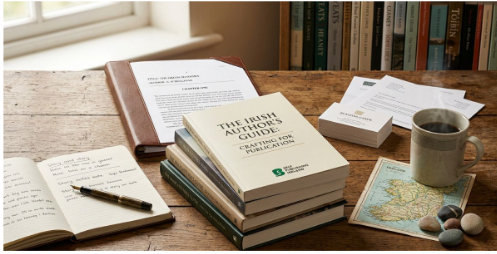
Breaking into the literary world requires more than just a captivating story—it demands a manuscript refined to industry standards. Whether you are aiming for a traditional publishing deal or preparing to independently release your book through book publishing in Ireland, understanding what local publishers and readers expect is vital.
The Irish literary landscape is vibrant, steeped in rich storytelling traditions, yet highly competitive. From understanding manuscript formatting rules to tailoring content for regional genres like children’s literature, mastering the nuances of the Irish market will give your manuscript a significant advantage. In this guide, you will learn ten proven secrets to elevating your manuscript, avoiding common rejection triggers, and preparing your work for professional publication and printing.
1. Master the Standard Irish Manuscript Format
Before an editor reads your first sentence, they evaluate your presentation. Irish traditional publishers and independent self-publishing platforms require clean, standardized formatting.
- Font & Spacing: Use 12-point Times New Roman or Arial, double-spaced, with 1-inch margins on standard A4 layout.
- Page Numbering: Include consecutive page numbers and a header with your working title and surname.
- Dialogue Punctuation: In Ireland and the UK, single quotation marks (‘…’) are standard for dialogue, with double quotation marks reserved for quotes within quotes.
Adhering strictly to standard presentation instantly signals to literary agents and publishing teams that you respect industry protocols.
2. Refine Your Voice for the Irish Literary Market
Irish readers and publishers appreciate distinct storytelling voices, strong narrative prose, and authentic local cadence.
- Authentic Idiom over Caricature: If your narrative involves Irish characters, capture modern phrasing naturally without relying on exaggerated or outdated stereotypes.
- Universal Themes with Local Flavor: Whether set in rural Galway or modern Dublin, ensure the emotional core resonates internationally while maintaining authentic local detail.
3. Edit Ruthlessly with a Professional Eye
Self-editing is essential, but professional editorial support is critical before submitting to traditional houses or sending files to book printing in Ireland.
Key Editorial Phases
- Developmental Editing: Focuses on plot structure, pacing, character arcs, and thematic consistency.
- Line Editing: Refines sentence structure, flow, tone, and stylistic clarity.
- Copyediting & Proofreading: Eliminates grammatical errors, typographical mistakes, and punctuation inconsistencies.
Skipping professional editing often leads to immediate rejection from traditional publishers or costly errors in self-published print runs.
4. Understand Guidelines for Children’s Book Publishers in Ireland
Writing for children is one of the most competitive segments within Irish publishing. Children’s book publishers in Ireland maintain strict standards regarding word counts, age-appropriateness, and formatting.
- Picture Books (Ages 3–6): Typically 500 to 800 words. Keep language evocative and visual for potential illustrators.
- Middle Grade (Ages 8–12): Usually 30,000 to 50,000 words. Focus on strong narrative drive, relatable young protagonists, and clear themes.
- Young Adult (YA): Generally 50,000 to 80,000 words. Focus on authentic youth perspectives and complex emotional themes.
5. Tailor Your Query Letter and Synopsis
Your query letter is your book’s executive summary. Publishers evaluate your pitch just as critically as your sample chapters.
Elements of a Strong Query
- The Hook: A brief, compelling sentence summarizing your plot or central conflict.
- The Pitch: A two-to-three paragraph summary of the main characters, stakes, and narrative arc.
- Metadata: Word count, primary genre, target demographic, and comparative titles.
- Author Bio: Relevant writing credentials, awards, publications, or background context.
6. Align Content for Print Preparation
If you choose independent book publishing in Ireland, preparing your manuscript for physical production requires specific layout considerations.
- Trim Size Selection: Choose standard Irish and European sizes, such as B-format paperback ($198 \times 129\text{ mm}$) or Demy ($216 \times 138\text{ mm}$).
- Bleed and Margins: Ensure images extend to the bleed boundary ($3\text{ mm}$ minimum beyond trim) and adjust inner gutter margins to accommodate binding thickness.
- High-Resolution Graphics: All cover art and internal illustrations must be set to 300 DPI in CMYK color mode.
7. Research Publisher Catalogs Thoroughly
Submitting a thriller to a press specializing exclusively in poetry or local history guarantees a rejection. Research local imprints and publishers before sending your work.
- Read recent titles published by your target publisher to understand their editorial taste.
- Review submission windows carefully; many Irish independent presses only accept unsolicited manuscripts during specific months.
- Verify whether the publisher accepts direct submissions or requires representation by a literary agent.
8. Balance Showing and Telling
A frequent issue cited by editorial readers is narrative exposition replacing active storytelling.
Weak (Telling):
Ciarán was extremely nervous about the meeting with the editor.
Strong (Showing):
Ciarán adjusted his collar three times in the lobby, his fingers leaving damp smudges on the manuscript envelope.
Utilize sensory details, active verbs, and realistic dialogue to immerse readers into the scene directly.
9. Ensure Legal and Copyright Compliance
Before printing or submitting, verify that your manuscript respects intellectual property and libel standards.
- Permissions: Secure explicit written permission for quoted song lyrics, poetry excerpts, or extended excerpts from copyrighted works.
- Libel Concerns: Ensure non-fiction works are factual and legally defensible, and fictional works do not inadvertently defame real individuals or businesses.
- Public Domain: Verify copyright terms; in Ireland, public domain status typically applies 70 years after the author’s death.
10. Consider Self-Publishing and Hybrid Publishing Options
Traditional publishing is not the sole route to success. Independent book publishing in Ireland gives authors complete creative control, faster time-to-market, and higher royalty rates.
| Feature | Traditional Publishing | Self-Publishing (Self Publishing Ireland) |
| Rights Control | Publisher acquires rights | Author retains 100% rights |
| Time to Market | 12 to 24 months | 1 to 3 months |
| Royalty Rates | 8% – 15% net | Up to 100% after production costs |
| Distribution | Bookshop network focus | Direct sales, local shops & global online distribution |
| Upfront Cost | None | Author covers editing, layout & printing |
Frequently Asked Questions
Do I need a literary agent to publish a book in Ireland?
No, many Irish independent publishers accept direct, unsolicited manuscript submissions without an agent. However, larger international houses operating in the UK and Ireland may require representation.
What is the average word count for a novel in Ireland?
For adult commercial or literary fiction, standard word count ranges between 70,000 and 95,000 words. Sci-fi and fantasy manuscripts may extend to 100,000 words, whereas non-fiction typically runs between 60,000 and 80,000 words.
How much does professional book printing cost in Ireland?
Printing costs depend on print run size, page count, binding type (paperback vs. hardback), and color requirements. Short-run digital printing provides cost-effective options for self-published authors starting with small initial batches.
Can international authors submit to Irish publishers?
Yes, most Irish publishers accept submissions from international writers, provided the manuscript meets their editorial focus, quality standards, and submission guidelines.
How do I protect my copyright when publishing in Ireland?
In Ireland, copyright is automatic upon creation of the original work in a tangible form. Including a standard copyright page (© 2026 Self Publishing Ireland All rights reserved.) in your manuscript confirms your ownership.
Conclusion
Perfecting your manuscript for Irish publishers requires a strategic blend of strong storytelling, rigorous editing, professional formatting, and target market awareness. By mastering standard manuscript preparation, researching publisher catalogs, and understanding the requirements of book publishing in Ireland, you significantly increase your chances of publication.
If you decide to take control of your publishing journey, partner with experienced professionals to bring your manuscript to print. Contact Self Publishing Ireland today for expert editorial guidance, custom book design, and high-quality local book printing.