
In today’s competitive market, customers want products that are safe, reliable, and of consistent quality. For businesses selling products in India, following the applicable Indian Standards can also be a legal requirement.
The Bureau of Indian Standards (BIS) is India’s national standards body. BIS certification helps businesses demonstrate that their products meet the relevant Indian Standards. While BIS certification is generally voluntary, the Government of India has made it compulsory for many products through Quality Control Orders (QCOs).
For Indian manufacturers, importers, and overseas companies entering the Indian market, BIS certification can provide both regulatory compliance and business benefits.
What Is BIS Certification?
BIS Certification is a conformity assessment system through which eligible products are assessed against applicable Indian Standards.
Depending on the product category, businesses may need to follow different BIS schemes. For example:
- ISI Mark Certification (Scheme-I) applies to many products covered by mandatory certification requirements.
- BIS CRS Registration applies to notified electronic and IT products under the Compulsory Registration Scheme.
- FMCS is relevant to many foreign manufacturers supplying products to India.
- Certain products, such as toys, have specific mandatory certification requirements.
The applicable scheme depends on the product, Indian Standard, manufacturing location, and relevant government notification.
Why Is BIS Certification Important for Businesses?
BIS certification is not simply about displaying a mark on a product. It can help businesses demonstrate product quality, meet regulatory requirements, enter the Indian market, and build customer confidence.
Here are the major benefits.
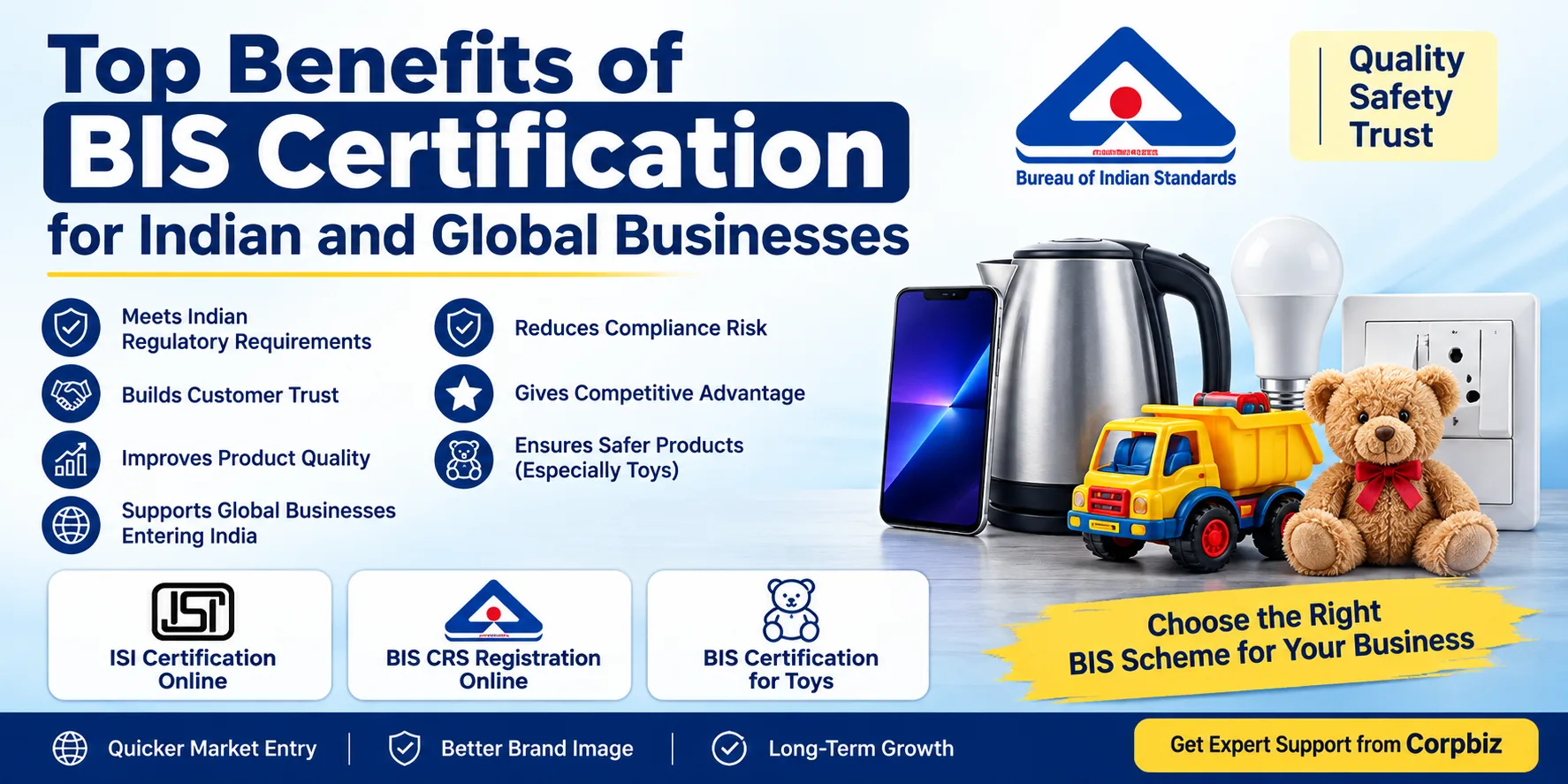
1. Helps Meet Indian Regulatory Requirements
One of the biggest benefits of BIS certification is regulatory compliance.
The Government of India makes BIS certification compulsory for certain products through Quality Control Orders. Businesses dealing in products covered by such orders generally need to obtain the required BIS licence or registration before manufacturing, importing, selling, or distributing them in India.
Therefore, businesses should first check whether their product falls under a mandatory BIS requirement.
2. Builds Customer Trust
Customers are more likely to trust products that follow recognised quality and safety standards.
A valid BIS certification can show customers that the product has been assessed against the applicable Indian Standard. This is especially important for products where safety and reliability directly affect consumers.
For businesses, this can strengthen:
- Brand credibility
- Customer confidence
- Product reputation
- Market acceptance
3. Improves Product Quality
The BIS framework encourages manufacturers to maintain consistent product quality.
Depending on the certification scheme and product, the process may involve product testing, documentation, manufacturing controls, and other compliance requirements.
This encourages businesses to identify quality problems early and improve their manufacturing processes.
4. Makes Market Entry Easier
For businesses planning to enter the Indian market, BIS compliance can be an important part of the market-entry strategy.
Foreign manufacturers should not assume that an internationally recognised certification automatically replaces BIS requirements. If a product is covered by a mandatory Indian requirement, the applicable BIS process must be followed.
This is particularly important for companies exporting products to India.
5. Supports Global Businesses Entering India
BIS certification is not limited to Indian manufacturers.
Foreign manufacturers supplying certain products to India may also need BIS certification under the applicable scheme. BIS has a Foreign Manufacturers Certification Scheme (FMCS), while specific product categories may have different registration or certification routes.
This gives global businesses a structured way to demonstrate compliance with Indian product standards.
6. Reduces Compliance Risk
Selling a product without the required certification can expose a business to regulatory action, product restrictions, financial losses, and reputational damage.
Obtaining the correct certification before entering the market helps businesses reduce these risks.
Companies should also keep their licence or registration active and comply with applicable conditions after certification.
7. Gives Businesses a Competitive Advantage
In crowded markets, certification can help differentiate a product from competitors.
A business that follows recognised safety and quality standards can use compliance as part of its value proposition, particularly when selling to:
- Large distributors
- Institutional buyers
- Retailers
- E-commerce platforms
- Corporate customers
For some product categories, BIS compliance may also be a basic requirement for market participation.
8. Supports Safer Products
Product safety is one of the key reasons why the Government makes BIS certification mandatory for selected products.
BIS requirements can cover areas such as:
- Product performance
- Mechanical safety
- Electrical safety
- Chemical safety
- Material quality
- Testing requirements
- Manufacturing controls
The exact requirements depend on the applicable Indian Standard.
9. Helps Businesses Maintain Consistency
Customers expect the same level of quality every time they purchase a product.
BIS compliance encourages manufacturers to maintain defined production and quality-control practices. This can help reduce variations between batches and improve overall product consistency.
Consistent quality can lead to fewer complaints, better customer experience, and stronger brand loyalty.
10. Supports E-Commerce and Modern Retail
Online marketplaces and organised retailers increasingly focus on product compliance, safety, and documentation.
For businesses selling regulated products online, having the appropriate certification can help demonstrate that the product meets applicable Indian requirements.
This is particularly relevant for products such as electronics, electrical goods, toys, and other regulated categories.
11. BIS Certification for Toys Helps Protect Children
BIS Certification for Toys is a particularly important example of mandatory product certification.
Under the Toys (Quality Control) Order, safety of toys was brought under compulsory BIS certification from January 1, 2021. Toys are required to conform to applicable Indian Standards and carry the Standard Mark under a BIS licence, subject to the applicable requirements and exemptions.
BIS lists standards for both non-electric and electric toys. Non-electric toys are covered under the IS 9873 series, while electric toys are covered under IS 15644.
For toy manufacturers and businesses, compliance can help:
- Improve toy safety
- Reduce safety-related risks
- Build parent and customer confidence
- Meet mandatory Indian requirements
- Support legal sale of compliant products in India
BIS Certification vs BIS CRS Registration
Businesses often confuse BIS certification with BIS CRS registration. They are not the same.
BIS Certification / ISI Mark
The ISI Mark Scheme (Scheme-I) covers various products for which the Government has prescribed mandatory BIS certification.
Businesses may need to undergo applicable testing and certification requirements before using the Standard Mark.
BIS CRS Registration
The Compulsory Registration Scheme (CRS) applies to notified products, particularly certain electronic and IT goods.
Under CRS, manufacturers need to follow the applicable product-specific requirements and registration process.
Therefore, BIS CRS Registration Online and ISI Certification Online should not be treated as interchangeable services. The correct route depends on the product and applicable government notification.
What Is BIS Certification Online?
Businesses can initiate many BIS-related applications through online systems, depending on the applicable certification scheme.
However, BIS Certification Online does not mean that every step can be completed without physical testing or other compliance activities.
Depending on the product, the process may involve:
- Identifying the applicable Indian Standard
- Checking whether certification is mandatory
- Preparing documents
- Product testing at an appropriate laboratory
- Submitting the application
- Factory-related assessment, where applicable
- Addressing observations or deficiencies
- Obtaining the BIS licence or registration
- Maintaining ongoing compliance
The exact process varies by scheme and product.
Key Benefits for Indian Businesses
For Indian manufacturers, BIS certification can help with:
- Legal compliance
- Better product quality
- Stronger brand image
- Customer trust
- Wider market access
- Reduced regulatory risk
- Better relationships with distributors and retailers
It can also encourage businesses to introduce stronger internal quality-control systems.
Key Benefits for Global Businesses
For overseas manufacturers and brands, BIS compliance can help them enter and operate in the Indian market more smoothly.
Major benefits include:
- Demonstrating compliance with Indian Standards
- Supporting imports into India
- Building trust among Indian customers
- Improving acceptance by distributors
- Reducing compliance-related delays
- Supporting long-term market expansion
However, foreign businesses should identify the correct BIS scheme before applying because requirements can differ based on the product category.
How to Choose the Right BIS Scheme?
Before applying, businesses should answer these questions:
- What is the exact product?
Identify the product and its technical specifications. - Is the product covered by a QCO?
Check the latest mandatory certification requirements. - Which Indian Standard applies?
Different products can have different standards. - Which BIS scheme applies?
It could be ISI Mark Scheme, CRS, FMCS, or another applicable conformity assessment route. - Where is the product manufactured?
Requirements can differ for Indian and foreign manufacturers. - Does the product require laboratory testing?
Check the testing requirements applicable to the product.
These checks can prevent businesses from applying under the wrong scheme and facing unnecessary delays.
Why Choose Corpbiz for BIS Certification?
Corpbiz provides compliance support to businesses looking to obtain the appropriate BIS certification or registration.
Our support can include:
- Product and standard identification
- Documentation assistance
- Application preparation
- Testing coordination
- BIS application support
- Query and observation assistance
- Certification and compliance guidance
Whether you need BIS Certification Online, BIS CRS Registration Online, ISI Certification Online, or BIS Certification for Toys, the first step is to identify the correct certification route for your product.
Conclusion
BIS certification can offer much more than regulatory compliance. It can help businesses improve product quality, build customer trust, reduce compliance risks, and enter the Indian market with greater confidence.
For Indian manufacturers, certification can strengthen product credibility and market acceptance. For global manufacturers, it can provide an important pathway for complying with Indian product requirements.
However, BIS requirements vary significantly by product. Before applying, businesses should check the latest applicable QCO, Indian Standard, and BIS certification scheme.
Need help with BIS certification or registration? Contact Corpbiz for expert guidance on the applicable BIS compliance process.
Frequently Asked Questions
1. Is BIS certification mandatory for every product?
No. BIS certification is generally voluntary, but the Government of India has made it mandatory for specific products through Quality Control Orders and other regulatory requirements.
- What is BIS CRS Registration Online?
BIS CRS Registration is the registration route applicable to products notified under the Compulsory Registration Scheme. It is different from the ISI Mark certification scheme.
3. What is ISI Certification Online?
ISI Certification refers to BIS certification under the applicable ISI Mark Scheme, where manufacturers obtain a BIS licence to use the Standard Mark for products covered by the relevant requirements.
4. Is BIS Certification for Toys mandatory?
Yes, toys covered by the Toys (Quality Control) Order are subject to compulsory BIS certification requirements. The applicable standards include the IS 9873 series for non-electric toys and IS 15644 for electric toys.
5. Can foreign manufacturers obtain BIS certification?
Yes. BIS has certification mechanisms for eligible foreign manufacturers, including the Foreign Manufacturers Certification Scheme (FMCS). The applicable route depends on the product category.
6. Can BIS certification be obtained completely online?
The application process for several BIS schemes uses online systems, but the overall compliance process may also require product testing, documentation, inspection, or other activities depending on the product and scheme.
7. Does BIS certification improve customer trust?
Yes. BIS certification can demonstrate that a product complies with applicable Indian Standards, which can help improve consumer confidence and brand credibility.
8. How long is BIS certification valid?
The validity and renewal requirements depend on the applicable BIS scheme and licence/registration conditions. Businesses should check the specific requirements applicable to their product.
9. What happens if a business sells a product that requires BIS certification without it?
Businesses can face regulatory action and other consequences for non-compliance. The exact consequences depend on the applicable law, QCO, product category, and nature of the violation.
10. How can Corpbiz help with BIS certification?
Corpbiz can assist businesses with product identification, documentation, testing coordination, application support, and other steps involved in the applicable BIS certification or registration process.
About the Author
Atul Shukla
Legal Compliance Content Professional
Atul Shukla writes about Indian business laws, regulatory approvals, registrations, and compliance requirements. His work focuses on explaining complex regulatory topics in simple and practical language so that business owners, manufacturers, startups, and professionals can make better compliance decisions.