
ISO 14001 Lead Auditor Training: Building Practical Environmental Audit Skills
Environmental compliance is no longer a side responsibility handled by facilities teams once a year. Organizations in manufacturing, energy, construction, and services now need clear evidence that their environmental management practices work. This change has increased the need for professionals who can audit environmental management systems with care and objectivity. Effective auditors do more than tick boxes on a checklist. They examine processes, review evidence, and identify gaps that may affect environmental performance.
This is where lead auditor training for ISO 14001 Lead Auditor Training becomes relevant. The training helps professionals move beyond the theory of environmental management systems. It also helps them assess how those systems work in real workplaces. Participants learn how to approach audits with structure, discipline, and objectivity.
Who This Training Is Actually For
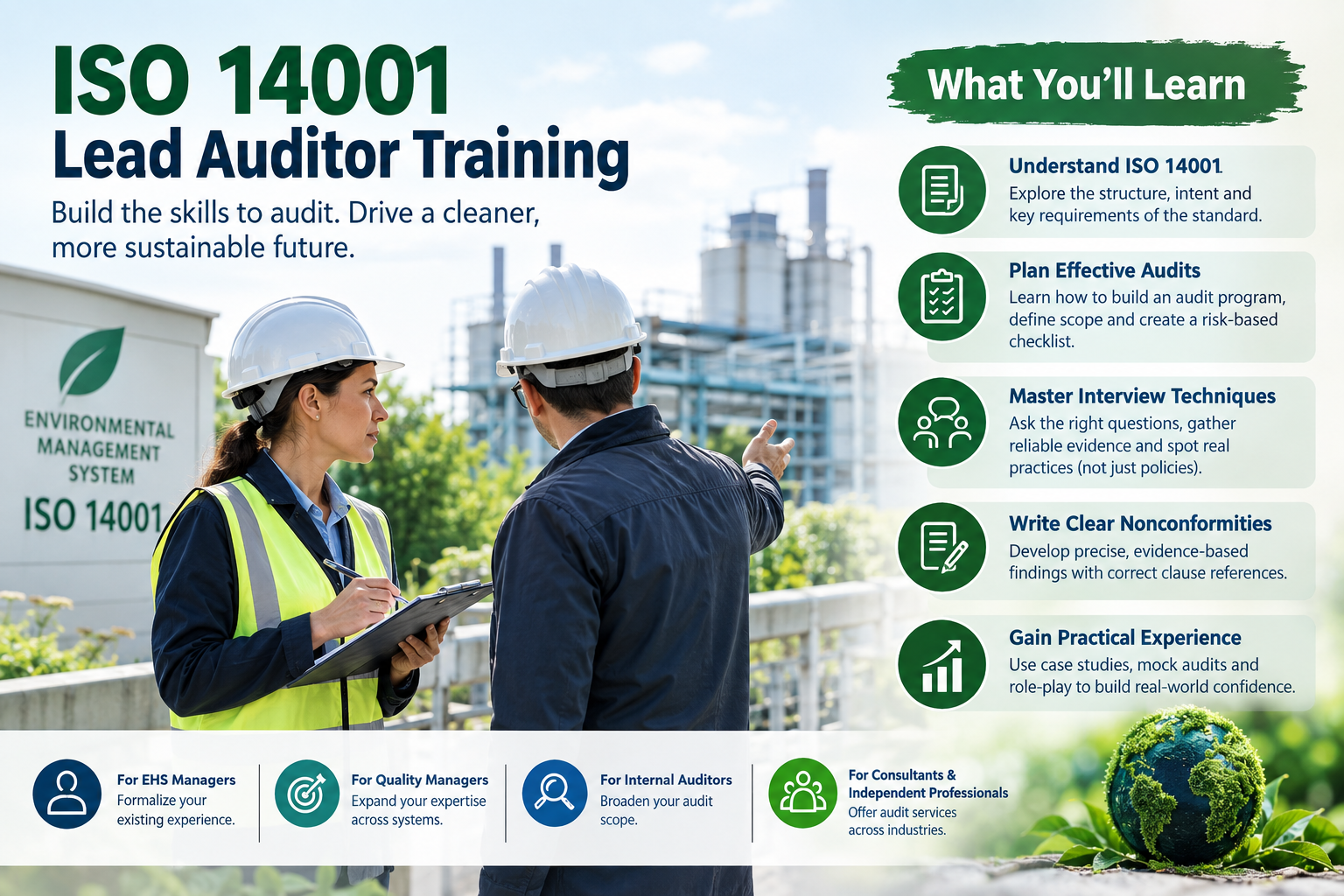
Several professional groups can benefit from this training. Environmental, health, and safety managers often take the course to strengthen the audit skills they already use in their daily roles. Quality managers may also pursue the training when they take responsibility for environmental management systems alongside quality systems.
Internal auditors can use the training to expand their audit responsibilities. Many already review other management systems and may need to add environmental audits to their scope. Independent professionals and consultants can also gain useful skills when they plan to provide audit services to different organizations.
These professionals share a practical need. They must understand how an organization interacts with the environment. They must also assess whether its management system controls environmental risks effectively.
Why the Skill Gap Matters
Reading the ISO 14001 standard is relatively straightforward. Applying its requirements during a live audit can prove more challenging. The standard uses general requirements because it applies to many industries. Food processing and semiconductor manufacturing, for example, face very different environmental conditions.
Auditors must connect those general requirements with the activities of each organization. Strong auditing skills help them make that connection. They also help auditors ask relevant questions, collect useful evidence, and assess whether processes meet requirements.
The Cost of Getting Audits Wrong
A weak audit can create a false sense of security. Leadership may believe that environmental risks remain under control when important gaps still exist. An incident, regulatory inspection, or customer complaint may later expose those gaps.
Strong auditor training helps professionals identify weaknesses before they create larger problems. A structured audit can give management a clearer view of environmental performance and system effectiveness.
What the Training Actually Covers
Good lead auditor programs cover the complete audit lifecycle instead of focusing only on individual clauses. Training usually begins with the structure and purpose of ISO 14001 Lead Auditor Training . Participants explore environmental aspects, legal and other requirements, operational controls, and performance evaluation.
The course then moves into audit planning. Participants learn how to create an audit program and define its scope and objectives. They also learn how to prepare checklists that reflect the organization’s actual risks. A practical checklist should support the audit rather than simply repeat the standard’s requirements.
Interviewing and Evidence Gathering
Interviewing plays an important role in environmental auditing. Auditors need to ask open questions that encourage detailed answers. They also need to trace processes from documented procedures to actual workplace activities.
Good interview techniques can reveal gaps that documents alone may not show. Auditors learn to recognize when employees describe actual practices and when they simply repeat written policies. This skill helps auditors gather reliable evidence during site visits.
Nonconformity Writing and Reporting
Finding a gap is only one part of an auditor’s work. The auditor must also document the finding clearly. A strong nonconformity statement should include objective evidence and a clear reference to the relevant requirement.
Training programs often use practical exercises to develop this skill. Participants practice writing findings that explain the problem clearly. Specific findings help organizations understand what needs attention and support appropriate corrective action.
How Classroom Learning Translates to Real Audits
Many training courses use case studies, mock audits, and role-play exercises. These activities recreate situations that auditors may face in real workplaces. Auditing requires practical experience, so participants need opportunities to apply what they learn.
A person may understand every clause of ISO 14001 Lead Auditor Training and still feel uncertain during a live audit. Practice can improve this confidence. Participants can learn how to manage opening meetings, interview employees, respond to difficult situations, and keep an audit on schedule.
Participants may also complete simulated site visits. These exercises can include document reviews, floor walks, and closing meeting preparation. Such activities help develop practical habits that auditors need in the field.
For professionals who want a structured path into this field, ISO 14001 lead auditor training courses can guide candidates through the main stages of an audit. The training can move from standard interpretation to audit planning and practical audit simulation.
This progression matters because auditing skills build over time. A person who does not understand the standard may struggle with audit planning. Someone who can plan an audit but lacks interview practice may struggle to gather useful evidence.
Common Misconceptions About the Role
One common misunderstanding is that auditors mainly look for faults. Auditors also need to understand what works well within a management system. This broader view helps them separate systemic weaknesses from isolated problems.
Another misconception is that environmental knowledge alone makes someone an effective auditor. Knowledge of emissions, waste, water use, and other environmental aspects can help. However, auditors also need a structured method for gathering evidence and evaluating processes.
Auditing Is Not Inspection
Auditing and inspection serve different purposes. An inspector usually checks whether something meets a specific technical requirement at a particular point in time. An auditor examines whether a management system can consistently achieve its intended results.
This difference affects how professionals approach their roles. Auditors need to review processes, evidence, responsibilities, and system performance over time.
Building Long-Term Value from the Training
Professionals can apply their new skills through internal audits. They can review their organization’s environmental management system before an external audit or other formal review. Regular internal audits can help organizations identify issues earlier.
The skills can also support supplier evaluation. Many organizations assess suppliers based on environmental requirements. A trained auditor can review supplier processes and examine whether environmental claims have supporting evidence.
Professionals who want to provide audit services can also apply these skills across different sectors. The environmental risks may vary between industries, but many core auditing methods remain useful.
What to Look for in a Training Program?
Training programs can differ greatly in their approach. One important factor is the amount of practical work included in the course. A program that focuses heavily on theory may give participants knowledge without enough opportunities to apply it.
Assessment methods also deserve attention. Practical exercises can show how well participants apply auditing skills. A course that combines knowledge assessment with practical activities can give participants more opportunities to develop their audit techniques.
Trainer Experience Matters
Trainer experience can also influence the learning experience. Auditing involves many situations that the standard cannot explain in detail. Trainers with field experience can use real examples to show how auditors handle different situations.
Practical examples can help participants understand how audit principles work in less predictable circumstances. They can also help connect classroom concepts with situations that auditors may encounter during actual audits.
Environmental Auditing in a Changing Regulatory Landscape
Environmental expectations continue to change. Regulators, customers, and investors may ask organizations for more information about environmental performance and risk management.
Organizations may need stronger data collection, clearer responsibilities, and better links between environmental management and wider business risks. These changes increase the need for skilled internal auditors who can review systems regularly.
Organizations that develop internal audit skills can review their systems more often. They can also identify weaknesses before an external review or other formal assessment.
How This Training Fits into a Broader Career
Environmental management careers can take different directions. Lead auditor training can support professionals who want to move from operational environmental work toward governance or assurance roles.
Some professionals may also use auditor training when working with teams across an organization. Operations, legal, finance, and environmental teams often need to discuss shared risks. A structured audit approach can help professionals present environmental findings with clear evidence.
Preparing Yourself Before the Course Begins
Some preparation before a lead auditor course can make the learning experience more productive. Reviewing the structure of ISO 14001 can help participants understand the main clauses before training begins.
Reviewing the Standard in Advance
Read through the standard before the course if possible. Pay close attention to environmental aspects, compliance obligations, and performance evaluation. These areas can require careful discussion during training and practical audits.
Setting Realistic Expectations
Auditing skills develop through practice. You may feel less confident during your first mock interview or nonconformity exercise. That is a normal part of learning.
Repeated practice can improve your ability to ask questions, gather evidence, and document findings. Feedback from trainers can also help you identify areas that need more attention.
Working Alongside Other Management System Auditors
Many organizations conduct integrated audits that cover quality, environmental, and health and safety management systems. Lead auditors who complete ISO 14001 Lead Auditor Training may work alongside auditors who specialize in other standards.
Good coordination can help audit teams manage their scope and findings more effectively. Environmental risks can also connect with quality and safety risks. For example, poorly maintained equipment may create quality issues, safety concerns, and environmental risks.
Auditors who communicate clearly across different disciplines can examine these connections more effectively. This approach can give the organization a broader view of its management system.
Keeping Skills Sharp After the Course Ends
Auditing skills can weaken when professionals rarely use them. Someone who conducts only one audit each year may need more preparation than someone who performs regular internal reviews.
Organizations can address this issue by sharing audit responsibilities among trained team members. This approach gives several people opportunities to practice their skills. It can also distribute the workload across the team.
Getting Started
Professionals considering this training should first think about their current responsibilities and career goals. If environmental compliance already forms part of your role, formal auditor training can help you develop a more structured audit approach.
It can also help to speak with colleagues or peers who have completed similar training. Their experiences can give you practical insight into the course, preparation requirements, and how they use their skills after training.
Professionals who want to expand into environmental auditing can use this training as a foundation. Auditing requires more than knowledge of the standard. It requires practice, feedback, and repeated application. A well-structured training program can provide opportunities to develop those skills.