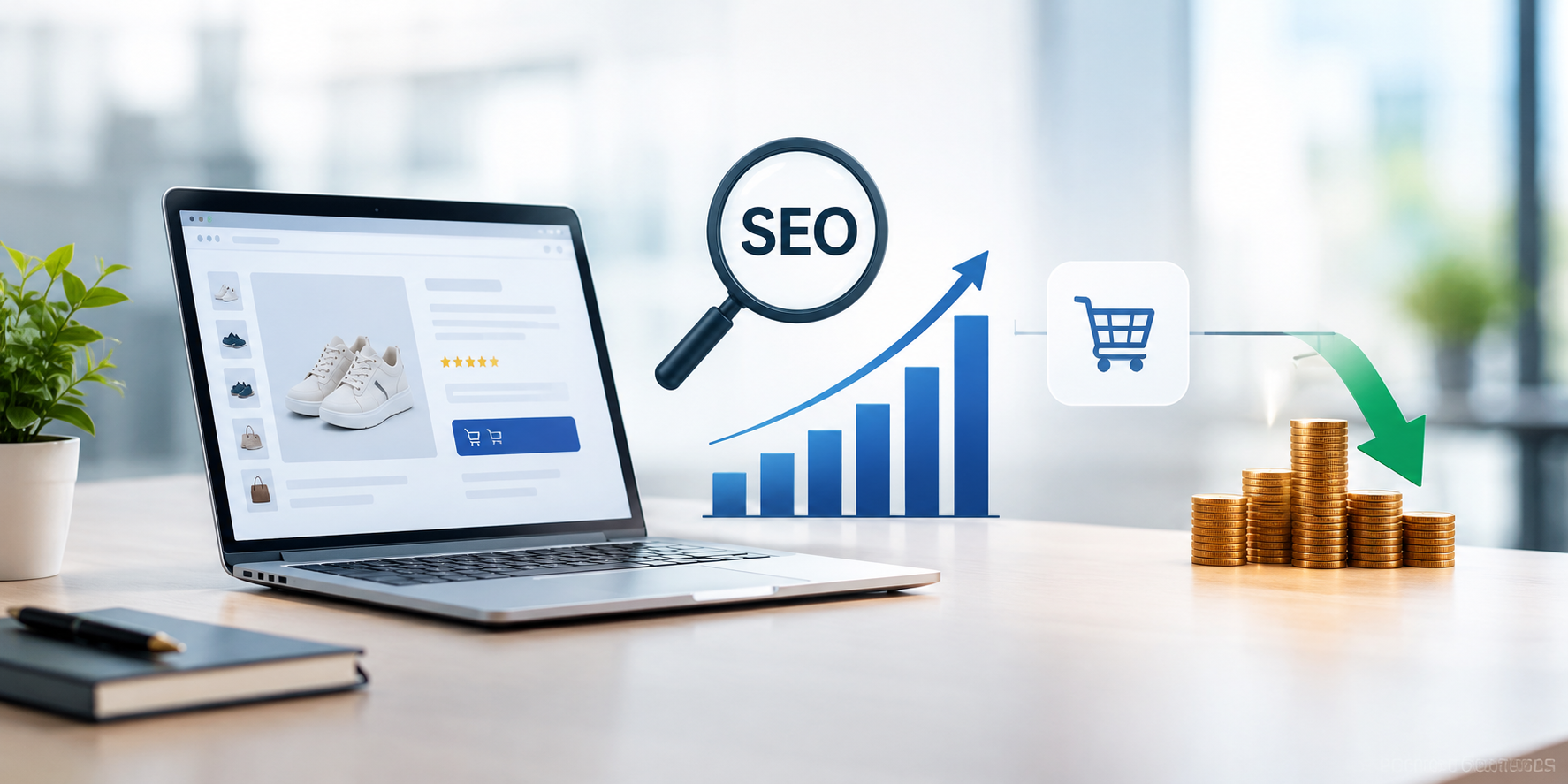
Every time an ecommerce brand pays for a click, it has to earn that money back through a sale. Rising ad costs, low conversion rates, and shoppers who need several visits before purchasing can make that increasingly difficult. Even a profitable advertising campaign can become expensive when a store relies on paid traffic for nearly every new customer.
Organic search offers another way to bring shoppers to your store. When your product and category pages appear for relevant searches, you can attract potential buyers without paying for each individual click. This is one reason businesses invest in SEO services for ecommerce, particularly when they want to lower customer acquisition costs without sacrificing sales opportunities.
However, ranking higher does not automatically make customer acquisition cheaper. SEO delivers better results when it attracts shoppers who are likely to buy, directs them to the right pages, and helps them complete their purchase.
The real opportunity is to build an acquisition channel that becomes more efficient over time, rather than continually paying to replace every visitor you lose.
Why Does Customer Acquisition Cost Become a Problem for Ecommerce Brands?
Customer acquisition cost (CAC) measures how much a business spends to acquire a customer. Depending on how a company calculates it, the figure may include advertising, agency fees, marketing software, creative production, and other acquisition-related expenses.
For example, suppose an online store spends $12,000 on marketing in one month and acquires 300 new customers. Its blended CAC is $40 per customer.
Now imagine advertising costs increase while the number of purchases stays the same. The store spends more to acquire the same number of customers, leaving less money to cover product costs, shipping, returns, and operating expenses.
Several factors can create this pressure:
- Dependence on paid advertising: The store must keep spending to maintain its current flow of visitors.
- Poor traffic quality: Ads or keywords attract people who browse but rarely purchase.
- Weak landing pages: Shoppers arrive at pages that do not match their expectations.
- Strong competition: Other retailers bid on the same commercial keywords, increasing advertising costs.
- Low repeat purchase rates: The business has to acquire new customers more frequently to maintain revenue.
Ecommerce SEO can address some of these problems by attracting relevant organic traffic and improving the pages those visitors use to make purchase decisions.
It is important to distinguish between reducing the cost of acquiring a customer and simply increasing website traffic. A store that attracts thousands of additional visitors who never buy may see higher organic sessions without any meaningful improvement in CAC.
Can Organic Search Reduce Your Dependence on Paid Ads?
Paid advertising can generate traffic quickly, which makes it useful for product launches, seasonal promotions, and testing new offers. The challenge comes when paid campaigns become the only reliable source of new customers.
Organic search creates another route to discovery.
Consider an online store selling home office furniture. It might pay for clicks on searches related to ergonomic office chairs, standing desks, and compact desks for small apartments. At the same time, its category pages could earn organic visibility for these searches through relevant content, clear product listings, and sound technical SEO.
If those pages begin attracting qualified organic visitors, the store may be able to reduce its reliance on paid clicks for some queries. Paid campaigns can then focus on opportunities where advertising offers a clear advantage.
This does not mean switching off ads as soon as organic rankings improve. Paid and organic search can support different parts of the buying journey, and their value depends on the product, competition, and customer behaviour.
A better approach is to compare the performance of both channels by product category and search intent. Identify where organic search is bringing in new customers, where paid advertising remains more effective, and where the two channels work together.
Also, avoid assuming that every organic click replaces a paid click. Some customers may never have clicked an ad in the first place. The goal is to improve the overall cost and quality of customer acquisition, not to claim savings that the data cannot support.
Which Ecommerce Pages Should You Optimise First?
When acquisition costs are high, it is tempting to start publishing more blog posts. But educational content is not always the fastest route to a purchase.
For many ecommerce stores, the first priority should be pages that already attract commercial searches or have a clear opportunity to do so.
Category pages are a useful starting point because they help shoppers compare several products within a specific range. A well-optimised category page for running shoes, for example, can serve shoppers comparing trail shoes, road-running shoes, and everyday trainers.
Product pages matter when shoppers search for a particular item, brand, model, or feature. These pages should provide enough information to help someone decide whether the product meets their needs.
Comparison and buying guides can help customers who are still choosing between alternatives. They are particularly useful for products with higher prices, complex specifications, or several competing options.
Review your Google Search Console data to find pages that receive impressions but generate relatively few clicks. Look for relevant search queries, weak title tags, missing product information, and opportunities to improve the match between the page and the searcher’s intent.
Prioritise pages using commercial value, existing demand, conversion performance, and the effort required to improve them. A category page with strong purchase intent may be more valuable than a general blog post with a much larger potential audience.
Google’s ecommerce SEO guidance also explains how site structure, product information, and crawlability help search engines discover and understand ecommerce content.
How Can Better Keyword Targeting Bring More Buyers Instead of More Browsers?
Not every search visitor is equally likely to purchase.
Someone searching for “what is a standing desk” may be researching the category. Another person searching for “electric standing desk with memory presets” has a more specific requirement and may be closer to choosing a product.
Both searches can be valuable, but they serve different purposes.
Ecommerce keyword research should account for where shoppers are in the buying process. Instead of focusing only on search volume, consider what the query reveals about the customer’s needs.
For example:
- Broad research queries: “How to choose a mattress” or “types of coffee grinders.”
- Category-level queries: “Memory foam mattresses” or “burr coffee grinders.”
- Feature-specific queries: “Queen mattress for side sleepers” or “espresso grinder with adjustable settings.”
- Product-specific queries: Searches containing a brand, model, or exact product name.
Map these queries to appropriate pages. Category terms generally belong on relevant category pages, product-specific terms belong on product pages, and detailed research questions may deserve a guide or buying resource.
Avoid creating separate pages for every minor keyword variation. If several searches express the same underlying need, one useful page may serve them all.
Review actual search queries and sales data regularly. A keyword that attracts fewer visitors but consistently brings qualified buyers may be more valuable than a high-volume term with little commercial intent.
What Makes a Product Page More Likely to Convert Organic Visitors?
Getting a shopper to your website is only part of the job. If the product page fails to answer their questions, they may return to search results and buy from another retailer.
A useful product page should reduce uncertainty before the shopper reaches checkout.
Start with the information people need to make a decision. Product titles should identify the item clearly. Descriptions should explain its practical benefits without hiding important specifications. Images should show the product accurately, including useful details such as dimensions, materials, available colours, and different angles.
Other important elements include:
- Current pricing and stock availability.
- Shipping costs and estimated delivery information.
- Clear returns and warranty policies.
- Relevant product specifications and compatibility details.
- Genuine customer reviews.
- Helpful answers to common pre-purchase questions.
- A clear path to selecting variants and adding the item to the cart.
Suppose a customer is comparing two office chairs. One product page says the chair is comfortable and stylish. The other explains its adjustment options, seat dimensions, weight capacity, materials, and warranty. The second page gives the shopper more information to make an informed choice.
Do not assume that adding more content will always improve conversion. Information should help shoppers decide, not overwhelm them. Use analytics, customer feedback, and controlled tests to identify which changes actually improve purchase behaviour.
A stronger product page can also help the business get more value from its existing traffic, including visitors who arrive through paid advertising, email campaigns, and direct links.
Can Category Pages and Internal Links Help Reduce Acquisition Costs?
A store’s navigation can affect both product discovery and organic search performance.
If shoppers struggle to find the right products, they may leave before reaching a purchase. If search engines cannot easily discover important product URLs, those pages may miss opportunities to appear in relevant results.
Organise the website around how customers shop. A store selling outdoor equipment, for example, might organise its main categories around camping, hiking, climbing, and travel. Subcategories can then help visitors narrow their choices by product type, use case, or other meaningful attributes.
Link related pages together so shoppers can move naturally from category pages to subcategories and individual products. Buying guides can link to relevant categories or products when those links genuinely help readers take the next step.
Google recommends making products reachable through crawlable links and using a clear navigation structure. Its guidance on ecommerce site structure explains why category-to-product links matter for discovery.
Pay attention to filters and sorting options, too. Ecommerce sites can generate large numbers of URLs from combinations of sizes, colours, prices, and other attributes. If these URLs create crawling problems or duplicate pages, review the site’s faceted navigation and canonicalisation strategy.
The aim is not to create the largest possible internal linking network. It is to help shoppers and search engines reach the pages that matter.
How Can Content Marketing Support Ecommerce SEO Without Wasting Budget?
Content can introduce shoppers to a brand before they are ready to purchase. It can also answer the questions that prevent them from making a decision.
The key is to connect content topics to actual customer needs and relevant product categories.
A skincare retailer might publish a guide explaining how to choose a moisturiser for different skin types. A cycling store could explain the differences between road and gravel bikes. A kitchen equipment retailer might compare coffee grinders for different brewing methods.
These topics can attract relevant visitors, provided the content is accurate and useful. Internal links can then direct readers to appropriate products or category pages when they are ready to explore their options.
Before commissioning a new article, check whether the store already has a page that answers the same question. Expanding an existing resource may be more effective than publishing another article with overlapping intent.
Measure content performance beyond page views. Useful indicators include organic entrances, assisted conversions, product-page visits, add-to-cart activity, and purchases where tracking supports those measurements.
Not every educational article needs to generate a direct sale. Some help build awareness and influence a later purchase. However, if content consistently attracts visitors who have no connection to the store’s products, review whether the topic deserves further investment.
Which Technical SEO Problems Can Waste Your Acquisition Budget?
Technical SEO issues can prevent valuable pages from appearing in search results or make the shopping experience harder to use.
A product may be in stock and ready to sell, yet its page could be excluded from indexing because of an incorrect noindex directive. A category page might have few internal links, making it harder to discover. Duplicate URLs could split attention across several versions of essentially the same page.
A technical audit should examine issues such as:
- Important product and category pages that are not indexed.
- Broken internal links and unnecessary redirect chains.
- Incorrect canonical tags.
- Crawl problems caused by faceted navigation.
- Slow or unstable page experiences, particularly on mobile.
- Missing or inaccurate product structured data.
- Outdated product URLs after a platform migration.
- XML sitemaps that contain irrelevant or non-indexable URLs.
Product structured data can help Google understand details such as product names, prices, and availability, and may make eligible product pages suitable for enhanced search appearances. It does not guarantee a ranking improvement or rich result. Check the Google documentation for merchant listing structured data before implementing it.
Technical work should be prioritised according to the pages and revenue opportunities affected. Fixing an indexing issue on a major product category may be more urgent than correcting a minor issue on a page that contributes little to acquisition.
How Do You Know Whether Ecommerce SEO Is Actually Lowering CAC?
Organic traffic growth alone cannot prove that customer acquisition has become more efficient. To understand the financial impact, compare acquisition costs, customer quality, and sales outcomes over a meaningful period.
Start by defining how your business calculates CAC. If you are measuring blended CAC, include the acquisition-related marketing expenses and new customers covered by that calculation. If you are measuring paid-channel CAC, keep the scope specific to the channel.
For example, suppose a store spends $20,000 per month on acquisition marketing and gains 500 new customers. Its blended CAC is $40.
After improving organic search performance, the store acquires 600 new customers while maintaining the same total marketing spend. Its blended CAC falls to approximately $33.33.
That would be a meaningful improvement, assuming the figures use the same cost definitions and attribution period. However, it would not prove that SEO alone caused the reduction. Changes in promotions, paid advertising, seasonality, and customer demand may also have contributed.
Track the following metrics together:
- Organic revenue: Sales attributed to organic search under your chosen attribution model.
- New customers from organic search: Helps distinguish customer acquisition from repeat purchases.
- Organic conversion rate: Shows how effectively organic visitors become customers.
- Cost per organic acquisition: Includes relevant SEO investment and new customers acquired through organic search.
- Blended CAC: Shows whether the overall cost of acquiring customers is improving.
- Customer lifetime value: Helps determine whether acquired customers generate enough long-term value to justify acquisition costs.
SEO costs should not be treated as zero simply because organic clicks do not carry a per-click charge. Content production, technical work, tools, and agency fees all require investment.
Also, avoid judging SEO solely on monthly returns. Rankings and organic traffic can take time to improve, and the value of an established page may continue beyond the month in which it was created. Compare performance over appropriate periods and account for seasonal differences.
When Should You Invest More in Ecommerce SEO?
Ecommerce SEO deserves a closer look when paid acquisition is becoming expensive, important products are difficult to discover, or the store has meaningful search demand that it is not capturing.
It can also be a strong investment for businesses with broad product catalogues, useful product information, established customer demand, and opportunities to improve category or product pages.
However, SEO is not a quick fix for every acquisition problem. If a store has poor product-market fit, uncompetitive pricing, weak fulfilment, or a checkout process that prevents purchases, better rankings will not solve the underlying issues.
Before expanding the SEO budget, identify the main constraint. If the store receives little relevant organic traffic, keyword targeting and indexability may need attention. If traffic is strong but purchases are weak, product pages, pricing, trust signals, and checkout experience may deserve priority.
For businesses that need specialist support, SEO services for Ecommerce stores can help connect technical improvements, keyword strategy, product-page optimisation, and performance measurement to a clear commercial objective.
The right programme should explain which problems it will address, how progress will be measured, and how the work supports the store’s acquisition goals. More rankings are useful only when they contribute to a healthier business.
Conclusion
Reducing customer acquisition costs through ecommerce SEO is about more than replacing paid clicks with organic visits. It requires attracting shoppers with genuine purchase intent, helping them find the right products, and giving them enough information to make confident buying decisions.
Start with the categories and product pages that have the clearest commercial value. Improve keyword targeting, fix technical barriers, strengthen the shopping experience, and measure how organic search contributes to new customers and overall acquisition costs.
ResultFirst helps ecommerce businesses build SEO strategies around organic visibility, relevant traffic, and measurable growth. With the right priorities and consistent performance tracking, organic search can become a valuable part of a more balanced and cost-efficient customer acquisition strategy.