
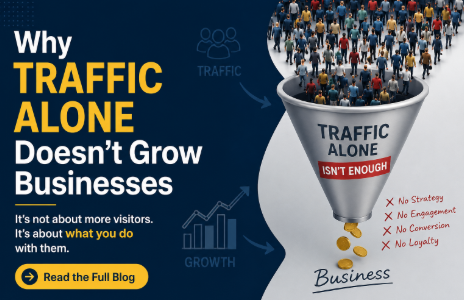
Many business owners believe that increasing website traffic is the ultimate goal of digital marketing. While attracting visitors is important, traffic alone does not guarantee growth, sales, or profitability. A website can receive thousands of visitors every month and still struggle to generate leads or revenue. The real measure of success is not how many people visit your website, but how many take meaningful actions that contribute to your business goals.
In today’s competitive digital environment, businesses often invest heavily in SEO, social media marketing, paid advertising, and content creation to drive more traffic. However, without a strategy to convert visitors into customers, those efforts can result in little more than vanity metrics. High traffic numbers may look impressive on reports, but they have limited value if they do not produce inquiries, purchases, subscriptions, or long-term customer relationships.
Successful businesses understand that traffic is only the first step in the customer journey. The real challenge is guiding visitors through a well-structured path that encourages engagement and conversion. This is where strategic digital marketing and optimization become critical.
The Gap Between Traffic and Revenue
One of the biggest mistakes businesses make is focusing solely on visitor numbers. A website may rank well on search engines and attract significant traffic, but if visitors cannot find what they need or do not trust the brand, they are likely to leave without taking action.
User experience plays a major role in determining whether traffic converts into business results. Slow-loading pages, confusing navigation, poor mobile responsiveness, and unclear messaging can drive potential customers away. Even if a business successfully attracts the right audience, a weak website experience can prevent conversions.
Another common issue is attracting the wrong type of traffic. Not all visitors have purchasing intent. Businesses that focus on quantity rather than quality often generate traffic from audiences that have little interest in their products or services. The goal should always be to attract relevant visitors who are more likely to become customers.
A strong digital marketing strategy helps businesses identify their ideal audience and create targeted campaigns that attract qualified traffic. By focusing on user intent rather than just visitor volume, companies can improve both conversion rates and overall marketing performance.
Why Conversion Optimization Matters
Conversion optimization is the process of improving a website and marketing funnel to encourage users to take specific actions. These actions may include filling out a contact form, requesting a quote, making a purchase, or subscribing to a newsletter.
Businesses that invest in conversion optimization often achieve better results without increasing their traffic. Small improvements in website design, content, and user experience can significantly impact conversion rates. This means companies can generate more leads and revenue from their existing audience rather than spending additional resources on attracting new visitors.
Effective conversion strategies typically focus on:
- Clear and compelling calls to action
- Fast-loading and mobile-friendly pages
- Trust signals such as reviews and testimonials
- Simplified forms and checkout processes
- Relevant and persuasive content
When these elements work together, visitors are more likely to move through the customer journey and become paying customers.
Building Trust and Customer Engagement
Traffic alone does not create trust. Customers need confidence in a brand before they are willing to share information, make purchases, or commit to long-term relationships. Businesses must focus on building credibility through consistent messaging, valuable content, and excellent user experiences.
Educational blogs, case studies, customer testimonials, and industry insights help establish authority and demonstrate expertise. When visitors find useful information and solutions to their problems, they are more likely to view the business as trustworthy.
Many companies offering digital marketing services Dubai emphasize the importance of combining traffic generation with engagement strategies. This approach helps businesses build stronger connections with their audience and improve conversion outcomes over time.
Customer engagement extends beyond the website as well. Email marketing, social media interaction, and retargeting campaigns help nurture potential customers and keep the brand top of mind throughout the decision-making process.
Measuring What Actually Matters
Modern digital marketing provides access to detailed performance data. Instead of focusing solely on page views or visitor counts, businesses should monitor metrics that directly impact growth. These include conversion rates, lead quality, customer acquisition costs, and return on investment.
Tracking meaningful metrics helps businesses understand which marketing efforts are generating real value. It also allows them to identify weaknesses in their sales funnel and make informed improvements.
Companies that prioritize data-driven decision-making often achieve better long-term results because they continuously refine their strategies based on actual customer behavior rather than assumptions.
Many top digital marketing agencies in Dubai focus on performance metrics that align with business objectives rather than vanity statistics. This approach ensures that marketing efforts contribute directly to growth and profitability.
Creating a Complete Growth Strategy
Sustainable business growth requires a balanced approach that combines traffic generation, conversion optimization, customer retention, and performance analysis. Businesses that focus exclusively on attracting visitors often overlook the factors that truly drive revenue.
A complete growth strategy begins with attracting the right audience, providing an exceptional user experience, building trust, and guiding visitors toward meaningful actions. It also involves continuously analyzing results and making improvements based on data and customer feedback.
As competition continues to increase across industries, businesses that prioritize conversions and customer experience will outperform those that focus solely on traffic numbers.
Conclusion
Website traffic is an important component of digital success, but it is not the ultimate goal. Without a clear conversion strategy, even large amounts of traffic can fail to generate meaningful business results. Growth comes from turning visitors into leads, customers, and loyal advocates.
By focusing on conversion optimization, audience quality, customer engagement, and data-driven decision-making, businesses can maximize the value of their traffic and achieve sustainable growth. The most successful companies understand that traffic opens the door, but conversions are what truly drive business success.