
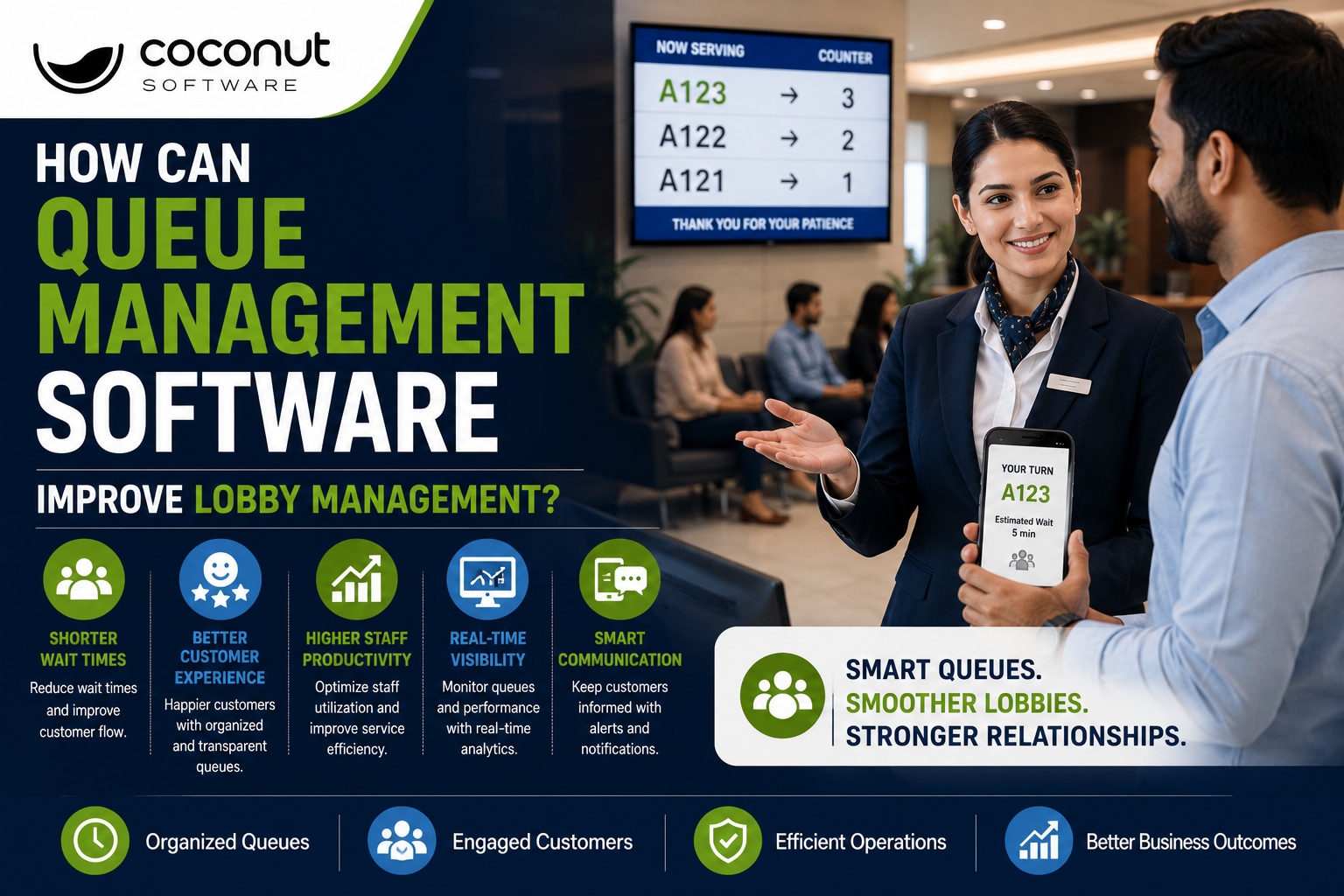
In a Nutshell: Do you remember your last visit to a bank, a government office, or even a clinic? What did you remember about that place? The thing that you most remember from those places is waiting in a queue. All of us have stood there and watched the queue not move an inch while everyone is counting how much more time they would have to spend there and whether they should just walk away.
A whopping 85% of customers will leave a location if they have to wait for service.
That is many people walking out the door! These are lost sales, missed opportunities, and unhappy faces. When the lobby is a mess, everyone feels the stress. So, a well-designed lobby can solve this.
This is where queue management software comes in. It works like a digital traffic controller for your lobby. It helps manage the flow of people so that service is faster and wait times are much shorter.
In fact, banks that consistently enhance the customer experience perform 3.2 times better than their competitors.
Read on to learn the ways queue management software improves lobby management.
Why Does Lobby Management Need a Smarter Approach?
A crowded lobby can easily turn into a difficult situation to handle. While some customers may have scheduled meetings, others may show up without any. It may also happen that different customers require assistance in different ways.
For instance, while one customer might need to update their account, another might need to speak with an advisor about the loans. If it is not easy for the staff to distinguish between the customers, then they may end up handling the customers the wrong way
The New Way: A Digital Solution
The modern queue management system fixes these problems. Instead of a messy paper list, it uses a digital check-in process. A customer can check in using a tablet at the door, a mobile phone, or a self-service kiosk.
This small change has a huge impact. With this system, staff are freed from playing “host.” Receptionists can focus on helping people with their actual needs instead of just checking them in. Here is what happens:
- The customer checks in. They can even say why they are here. This helps staff know who needs to see them.
- The customer sees a wait time. The system predicts how long they will have to wait. This sets clear expectations.
- The customer waits freely. During free time, they can get a coffee, run an errand, or just sit back and relax. The system sends them a text message or notification when it’s almost their turn.
Key Features That Make a Difference
Good queue management systems include features that make them extremely useful for optimizing your lobby experience
- Real-Time Visibility: Employees get access to a dashboard that shows them the current status of each person who is waiting there, including their needs and how long they have been in line. It is like having a map of the traffic in your lobby.
- Virtual Queuing: No physical queue is necessary. People can join a “virtual” queue right from their phones. They can wait at home and just show up at the branch once their appointment time arrives. It’s a breakthrough for everyone who’s always on the move.
- Appointment Scheduling: The program can schedule walk-in customers as well as appointments. It will all be done through one system where the exact process is known beforehand. This is essential for an effective customer experience.
- Data and Insights: Data related to peak hours and average wait times are recorded by the software. These insights may help managers make intelligent staffing decisions. This means that the queue management system is not just technical; it is designed to enhance human interaction.
How Can Queue Management Software Make Waiting Less Frustrating?
This software provides useful information to customers prior to their visit and even while they are there. Rather than having to ask a representative, “How long?” customers are provided with a projected wait time through a computerized system.
This simple change gives people more control. They can decide whether to wait, book an appointment, or return later.
1. Show Customers How Long They May Wait
Knowing the amount of time left to wait can take away most of the pressure that comes with waiting.
They can have some coffee, do something else, or simply relax. They will receive a text or notification when it is almost their turn. Real-time information reduces their frustration by 35%.
The goal is not always to make the wait disappear. The goal is to make the wait predictable and manageable.
2. Let Customers Wait Without Standing in Line
Virtual queuing takes this idea one step further.
Customers can join a queue online and continue with their day instead of standing inside the branch. SMS and email notifications can be sent to notify them when their turn is approaching.
This solution will not only reduce congestion in the lobby but also provide more freedom to the customers.
That creates a better experience for everyone. Customers gain flexibility, while employees can focus on serving the person currently in front of them.
How Does It Help Staff Manage a Busy Lobby?
The use of a virtual queue enables employees to see the current status of the visitors, their waiting time, their purpose of arrival, and needed assistance. Such data allows the staff to make proper decisions.
3. Match Customers With the Right Employee
Not every employee handles every request. A customer looking for mortgage advice may need a different employee than someone making a basic account inquiry.
Queue management software can collect information when customers join the queue. Custom questions can help staff understand what each person needs before the interaction begins.
This gives employees useful context.
For example, the system might ask:
- What service do you need?
- Do you need help with an existing account?
- Are you interested in a loan?
- Do you want to consult with an advisor?
With such responses from customers, the staff is able to refer customers to the right people, thus avoiding unnecessary transferring of customers and preparation for tough talks by the employees.
4. Give Customers an Appointment Option
At times, the customer cannot wait. Rather than walking out of the branch, there is something else that the customer can do.
Using a connected queue system, the customer will be able to convert their position in the line into a future appointment. The customer can also ask to be called back whenever there is some time. This will help the customer remain connected to the branch despite the situation.
Also, it provides a means for the employees to handle the demand more effectively. Since they will be aware of the forthcoming appointments and will make appropriate plans, they won’t have to deal with the hectic rush.
Conclusion
An overcrowded lobby does not necessarily have to result in a bad experience for the customers. This can be achieved when banks employ the use of wait time estimation, virtual queues, scheduling, client information, and traffic management.
The secret lies in providing information for both parties involved, the customers and the employees.
The customers will have the opportunity to choose how they queue; the employees will know whom to attend to and why. The managers will know the traffic patterns better and allocate resources accordingly.
Ultimately, the art of lobby management is not only about efficient queuing. It is also about making the entire process smoother.
FAQs
What is queue management software?
This software enables organizations to manage customer queues and requests for services. In the banking industry, it manages walk-in customers, scheduled appointments, online queues, waiting times, and customer communication.
How does queue management software reduce waiting?
It helps eliminate unnecessary physical wait time since customers are able to join the queue online, get wait time estimates, get notifications, and make an appointment instead.
Can queue management software improve staff productivity?
Surely it could. It would give them a better understanding of the demand for services. Thus, help them properly direct the customer to the appropriate staff member.
Is virtual queuing useful for bank branches?
Yes. Virtual queues will enable clients to wait outside the branch without compromising their spot in line. They can be alerted automatically when their turn is close at hand.