
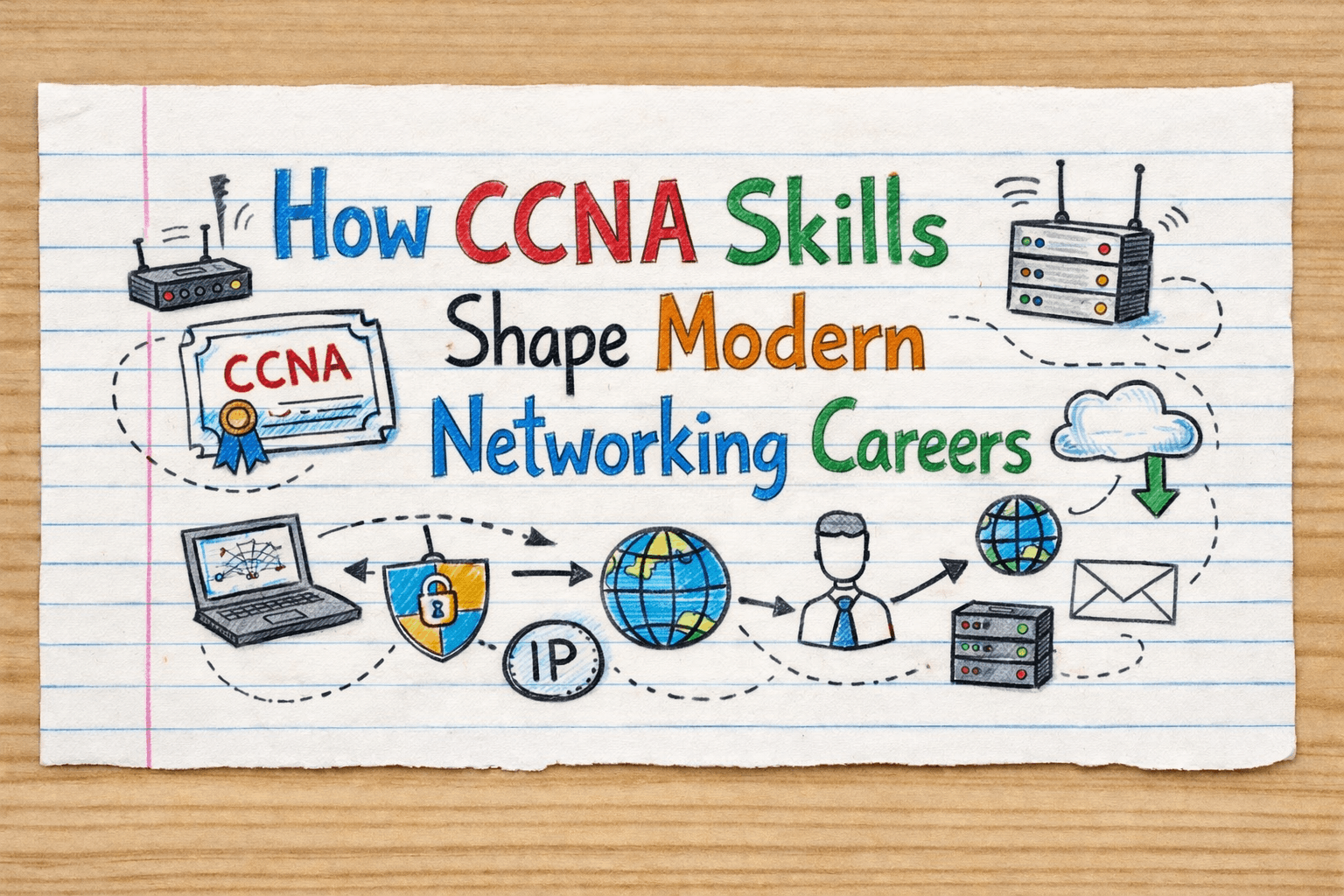
Introduction- Why CCNA Still Matters in the Modern IT Landscape
There has never been a time when skilled professionals had as many opportunities as there have been in the past decade. With several certifications available today, the CCNA (Cisco Certified Networking Associate) credential remains one of the most useful foundational certifications and continues to shape successful careers in IT. For those considering the CCNA, it is important to understand how CCNA skills shape modern networking careers, as it offers the potential to connect professionals to jobs in networking and integrate that with new opportunities in cloud networking, cybersecurity, automation, and other emerging fields.
Understanding the Value of CCNA in Today’s Job Market
There is a need for professionals with the necessary skills to construct, implement, and troubleshoot a complex network system within the work environment of today’s networked businesses. From small businesses to large multinational companies, they all need a network that is stable and secure for the proper functioning of all their operations, and as a result, the need for specialists in the area is constant.
Once professionals complete their foundational training, they gain competencies that employers highly prioritize. Given that engineers have trained and certified in network fundamentals, IP connectivity, basic security, and automation, they have developed skills that provide impactful solutions to network disruptions, and in many workplaces, downtime could lead to thousands of dollars lost every minute.
Candidates who present certifications are viewed more favorably than others who do not present certifications. This is due to the fact that certifications demonstrate more commitment to the field and ensures that these candidates possess some knowledge of the fundamentals. This often results in candidates being more competitive for places in entry-level and mid-level positions in a tough marketplace.
Foundational Technical Competencies That Support Career Growth
Network professionals must possess a wide and diverse range of technical skills to thrive in contemporary settings. The fundamentals of network design, IP addressing and subnetting, serve as the foundation for the development of effective organizational addressing strategies for any level of company. Meanwhile, knowledge of data behavior within networks is critical for troubleshooting, and is achieved through the understanding of routing and switching protocols.
Security is and will continue to be a central component of the networking professions. Professionals are taught to implement access control lists, and to configure a secure management access, and grasp core security issues. The increasing levels of sophistication inherent to current cyberattacks make that skill and knowledge critical in all networking roles, as the demand for network professionals increases.
Wireless Networking and Automation as Core Skills
Knowledge of wireless networking has shifted from being a specialized skill to now a baseline requirement. With mobile devices outnumbering desktop computers in most workplaces, the understanding of wireless standards along with the ability to configure and troubleshoot wireless networking systems, is now imperative to the maintenance of optimal productive working environments.
Automation is one of the most significant changes in networking in the last several years. Today’s professionals need to understand the basics of programming, be proficient in working with APIs, and employ automation in the management of networks of large scale. This is the skill set that distinguishes candidates that will thrive in changing operational roles from the candidates that will have difficulties in the changes in the industry.
Career Paths Enabled by CCNA Skills
The certification acts as a springboard into a variety of career paths. Network administrators are responsible for the smooth running of the daily operations of the systems, and the troubleshooting of issues as they arise. This role is an excellent way to obtain practical experience and typically serves as the first step for a large number of professionals.
Network engineers are responsible for the designing and implementing of network solutions, and for working in projects that range from the expansions of offices to the complete overhauls of infrastructure. This role demands a more advanced technical skill and problem solving that are built from the basic foundational of the skills.
Systems administrators frequently require networking skills in order to properly manage the infrastructures of the servers. The divisions of pure networking and systems administration are increasingly becoming indistinct, which creates a variety of opportunities for professionals with a variety of skills.
Safety analysts are professionals that intertwine networking skills to ascertain the routes that threats take in an environment, and the means of implementing protective measures. As organizations are perpetually being challenged by security problems, the professionals that merge networking skills with security skills become increasingly essential.
A career path as a cloud network engineer is a combination of traditional networking and new cloud technologies networking. This type of role is new. The certification provides foundational knowledge of networking and how cloud providers such as Amazon Web Services, Microsoft Azure, or Google Cloud Platform function.
Building Practical Experience Through CCNA Training
Networking as a profession requires practical knowledge in addition to theoretical knowledge. Understanding networking concepts is one thing, but configuring and troubleshooting systems is another. Hands-on training is crucial and is one of the main focuses of the CCNA course at PyNetLabs.
Real world networking scenarios can be easily recreated in a simulated environment. The ability to build a network from the ground up, add and configure routers and switches, and implement routing protocols offers invaluable experience. Muscle memory is created and invaluable from added confidence when new employees face high stress situations.
Placements and other job offers in networking fields require a high level of troubleshooting. Systemically and thoroughly gathering pertinent details to develop a strong hypothesis and resolve the issue at hand is the most efficient way to overcome networking challenges.
Salary Expectations and Long-Term Career Advancement
Increased job privileges at a high job tier level all offer competitive salaries when starting out. The salaries account for the knowledge and specializations of the high tier employees. As more and more senior level certifications are added, the compensation increases. Earnings can be strongly affected by geographic location. Cities with a large number of tech companies tend to pay high salaries, but come with high costs of living. With remote work becoming more common, employees can work from anywhere and earn a higher salary.
Careers tend to develop in a linear fashion. People tend to begin at an entry-level support role and progress to engineering, then to architecture or management. Each of these roles adds responsibility, and in turn, growth in salary.
Remaining Relevant in a Rapidly Changing Networking Industry
The field of networking is transitory in a positive sense. New technologies, standards, and best practices are always emerging. Good professionals are expected to learn constantly.
More insights on tech – Visit regic
Knowledge of the same operating system can be coupled with the same vendor-neutral networking knowledge. Your networking knowledge applies to various operating systems and makes you more adaptable to a better career. A wide knowledge base makes you a more valuable asset to an organization.
Coordination of soft skills with the lack of tech skills is evident and is very valuable. Technical problems with non-technical audiences can be solved using tech communications skills. Where most people see technical challenges, more holistic problem solving should also be used.
Preparing Effectively for CCNA Certification Success
Reading texts and study materials is not enough to show effective preparation. Most successful students use other additional tools and materials such as study guides, video courses, and practice labs, often combining them to include study group sessions. This method is likely to address and engage varying learning preferences and reinforce learners’ understanding.
For many working professionals, the most challenging part would be effective time management while preparing. Daily study sessions often yield better outcomes than extended hours of makeup sessions. Preparing a study timetable contributes to gaining the level of self-discipline that is necessary for both securing the certification and succeeding in your career.
Taking practice questions is often a good way to identify if you are ready for the exam, and the areas you still need to work on. Exam questions might be phrased in a format and speak in an unfamiliar way for test writers. Managing time wisely, and practicing the phrasing of questions would help in having the anxious feelings, and to focus better in the exam.
Conclusion- CCNA as a Long-Term Career Foundation
As the journey into networking careers commences, the first step consists of developing robust foundational skills that stand the test of time, despite technological advancements. The CCNA certification offers that sort of foundation that certifies top-tier skills that are sought after by employers, as well as offering the potential to develop valuable career prospects. The skills gained through excellent training are able to refine professional trajectories for years to come, from positions at the ground level to positions at the specialized level in the niches of security, cloud, or automation. All in all, mastering these essential cornerstone concepts in networking offers individuals the chance to be successful in an industry that presents intellectual complexities, as well as profitable financial rewards.