
Therapeutic proteins can trigger immune responses that affect drug exposure, biological activity, and treatment outcomes. During clinical trials, researchers must determine whether patients develop antibodies against an administered therapy and assess their potential clinical significance.
ELISA Assays support immunogenicity assessment by detecting anti-drug antibodies (ADAs) in biological samples. These measurements help researchers characterize immune responses and investigate their relationship with pharmacokinetic, pharmacodynamic, and clinical findings. Reliable antibody detection is particularly important when evaluating the safety and effectiveness of therapeutic proteins.
Why Is Immunogenicity Assessment Important in Clinical Trials?
Immunogenicity refers to a therapeutic product’s ability to induce an immune response. For protein-based medicines, this response may involve antibodies that bind to the administered drug and potentially alter its activity or clearance.
Some antibodies have little measurable clinical impact, while others may reduce therapeutic exposure, interfere with drug function, or contribute to adverse reactions. Assessing antibody development throughout treatment helps researchers identify these responses and evaluate their significance.
The interpretation depends on antibody characteristics, treatment duration, patient factors, and supporting clinical evidence.
How Does the ELISA Method Detect Anti-Drug Antibodies?
The enzyme-linked immunosorbent assay (ELISA) uses specific molecular binding interactions and enzyme-mediated signal generation to detect target analytes.
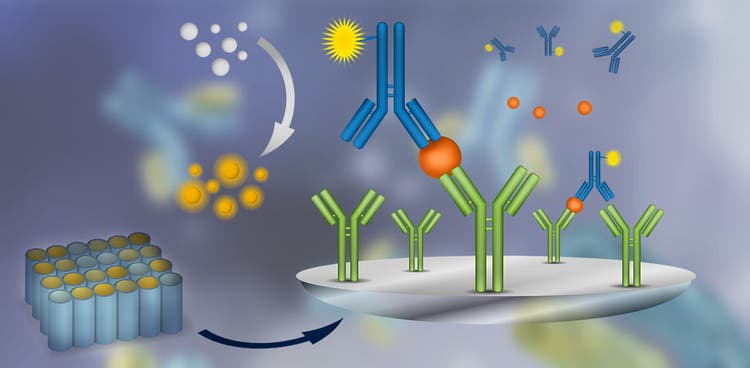
In an immunogenicity assessment, the ELISA method may use the therapeutic drug as a reagent to capture antibodies present in patient samples. A suitable detection system then generates a measurable signal indicating antibody binding.
A bridging ELISA immunoassay, for example, can use labelled therapeutic drug molecules to capture and detect antibodies capable of binding the drug through multiple sites.
The selected ELISA assay method depends on the therapeutic molecule, expected antibody characteristics, and analytical requirements. Assay design must also account for potential interference from circulating drug and sample components.
How Are ELISA Assays Applied During Clinical Trials?
Clinical immunogenicity assessments generally follow a tiered strategy that identifies potentially positive samples and characterizes confirmed antibody responses.
Screening for Anti-Drug Antibodies
Screening assays identify samples that may contain antibodies against the therapeutic product. Researchers establish an appropriate screening cut point to distinguish potentially positive responses from background signals.
Samples exceeding the screening threshold undergo confirmatory testing to investigate whether the detected binding is specific to the drug.
Confirming Antibody Specificity
Confirmatory assays commonly use competitive inhibition or another suitable approach to establish drug-specific antibody binding.
Only confirmed positive samples are typically advanced for additional characterisation. This process helps reduce the risk of interpreting nonspecific analytical signals as genuine immune responses.
Characterising Antibody Responses
Confirmed positive samples may undergo titration to characterise antibody response magnitude. Additional assessments can investigate antibody persistence and neutralising activity.
Neutralising antibodies can interfere with a therapeutic protein’s biological function. Their evaluation generally requires a dedicated neutralization assay rather than relying solely on an ELISA binding result.
Must Read: qPCR Services for Monitoring Gene Expression Changes During Drug Treatment
What Can Immunogenicity Results Reveal About Treatment?
The clinical significance of an antibody response becomes clearer when immunogenicity findings are examined alongside drug exposure, pharmacological activity, and patient outcomes.
For example, a patient who develops persistent ADAs may experience altered drug concentrations during treatment. Comparing antibody results with pharmacokinetic measurements can help researchers investigate this relationship.
Similarly, confirmed neutralizing activity may provide evidence that antibodies interfere with the therapeutic mechanism. However, antibody detection alone cannot establish reduced efficacy or predict an adverse clinical outcome.
These assessments require appropriate sampling schedules and integrated interpretation of the available evidence.
Where Do Multiplexed ELISA and Complementary Analytical Methods Fit?
A multiplexed ELISA can measure several analytes within a sample, depending on the assay platform. Such methods are useful for evaluating cytokines or other biomarkers associated with immune responses.
However, multiplex biomarker measurements do not automatically establish the presence of drug-specific antibodies. Dedicated immunogenicity assays remain necessary for ADA detection and characterisation.
Complementary pharmacokinetic analysis may also help researchers investigate relationships between antibody formation and therapeutic drug exposure. LC-MS/MS Method Validation establishes the performance of suitable quantitative drug assays, particularly for selected small molecules and peptides.
LC-MS/MS can support certain therapeutic protein measurements using appropriately developed methods. However, drug quantification and immunogenicity assessment address different analytical questions.
What Challenges Must an ELISA Lab Address?
An ELISA lab performing clinical immunogenicity testing must consider factors that influence antibody detection and result interpretation.
Important considerations include:
- Drug Interference: Circulating therapeutic drug may interfere with ADA detection and produce false-negative results.
- Assay Sensitivity: The method must detect relevant antibody concentrations within its validated performance limits.
- Assay Specificity: Appropriate controls help distinguish drug-specific binding from nonspecific responses.
- Sample Handling: Consistent collection, processing, and storage help preserve sample integrity.
- Analytical Cut Points: Scientifically established thresholds support consistent screening and confirmation decisions.
Reliable ELISA analysis also requires appropriate control samples, documented procedures, and evaluation of assay performance throughout clinical sample testing.
How Do Regulatory Guidelines Inform Immunogenicity Testing?
The US Food and Drug Administration (FDA) provides specific guidance on developing and validating assays to detect anti-drug antibodies in therapeutic protein studies. Its recommendations cover screening, confirmation, titration, and neutralization. Validation strategies should reflect the assay’s intended application and the immunogenicity risks associated with the therapeutic product. These considerations help establish confidence in antibody data submitted for regulatory evaluation.
Summary
ELISA assays support clinical immunogenicity assessment by detecting and characterizing antibodies against therapeutic proteins. Tiered testing strategies provide evidence of antibody specificity, response magnitude, and potential neutralizing activity. Appropriate assay development, validation, and clinical data interpretation are essential for understanding the significance of immune responses. Integrating immunogenicity findings with pharmacokinetic, pharmacodynamic, and safety data strengthens the evaluation of therapeutic products during clinical development.