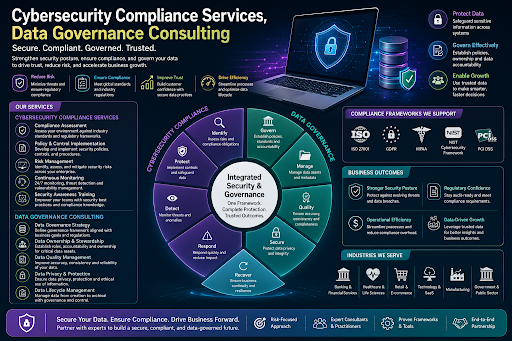
Regulators are no longer satisfied with a checklist approach to compliance, and customers are no longer forgiving of data mishandling. This tightening environment has pushed cybersecurity compliance services and data governance consulting closer together than ever before. Where one defines how data should be protected, the other defines how it should be managed — and enterprises that treat them as separate workstreams consistently end up with gaps that auditors and attackers alike are quick to find.
The stakes keep climbing. A single high-profile breach can wipe out years of brand equity, trigger class-action suits, and invite regulatory scrutiny that lasts for years. Getting compliance and governance right is no longer a back-office concern — it is a board-level priority that touches every customer conversation, every vendor negotiation, and every product decision.
Compliance Without Governance Is a House Built on Sand
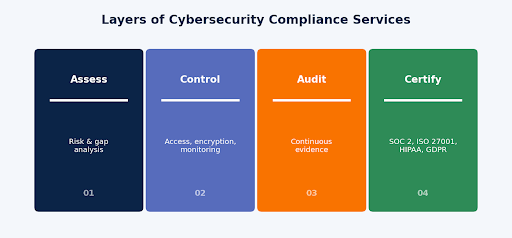
Passing a compliance audit means little if the underlying data is not actually understood — where it lives, who has access, how it flows between systems, and how long it should be retained. Cybersecurity compliance services are most effective when they are built on top of a governance framework that already answers those questions with confidence.
Without that foundation, compliance becomes reactive: a scramble to document controls right before an audit, rather than a continuous, defensible posture the business can stand behind at any time. Reactive compliance is expensive, stressful, and fragile. Governance-driven compliance is quieter, cheaper, and far more resilient over time.
Mapping Regulatory Requirements to Real Data Flows
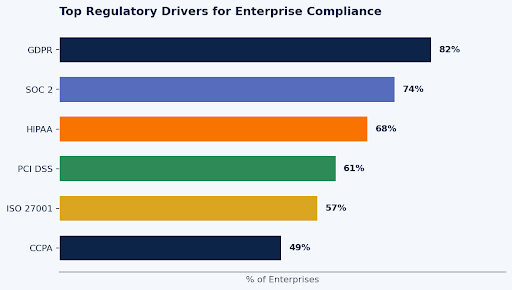
Frameworks like GDPR, HIPAA, SOC 2, PCI DSS, and CCPA all require knowing exactly where sensitive data resides and how it moves through the enterprise. Governance-driven data classification makes that mapping accurate instead of aspirational, turning audits from high-stakes discoveries into predictable reviews.
Access Controls as a Shared Responsibility
Role-based access is not just a security control — it is a governance discipline, ensuring the right people see the right data for the right reasons, consistently enforced across every system in the enterprise. Combined cybersecurity compliance services and data governance consulting engagements make sure access decisions are made once and enforced everywhere.
Building a Continuous Compliance Posture
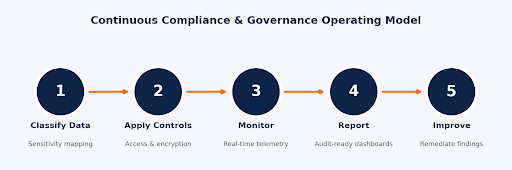
Enterprises that pass audits comfortably share one trait: they treat compliance as an ongoing operational discipline rather than an annual fire drill. Modern cybersecurity compliance services integrate continuous monitoring so that control drift — a misconfigured server, an overly broad permission, an unpatched vulnerability — is caught in real time rather than surfacing months later as an audit finding.
Data governance consulting reinforces this by keeping data inventories, classification schemes, and retention policies current as new systems and data sources are introduced across the business. Together, these disciplines produce an environment where compliance is a byproduct of good operations rather than a separate program.
- Automated data discovery and classification across cloud, SaaS, and on-premises environments
- Continuous control monitoring instead of point-in-time audits done under pressure
- Clear data retention and disposal policies aligned to specific regulatory obligations
- Incident response plans tested against realistic governance and compliance scenarios
- Vendor risk management integrated with internal governance rather than run as a parallel process
- Executive dashboards that show real-time compliance posture instead of quarterly snapshots
Preparing for the Next Wave of Regulation
Regulatory landscapes continue to evolve rapidly. New AI governance frameworks, expanded data protection laws, and stricter breach reporting requirements are being introduced across jurisdictions each year. Enterprises that treat compliance as static quickly fall behind, while those with mature governance frameworks find that adapting to new rules is a matter of extending existing practices rather than starting from scratch.
This future-proofing is one of the strongest arguments for investing in a coordinated program now rather than waiting for the next regulatory shock. Enterprises with strong data governance consulting foundations and continuous cybersecurity compliance services in place absorb new requirements in weeks or months, while less prepared organizations spend a year or more scrambling to catch up. Compliance maturity, once built, compounds.
Turning Compliance Into a Trust Advantage
Enterprises increasingly compete on trust, not just price or features. Demonstrating strong governance and compliance posture becomes a differentiator with enterprise customers and partners who conduct their own vendor risk assessments, security questionnaires, and audit reviews. Being ready with clear evidence shortens sales cycles and opens doors that would otherwise stay closed.
Rather than viewing compliance and governance as a cost center, forward-looking organizations treat the combination as a market advantage — proof that they can be trusted with sensitive data at scale. This mindset changes how the program is funded, measured, and communicated to the rest of the business.
Common Pitfalls in Compliance and Governance Programs
Even mature enterprises make the same mistakes in compliance and governance year after year. Naming these pitfalls explicitly helps leaders design programs that avoid them from the start.
- Treating cybersecurity compliance services as an annual audit exercise rather than a continuous discipline
- Building data classification schemes that do not align with actual regulatory obligations
- Underinvesting in vendor risk management, then discovering exposure only after a partner incident
- Assuming that passing an audit is equivalent to being genuinely secure and well-governed
- Failing to integrate data governance consulting insights into day-to-day access and control decisions
- Skipping tabletop exercises for incident response until an actual incident exposes the gaps
Actionable Insights for Enterprise Leaders
- Align data classification schemes directly with the specific regulatory frameworks your business must meet
- Automate continuous compliance monitoring rather than relying on periodic manual audits that always feel like fire drills
- Tie access control reviews to governance stewardship roles, not just to IT administration
- Use compliance certifications as a genuine trust signal in enterprise sales and partnership conversations
- Integrate vendor risk management into the same governance framework used internally, so third-party risk is treated consistently
- Track dwell time on unresolved findings as a leading indicator of the health of your cybersecurity compliance services program
Conclusion
Cybersecurity compliance and data governance were never meant to operate in isolation. Enterprises that pair cybersecurity compliance services with data governance consulting build a defensible, continuously monitored posture rather than a fragile, audit-driven one. As regulations tighten and customer expectations rise, this combined approach is no longer just risk mitigation — it is becoming a genuine competitive differentiator in the way modern enterprises win and keep business.